Guides
How Long Does a Nugget Ice Maker Take?
One manufacturer publishes an hourly rate. Everyone else leaves you guessing. Here is what the published data supports, and what slows a machine down.
Disclosure: we earn a commission if you buy through our links. It never affects which machines we recommend or how we rank them, and we take no sponsored placements. Read the full disclosure.
Quick picks
| # | Machine | Best for | Price |
|---|---|---|---|
| 1 | 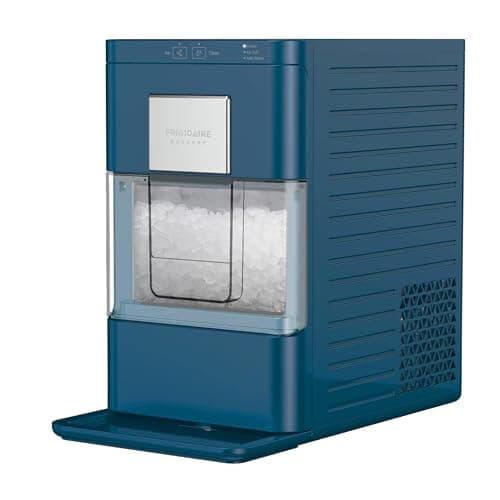 Frigidaire EFIC255 20 kg a day, which is 44 lbs, at 185 W. | Highest daily rating | |
| 2 | 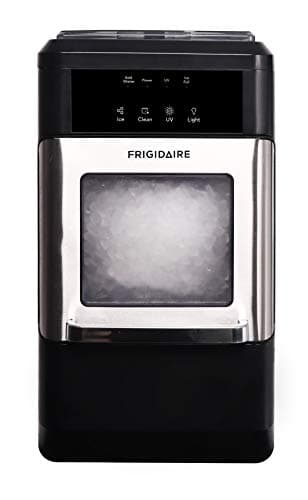 Frigidaire EFIC235 Bullet ice, with nothing to scrape or compress. | Fastest mechanism |
#ad We earn a commission on purchases made through this link. How this is funded. Prices last checked October 18, 2026.
What 1.6 pounds an hour means in glasses
At roughly half a pound per tall glass, 1.6 lbs an hour is about three glasses an hour, or one glass every twenty minutes, from a machine already at temperature.
| You want | Ice needed | At 1.6 lbs/hour |
|---|---|---|
| One tall glass | About 0.5 lbs | About 20 minutes |
| Two drinks | About 1 lb | About 40 minutes |
| A full 3 lb bin from empty | 3 lbs | Just under 2 hours |
| A cooler's worth (10 lbs) | 10 lbs | About 6 hours, harvesting as you go |
Note the last row. The bin holds 3 lbs, so anything beyond that means emptying it into the freezer as it fills. That workflow is on do countertop ice makers keep ice frozen.
Everyone else publishes a daily rate only
Which is much less useful, because a daily rating describes a machine running flat out into an empty bin for 24 hours — a scenario that never happens in a kitchen, since the bin fills and the machine stops.
You can divide a daily figure by 24 to get a nominal hourly rate: Frigidaire's 20 kg a day is about 1.8 lbs an hour on that arithmetic, and the original Opal's 24 lbs is about 1 lb an hour. That division is ours, not the manufacturers', and it assumes a constant rate the manufacturers do not claim. Treat it as an order of magnitude rather than a spec.
What actually slows a machine down
- Scale on the freezing cylinder. The most common cause of a machine that used to be faster. Scale insulates the surface that has to move heat, so cycles get longer. Fix: descale it.
- A warm room. The original Opal manual specifies 55F to 90F. Near the top of that range, the machine is fighting the room and the ice melts as fast as it arrives.
- Warm water in the reservoir. The machine must remove heat from the water. Warm water means more heat to remove. Cold water in is faster, and no, warm water does not freeze quicker.
- Blocked clearance. Every manual asking for 3 to 4 inches is describing how heat leaves. Blocked ventilation means longer cycles and higher running cost.
- Low water. A pump drawing air rather than water makes no ice and, per GE's own notes, is louder while doing it.
Cold starts
From switch-on, the machine has to bring the freezing cylinder down to temperature before any ice forms. That time is not published by anyone and it varies with room and water temperature, so we are not putting a number on it.
What follows practically: if you want ice at seven, switch the machine on before six rather than at ten to seven. And if you want ice for a gathering, start the day before and harvest into the freezer, because no machine here holds more than about 3 lbs at once.
If nothing arrives at all
That is a different problem from slow, and it has a checklist: nugget ice maker not making ice. The most common causes are a missing internal baffle, a blocked hot air outlet, a room over 90F and low water — all four of which Frigidaire lists in its own troubleshooting section.
The picks in full
1. Highest daily rating
Frigidaire Gallery Countertop Nugget Ice Maker
The only nugget machine here whose maker publishes an actual power consumption instead of a nameplate ceiling, and it is a low one.
- Rated output
- 44 lbs/day
- Bin capacity
- 3 lbs
- Electrical
- 185 W published
- Ceiling at 4 hrs/day, $0.18/kWh
- $4.00/month (from published watts)
#ad We earn a commission on purchases made through this link. How this is funded. Prices last checked October 18, 2026.
185 W published means the running-cost figure for this machine is not a derived ceiling — it is arithmetic on a number Frigidaire printed. That is the strongest cost data on the site.
It is rated at 20 kg a day, which is 44 lbs — higher than the Opal 2.0's 38. Both numbers are measured under ideal conditions the manual does not describe.
Ten inches wide and 16.5 tall makes it the narrowest full-size nugget machine in this set.
Skip this if
You need a manufacturer-published bin capacity. Frigidaire's specification table omits it, so the 3 lb figure on this page comes from a retail listing rather than the manual.
2. Fastest mechanism
Frigidaire Countertop Bullet Ice Maker
A bullet-ice machine, not a nugget one — and the fastest route to a full bin if the ice shape does not matter to you.
- Rated output
- 44 lbs/day
- Bin capacity
- Not published
- Electrical
- 200 W published
- Ceiling at 4 hrs/day, $0.18/kWh
- $4.32/month (from published watts)
#ad We earn a commission on purchases made through this link. How this is funded. Prices last checked October 18, 2026.
44 lbs a day at 200 W published. Bullet machines make ice by freezing water onto chilled prongs, which is a far simpler and faster process than extruding nugget ice.
This is the machine to buy if you want a lot of ice for a cooler, and the machine to avoid if you want ice you can chew.
At 19 inches tall it does not fit under a standard 18-inch upper cabinet gap. Measure first.
Skip this if
You came here for chewable ice. Bullet ice is hollow, hard cylinders. It is not nugget ice and no setting will make it nugget ice.
Questions people actually ask
How long does a nugget ice maker take to make the first batch?
Manufacturers in this category do not publish a first-ice time, so any specific figure you see is somebody's observation rather than a specification. What GE does publish for the Opal 2.0 is a rate of 1.6 lbs per hour, which is about three tall glasses an hour once the machine is up to temperature.
How long to fill a nugget ice maker bin?
On the Opal 2.0's published 1.6 lbs an hour, filling its 3 lb bin from empty is a little under two hours at rate. Real time will be longer from a cold start, because the machine has to bring the freezing cylinder down to temperature before it produces anything.
Why is my nugget ice maker suddenly slow?
Scale on the freezing cylinder, most often. Scale insulates the surface that has to move heat out of the water, so the machine runs longer for less ice. Descaling is usually the fix. Other causes are a hot room, warm inlet water, or blocked clearance around the machine.
Does warm water make ice faster in an ice maker?
No. That is a myth carried over from a phenomenon that does not apply here. The machine has to remove heat from the water, so warmer water means more heat to remove and a longer cycle. Cold water in produces ice faster.
Sources
- GE Profile Opal 2.0 Owner's Manual 49-9000029 Rev. 6, p.17 (38 lbs/day, 1.6 lb/hr) (read 2026-09-02)
- FirstBuild Opal Use & Care manual, Ver. 2/13/2017, p.12 (24 lbs/day, 55F-90F) (read 2026-09-02)
- Frigidaire EFIC255 Use & Care Manual, p.12 (20 kg/24h) (read 2026-09-02)
Read next
- How Much Ice Do You Actually Need?
Why rated output is the wrong number to shop on, and what bin capacity really limits.
- Nugget Ice Maker Not Making Ice
Ordered fault finding, starting with the four causes the manufacturers list themselves.
- How to Descale a Nugget Ice Maker
Different chemistry from cleaning, and usually the fix for a machine making ice slowly.
- The Best Nugget Ice Makers
Six machines ranked on published specs, each with a sourced monthly running-cost ceiling.
- Do Countertop Ice Makers Keep Ice Frozen?
No. The bin is unrefrigerated and the meltwater recirculates. What to do instead.
- GE Profile Opal 2.0 (XPIO13SCSS)
3.0 A, 38 lbs a day, 1.6 lbs an hour. The best-documented machine in the category.