Guides
Do Countertop Ice Makers Keep Ice Frozen?
No. Almost none of them refrigerate the bin, and the ones marketed as if they do are describing something else. Here is the mechanism and the workaround.

Disclosure: we earn a commission if you buy through our links. It never affects which machines we recommend or how we rank them, and we take no sponsored placements. Read the full disclosure.
Quick picks
| # | Machine | Best for | Price |
|---|---|---|---|
| 1 | 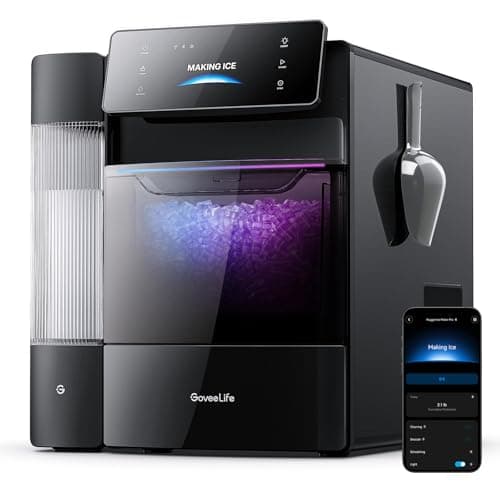 GoveeLife H8120 3.5 lbs on GoveeLife's product page, and the only maker here to publish a melt figure. | Largest bin you can buy | |
| 2 | 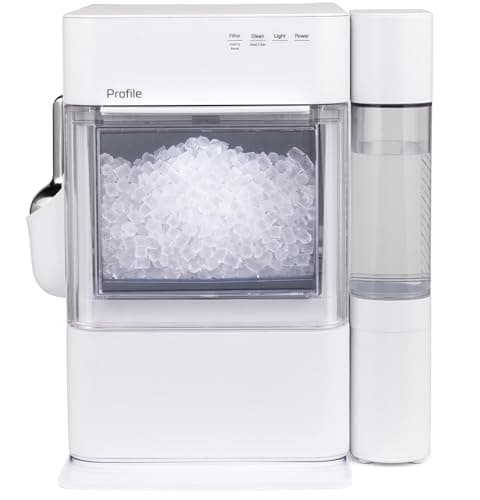 GE Profile XPIO43SCSS 3.0 lbs of storage, as large as any bin a manual documents for a machine in stock. | Largest bin in a manual | |
| 3 | 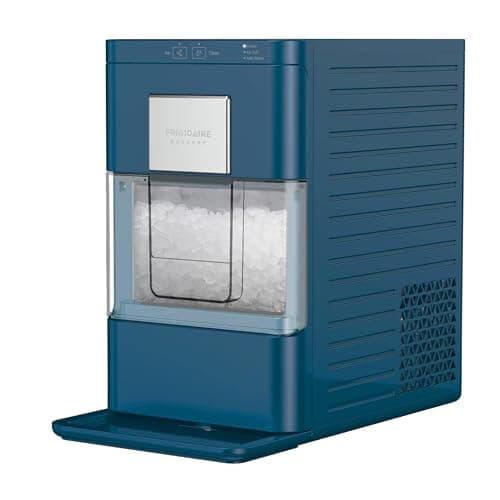 Frigidaire EFIC255 185 W published against a 44 lb per day rating. | Best value that is in stock |
#ad We earn a commission on purchases made through this link. How this is funded. Prices last checked October 19, 2026.
This is the single most common disappointment with this entire appliance category, and there is real measured search demand behind the question, which tells you how many people find out after buying rather than before.
Why it works this way
A countertop ice maker is a production line, not a freezer. The refrigeration system is dedicated to one job: chilling the surface where ice forms. Everything downstream of that — the chute, the bin, the lid — is unpowered plastic.
Adding a refrigerated bin would mean a second cold zone, more insulation, more compressor capacity and a physically larger machine. It would stop being a countertop appliance and start being an undercounter one, which is precisely the appliance class that does have refrigerated storage. That comparison is on countertop versus undercounter.
The recirculation is genuinely clever, to be fair to these machines. Meltwater draining back to the reservoir means the machine wastes very little water: what leaves the system is the ice you actually remove and use. It is why a machine rated at 38 lbs a day does not need 38 lbs of water poured into it daily.
What the specs show
Look at what manufacturers call the bin. GE calls it "ice storage capacity: 3.0 lbs". NewAir calls it "bucket capacity: 3.3 lb". A bucket. Nobody publishes a bin temperature, because there is nothing to publish.
Notice also how small it is. Three pounds is about six tall glasses. No manufacturer in this category ships a large bin, and the reason is obvious once you know the bin is unrefrigerated: a bigger bin would just hold more ice that is melting.
One maker does put a number on the melting. GoveeLife says the foam insulation around its Smart Nugget Ice Maker Pro maintains a 60% ice retention rate for 6 hours at 25C, which is 77F. It does not say whether the machine was running. Taken at face value, that is a confirmation rather than an exception: after six hours, four pounds in every ten are water again. More on the GoveeLife review.
How fast does it actually melt
We have not measured this and we are not going to give you a number we did not measure. What the published data does support is the direction of the effect: the original Opal manual specifies an operating range of 55F to 90F, and melt rate scales with the temperature difference between the ice and the room. A 90F kitchen melts ice roughly twice as fast as a 65F one.
Ice type matters too. Nugget ice is compressed flakes with enormous surface area and trapped air, so it melts faster than a dense clear cube. That is a genuine argument for a clear-cube machine if long holding matters, and it is covered on nugget versus clear ice.
The workflow that makes these machines good
1. Run the machine in advance
Switch it on an hour or two before you need ice rather than leaving it on permanently. GE's published 1.6 lbs an hour for the Opal 2.0 is the only manufacturer figure that lets you plan this properly: that is roughly three tall glasses an hour.
2. Harvest into the freezer
When the bin fills, empty it into a lidded container in your freezer. The machine immediately starts making more, and the ice you moved is now in the one place in your kitchen designed to keep it.
3. Repeat until you have what you need
Two or three harvests gets you well past what any 3 lb bin can hold at once, which is how you serve a party from a countertop machine.
4. Switch it off and empty it
When you are done, turn it off, empty the bin and drain the reservoir. This is also the single most effective thing you can do about biofilm.
Nobody who is happy with one of these machines uses it any other way. The mistake is treating it as a small freezer that also makes ice; it is a fast producer that stores badly.
Reading the marketing language
| What it says | What it usually means |
|---|---|
| Keeps ice frozen | Insulated bin, not refrigerated. Ice still melts, just a bit slower |
| With freezer | Almost always the same insulated bin. Check for a published bin temperature; there rarely is one |
| Self-recycling meltwater | Accurate, and standard on every machine here. The meltwater goes back to the reservoir |
| 24-hour ice supply | The machine will keep replacing melted ice while it is on. It is not storing 24 hours of ice |
| 44 lbs per day | A production rate under ideal conditions, not an amount the machine can hold. The bin is 3 lbs |
If keeping ice genuinely matters
- Use your freezer as the storage. Free, already installed, and it works.
- Buy the biggest bin available if you want the longest run before the machine has to catch up. The largest in stock is the 3.5 lbs GoveeLife lists on its product page; the largest printed in a manual is NewAir's 3.3 lbs, on a machine that is no longer sold new.
- Buy clear cubes rather than nugget if the ice sits in a glass for a while. Denser ice, less surface area, slower melt.
- Buy an undercounter machine if none of the above is acceptable. It is the appliance class that actually does this.
The picks in full
1. Largest bin you can buy
GoveeLife Smart Nugget Ice Maker Pro
The biggest published basket and daily figure of any nugget machine you can buy, and the only connected machine here from outside GE, documented on a product page rather than in a manual.
- Rated output
- 60 lbs/day
- Bin capacity
- 3.5 lbs
- Electrical
- 210 W published
- Ceiling at 4 hrs/day, $0.18/kWh
- $4.54/month (from published watts)
#ad We earn a commission on purchases made through this link. How this is funded. Prices last checked October 19, 2026.
GoveeLife's owner's manual exists but could not be retrieved for this page, so every value is from the maker's own product page and carries that lower source tier. Anything the page does not print, including refrigerant, clearance and an operating temperature range, reads Not published.
The product page describes two cleaning modes, a 10-minute quick clean and a 30-minute deep descale, with an app reminder after every 100 hours of ice-making. That is a usage-based interval rather than a calendar one.
GoveeLife advertises an average noise level 'as low as 40 dB' in its description copy with no test standard or measuring distance, so, as with Silonn's '35db', it is not recorded as a specification and the noise field reads Not published.
Skip this if
You want every specification backed by an owner's manual, or a machine that fits a normal counter. Every figure here is from GoveeLife's product page, and it is 21.3 inches deep and 42 lbs.
2. Largest bin in a manual
GE Profile Opal 2.0 Ultra Nugget Ice Maker
Mechanically the 2.0 with a bigger tank and a wider clearance requirement, and GE does not publish a production rate for it in the manual we could read.
- Rated output
- Not published
- Bin capacity
- 3 lbs
- Electrical
- 3 A at 120 V (360 VA nameplate)
- Ceiling at 4 hrs/day, $0.18/kWh
- $7.78/month (from the nameplate ceiling)
#ad We earn a commission on purchases made through this link. How this is funded. Prices last checked October 19, 2026.
Same 3.0 A rating and same 37.6 lb empty weight as the standard 2.0, so the electricity math is identical.
It wants 4 inches of clearance rather than 3. If you are fitting this under a cabinet run, that inch is the difference between working and not.
We could not read an ice-making rate on the Ultra's specification page and are not going to substitute the 2.0's 38 lbs a day for it. That field says Not published, and it means it.
Skip this if
You need a published ice rate before you buy. The Ultra's owner's manual specification table did not print a legible ice-making rate in the copy we read, and we will not carry over the standard 2.0's number.
3. Best value that is in stock
Frigidaire Gallery Countertop Nugget Ice Maker
The only nugget machine here whose maker publishes an actual power consumption instead of a nameplate ceiling, and it is a low one.
- Rated output
- 44 lbs/day
- Bin capacity
- 3 lbs
- Electrical
- 185 W published
- Ceiling at 4 hrs/day, $0.18/kWh
- $4.00/month (from published watts)
#ad We earn a commission on purchases made through this link. How this is funded. Prices last checked October 19, 2026.
185 W published means the running-cost figure for this machine is not a derived ceiling — it is arithmetic on a number Frigidaire printed. That is the strongest cost data on the site.
It is rated at 20 kg a day, which is 44 lbs — higher than the Opal 2.0's 38. Both numbers are measured under ideal conditions the manual does not describe.
Ten inches wide and 16.5 tall makes it the narrowest full-size nugget machine in this set.
Skip this if
You need a manufacturer-published bin capacity. Frigidaire's specification table omits it, so the 3 lb figure on this page comes from a retail listing rather than the manual.
Questions people actually ask
Do countertop ice makers keep ice frozen?
No. On every countertop machine we cover, the ice bin is insulated at best and never refrigerated. Ice melts continuously and the meltwater drains back into the reservoir to be frozen again. While the machine is switched on the bin looks permanently full, because the machine keeps replacing what melted, not because anything is being kept cold.
Is there a countertop ice maker with a freezer?
Machines are marketed with phrases like 'with freezer' and 'keeps ice frozen', but what almost all of them have is a better-insulated bin that slows melting rather than a refrigerated one that stops it. If keeping ice genuinely matters, an undercounter machine or your existing freezer is the honest answer.
Where does the melted ice go in a countertop ice maker?
Back into the water reservoir, where it is frozen again. That is by design and it is why these machines use much less water than their rated daily output suggests. It is also why leaving stale water in the machine matters: the same water goes round and round.
How long does ice last in a countertop ice maker?
Hours, not days, and it depends entirely on the room. In a warm kitchen a full bin will visibly shrink within a couple of hours of the machine being switched off. Switched on, the bin stays nominally full and the machine keeps working to make it so. The only maker here to put a number on it is GoveeLife, which claims its insulated basket keeps 60% of the ice for 6 hours at 25C (77F), without saying whether the machine was running.
What should I do if I want ice to keep?
Make it and move it. Run the machine, transfer the ice to a container in your freezer, and let the machine make more. That is the workflow this appliance is actually good at, and it is what everyone who is happy with one ends up doing.
Sources
- GoveeLife product page, Smart Nugget Ice Maker Pro (model H8120): Specs table and product description (read 2026-09-16)
- FirstBuild Opal Use & Care manual, Ver. 2/13/2017, p.12 (3.0 lb storage capacity, 55F-90F) (read 2026-09-02)
- GE Profile Opal 2.0 Owner's Manual 49-9000029 Rev. 6, p.17 (3.0 lb storage capacity) (read 2026-09-02)
- NewAir NIM044BS00 Owner's Manual, p.5 (3.3 lb bucket capacity) (read 2026-09-02)
Read next
- How Much Ice Do You Actually Need?
Why rated output is the wrong number to shop on, and what bin capacity really limits.
- Countertop vs Undercounter Ice Makers
Plug in versus install. Which class of ice maker actually solves your problem.
- The Best Countertop Ice Makers
The whole countertop category ranked by ice type, with sourced specs and running costs.
- What a Nugget Ice Maker Costs to Run
Per-model monthly costs with the wattage sourced, the duty cycle stated and the arithmetic shown.
- Are Countertop Ice Makers Worth It?
When one earns its place and when it does not, with the cost computed rather than asserted.
- Nugget Ice Makers With a Water Line
What a water-line connection really means on a countertop machine, and the alternatives.
- Do Any Refrigerators Make Nugget Ice?
Whirlpool is the only one. Samsung's Ice Bites and LG's Craft Ice are not nugget ice, and GE sells none.
- Can You Leave a Nugget Ice Maker On All the Time?
Safe, yes. Sensible, usually not. What a machine left running actually does, and what it costs.