Compare
Countertop vs Undercounter Ice Makers
These are two different appliances that happen to make the same product. One you plug in, the other you install, and the difference decides everything.
Disclosure: we earn a commission if you buy through our links. It never affects which machines we recommend or how we rank them, and we take no sponsored placements. Read the full disclosure.
Quick picks
| # | Machine | Best for | Price |
|---|---|---|---|
| 1 | 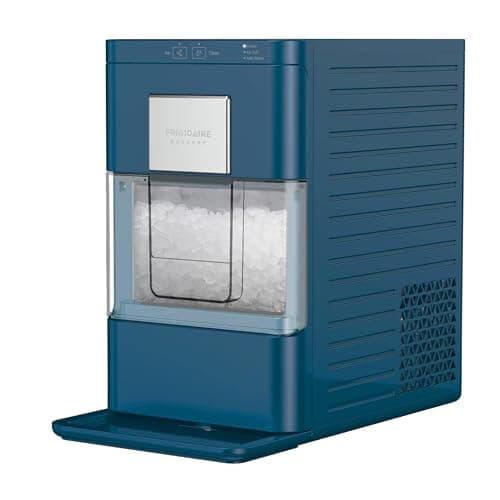 Frigidaire EFIC255 185 W published and 44 lbs a day, with no installation at all. | Best countertop value | |
| 2 | 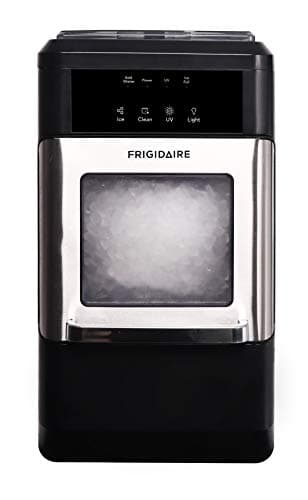 Frigidaire EFIC235 44 lbs a day of bullet ice from a simple, fast mechanism. | Best countertop for volume |
#ad We earn a commission on purchases made through this link. How this is funded. Prices last checked October 19, 2026.
The real difference in one table
| Countertop | Undercounter | |
|---|---|---|
| Water supply | Reservoir you fill | Plumbed to the water line |
| Drainage | Meltwater recirculates internally | Usually a drain, sometimes a pump |
| Ice storage | Unrefrigerated bin, 3 to 3.3 lbs | Insulated or refrigerated, typically far larger |
| Does ice keep? | No. It melts and gets refrozen | Generally yes |
| Installation | Unbox and plug in | Cabinetry, plumbing, often an electrician |
| Moves house with you | Easily | It is a fitted appliance |
| Typical outlay | One appliance purchase | Appliance plus installation |
| Published running cost | 90 W to 200 W where published | Varies widely by model and class |
The bin is the whole argument
Every countertop machine covered on this site stores ice in an unrefrigerated bin. Ice drops in, starts melting, and the meltwater drains back to the reservoir to be frozen again. While the machine is running that looks like storage, because it keeps replacing what melted. Switch it off and you have water.
Undercounter machines are built the other way round: they make ice into a storage bin designed to hold it. That is the functional difference you are paying for, and it is why the question "which should I buy" usually answers itself once you know whether you need ice to keep. Full explanation on do countertop ice makers keep ice frozen.
Scale, honestly
The countertop bin standard is 3 lbs, and NewAir's 3.3 lbs is the largest published. At roughly half a pound per tall glass, that is six or seven glasses before the machine has to catch up.
For a household that is plenty, because the machine refills throughout the day. For an evening with twelve guests it is not, and no countertop machine on the market fixes it — the constraint is the bin, not the production rate. If you regularly serve at that scale, the choice is an undercounter machine or making ice in advance and storing it in the freezer.
The mistake people make
Buying a countertop machine and installing it in a cabinet to get the undercounter look. It does not work. The published clearance requirements are 3 inches for the Opal 2.0, 4 inches for the Opal 2.0 Ultra and 3 inches at the sides and rear for the original Opal, and that gap is not decoration. It is how the condenser sheds heat.
Enclose the machine and the fan runs longer, the compressor works harder, ice takes longer to arrive and the electricity bill goes up. The original Opal manual also specifies an operating range of 55F to 90F, and a sealed cabinet around a heat-producing appliance is a good way to leave it.
Which one you need
- Countertop if you want a specific kind of ice — nugget, bullet or clear cube — for daily drinks, and you are willing to fill a reservoir. This is most people.
- Countertop if you rent, move often, or want the machine somewhere other than the kitchen.
- Undercounter if ice must be available without anyone filling anything, or if you serve at a scale a 3 lb bin cannot cover.
- Undercounter if you are building a bar and the machine is part of the cabinetry rather than an object on it.
If countertop is the right class, the machines are ranked on the countertop roundup, and the nugget-specific field is on the nugget roundup.
The picks in full
1. Best countertop value
Frigidaire Gallery Countertop Nugget Ice Maker
The only nugget machine here whose maker publishes an actual power consumption instead of a nameplate ceiling, and it is a low one.
- Rated output
- 44 lbs/day
- Bin capacity
- 3 lbs
- Electrical
- 185 W published
- Ceiling at 4 hrs/day, $0.18/kWh
- $4.00/month (from published watts)
#ad We earn a commission on purchases made through this link. How this is funded. Prices last checked October 19, 2026.
185 W published means the running-cost figure for this machine is not a derived ceiling — it is arithmetic on a number Frigidaire printed. That is the strongest cost data on the site.
It is rated at 20 kg a day, which is 44 lbs — higher than the Opal 2.0's 38. Both numbers are measured under ideal conditions the manual does not describe.
Ten inches wide and 16.5 tall makes it the narrowest full-size nugget machine in this set.
Skip this if
You need a manufacturer-published bin capacity. Frigidaire's specification table omits it, so the 3 lb figure on this page comes from a retail listing rather than the manual.
2. Best countertop for volume
Frigidaire Countertop Bullet Ice Maker
A bullet-ice machine, not a nugget one — and the fastest route to a full bin if the ice shape does not matter to you.
- Rated output
- 44 lbs/day
- Bin capacity
- Not published
- Electrical
- 200 W published
- Ceiling at 4 hrs/day, $0.18/kWh
- $4.32/month (from published watts)
#ad We earn a commission on purchases made through this link. How this is funded. Prices last checked October 19, 2026.
44 lbs a day at 200 W published. Bullet machines make ice by freezing water onto chilled prongs, which is a far simpler and faster process than extruding nugget ice.
This is the machine to buy if you want a lot of ice for a cooler, and the machine to avoid if you want ice you can chew.
At 19 inches tall it does not fit under a standard 18-inch upper cabinet gap. Measure first.
Skip this if
You came here for chewable ice. Bullet ice is hollow, hard cylinders. It is not nugget ice and no setting will make it nugget ice.
Questions people actually ask
What is the difference between a countertop and an undercounter ice maker?
A countertop machine is a plug-in appliance with a water reservoir you fill; it recirculates meltwater and stores ice in an unrefrigerated bin. An undercounter machine is installed into cabinetry, connects to a water supply and usually a drain, and typically has a refrigerated or insulated storage bin. One is an appliance you buy, the other is an appliance you install.
Do undercounter ice makers keep ice frozen?
Generally yes, which is the main functional difference. Countertop machines do not: on every countertop machine we cover, the bin is unrefrigerated, so ice melts and the meltwater drains back to the reservoir to be frozen again. If ice surviving overnight is the requirement, that alone points to an undercounter machine or a freezer.
Is an undercounter ice maker worth the extra cost?
It is worth it if you need ice continuously available without anyone filling anything, if you entertain at a scale a 3 lb bin cannot serve, or if you are building a bar. It is not worth it if what you actually want is chewable nugget ice in the evening, which a countertop machine delivers for a fraction of the money.
Can I put a countertop ice maker under a counter?
Not in an enclosed cabinet. Every countertop machine with a published clearance requirement asks for 3 to 4 inches at the sides and rear, because that gap is how heat leaves. Enclosing one makes the fan run longer, the compressor work harder and the ice arrive more slowly, and it costs more to run in the process.
Sources
- GE Profile Opal 2.0 Owner's Manual 49-9000029 Rev. 6, p.17 (read 2026-09-02)
- FirstBuild Opal Use & Care manual, Ver. 2/13/2017, p.12 (clearance, operating range) (read 2026-09-02)
- Frigidaire EFIC255 Use & Care Manual, p.12 (read 2026-09-02)
- EIA Electric Power Monthly, Table 5.6.A, June 2026 (read 2026-09-02)
Read next
- Nugget Ice Makers With a Water Line
What a water-line connection really means on a countertop machine, and the alternatives.
- Do You Need a Water Line?
No. What refilling actually involves, and what a side tank or plumbing buys you.
- Do Countertop Ice Makers Keep Ice Frozen?
No. The bin is unrefrigerated and the meltwater recirculates. What to do instead.
- The Best Countertop Ice Makers
The whole countertop category ranked by ice type, with sourced specs and running costs.
- How Much Ice Do You Actually Need?
Why rated output is the wrong number to shop on, and what bin capacity really limits.
- Are Countertop Ice Makers Worth It?
When one earns its place and when it does not, with the cost computed rather than asserted.
- Nugget Ice Makers for Small Kitchens
Published dimensions plus required clearance, worked out as the counter space each machine really takes.
- Do Any Refrigerators Make Nugget Ice?
Whirlpool is the only one. Samsung's Ice Bites and LG's Craft Ice are not nugget ice, and GE sells none.