Guides
Nugget Ice vs Bullet Ice
Almost every page answering this question is published by a company selling one of the answers. Here is the mechanical version, with the machine specs attached.
Disclosure: we earn a commission if you buy through our links. It never affects which machines we recommend or how we rank them, and we take no sponsored placements. Read the full disclosure.
Quick picks
| # | Machine | Best for | Price |
|---|---|---|---|
| 1 | 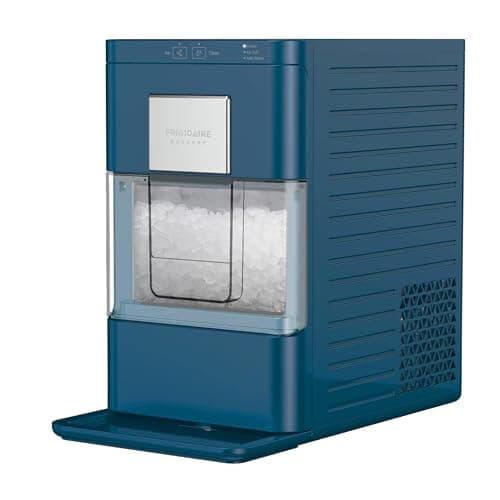 Frigidaire EFIC255 185 W published, 44 lbs a day, the chewable pellet. | Best nugget machine | |
| 2 | 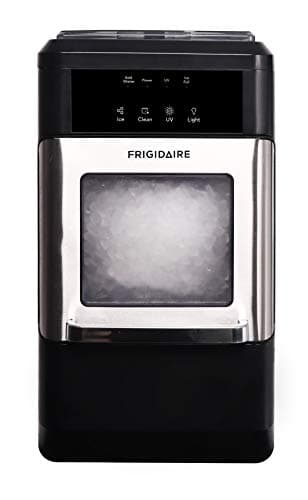 Frigidaire EFIC235 Same output rating, simpler mechanism, hollow cylinders. | Best bullet machine |
#ad We earn a commission on purchases made through this link. How this is funded. Prices last checked October 18, 2026.
Search this question and almost every result is published by a company that sells one of the two answers. That is not a conspiracy, it is just who writes about appliances, but it does mean the comparison usually arrives pre-loaded. This page is the mechanical version, with the manufacturers' own machine specifications attached so you can see what each mechanism actually costs to run.
How nugget ice is made
- Water is pumped into a vertical cylinder whose wall is chilled by the refrigeration system.
- A thin layer of ice crystals forms on the inside of that wall. This is flake ice, and on its own it is slush.
- A motor-driven auger turns inside the cylinder, scraping the flakes off the wall and driving them upward.
- At the top, the flakes are forced through a die that compresses them into a solid pellet, which breaks off and drops into the bin.
The chewability comes from step four. Compressed flakes are not solid ice: there is air between them, the structure is soft, and your teeth go through it. That same trapped air and enormous internal surface area is why nugget ice melts and dilutes quickly.
It also explains the price. That auger is a moving mechanical assembly operating inside a refrigerated cylinder, and it is the single biggest reason a nugget machine costs multiples of a bullet machine. Longer version: why nugget ice makers cost so much.
How bullet ice is made
- A set of chilled metal prongs lowers into a tray of water.
- Ice forms on the outside of each prong. Because the prong is cold and the water is not, the ice grows as a cylinder around it.
- After a set time the prongs are briefly warmed, releasing the ice.
- The hollow cylinders drop into the bin and the cycle repeats.
No auger, no compression, nothing to scrape. It is a much simpler machine, which is why it is faster and cheaper. The ice is solid and hard, and the hollow center is a by-product of forming around a prong rather than a design goal.
Side by side
| Nugget | Bullet | |
|---|---|---|
| Texture | Soft, chewable | Hard, hollow |
| Made by | Auger compressing flakes | Freezing onto chilled prongs |
| Melt rate | Fast. High surface area, trapped air | Moderate. Solid, but hollow |
| Dilution | High | Moderate |
| Chills a drink | Very fast | Fast |
| Machine complexity | Auger assembly under refrigeration | Prongs and a tray |
| Typical machine price | Higher | Lower |
| Best for | Chewing, iced tea, soda, sports bottles | Coolers, volume, general use |
The machines, on published specs
| Machine | Rated output | Bin | Electrical | Max $/mo |
|---|---|---|---|---|
| Frigidaire EFIC255 | 44 lbs/day [src] | 3 lbs [src] | 185 W [src] | $4.00(published W) |
| Frigidaire EFIC235 | 44 lbs/day [src] | Not published | 200 W [src] | $4.32(published W) |
| GE Profile XPIO13SCSS | 38 lbs/day [src] | 3 lbs [src] | 3 A [src] | $7.78(nameplate) |
The Frigidaire pair is the fairest comparison available because it is one manufacturer with one documentation standard. Both are rated at 20 kg per 24 hours. The nugget machine draws 185 W and the bullet machine draws 200 W.
That is worth pausing on, because it contradicts the common assumption that the more complicated mechanism must cost more to run. On these two machines, the nugget one is the more efficient of the pair. The bullet machine's advantage is purchase price and simplicity, not electricity.
Which should you buy
Buy nugget if
- You want ice you can chew. This is the only reason that matters and it is reason enough.
- The ice goes into iced tea, soda, water or sports bottles, where fast chilling is a feature and dilution is not a problem.
- You are replicating the ice from a drive-through. That is nugget ice, and the sonic-ice question is answered on its own page.
Buy bullet if
- You need volume for coolers, camping or entertaining and the shape is irrelevant.
- Budget is the binding constraint. A bullet machine gets you the most ice per dollar of purchase price by a wide margin.
- You are filling a cooler rather than a glass.
Buy neither if
You want ice that keeps. Neither type of countertop machine refrigerates its bin, so on both of them ice melts and the meltwater recirculates. That is covered properly on do countertop ice makers keep ice frozen, and it is the single most common source of disappointment with this entire category.
Pebble, crushed, chewblet and sonic
Four more words for roughly one thing. Pebble ice and chewblet are trade and colloquial names for nugget ice. Sonic ice is nugget ice from a particular drive-through. Crushed ice is genuinely different: it is solid ice smashed into sharp irregular shards, not compressed flakes, and it feels completely different in the mouth. A blender or a Lewis bag makes crushed ice. Only an auger makes nugget.
The picks in full
1. Best nugget machine
Frigidaire Gallery Countertop Nugget Ice Maker
The only nugget machine here whose maker publishes an actual power consumption instead of a nameplate ceiling, and it is a low one.
- Rated output
- 44 lbs/day
- Bin capacity
- 3 lbs
- Electrical
- 185 W published
- Ceiling at 4 hrs/day, $0.18/kWh
- $4.00/month (from published watts)
#ad We earn a commission on purchases made through this link. How this is funded. Prices last checked October 18, 2026.
185 W published means the running-cost figure for this machine is not a derived ceiling — it is arithmetic on a number Frigidaire printed. That is the strongest cost data on the site.
It is rated at 20 kg a day, which is 44 lbs — higher than the Opal 2.0's 38. Both numbers are measured under ideal conditions the manual does not describe.
Ten inches wide and 16.5 tall makes it the narrowest full-size nugget machine in this set.
Skip this if
You need a manufacturer-published bin capacity. Frigidaire's specification table omits it, so the 3 lb figure on this page comes from a retail listing rather than the manual.
2. Best bullet machine
Frigidaire Countertop Bullet Ice Maker
A bullet-ice machine, not a nugget one — and the fastest route to a full bin if the ice shape does not matter to you.
- Rated output
- 44 lbs/day
- Bin capacity
- Not published
- Electrical
- 200 W published
- Ceiling at 4 hrs/day, $0.18/kWh
- $4.32/month (from published watts)
#ad We earn a commission on purchases made through this link. How this is funded. Prices last checked October 18, 2026.
44 lbs a day at 200 W published. Bullet machines make ice by freezing water onto chilled prongs, which is a far simpler and faster process than extruding nugget ice.
This is the machine to buy if you want a lot of ice for a cooler, and the machine to avoid if you want ice you can chew.
At 19 inches tall it does not fit under a standard 18-inch upper cabinet gap. Measure first.
Skip this if
You came here for chewable ice. Bullet ice is hollow, hard cylinders. It is not nugget ice and no setting will make it nugget ice.
Questions people actually ask
What is the difference between nugget ice and bullet ice?
Nugget ice is made by freezing water into flakes on a chilled cylinder, scraping the flakes off with a rotating auger and compressing them into soft pellets. Bullet ice is made by freezing water onto chilled metal prongs and releasing hollow cylinders. Nugget ice is soft and chewable with a lot of trapped air; bullet ice is hard, hollow and quicker to produce.
Which melts faster, nugget or bullet ice?
Nugget, because it has far more surface area. It is an aggregate of compressed flakes with air trapped between them, and every one of those surfaces is in contact with your drink. Bullet ice is hollow, which also gives it high surface area, but it is solid ice rather than compressed flakes so it holds together longer.
Is nugget ice the same as sonic ice?
Yes, in the sense that matters. Sonic ice is nugget ice: the same soft, chewable compressed pellet made by the same kind of commercial machine. The brand name is a name for the ice, not a different product.
Are bullet ice makers cheaper than nugget ice makers?
Consistently, and the mechanism explains why. A bullet machine freezes water onto prongs and releases it. A nugget machine has to freeze flakes, scrape them off with a motor-driven auger and compress them, which is an extra mechanical assembly operating under refrigeration.
Which machine uses less electricity?
It is close, and it depends on the model rather than the ice type. Frigidaire publishes 185 W for its nugget EFIC255 and 200 W for its bullet EFIC235, both rated at 20 kg a day. On those figures the nugget machine is actually the more efficient of the two.
Sources
- Frigidaire EFIC255 Use & Care Manual, p.12 (nugget machine specs) (read 2026-09-02)
- Frigidaire EFIC235 User Manual, p.9 (bullet machine specs) (read 2026-09-02)
- GE Profile Opal 2.0 Owner's Manual 49-9000029 Rev. 6, p.17 (read 2026-09-02)
- EIA Electric Power Monthly, Table 5.6.A, June 2026 (US residential average price) (read 2026-09-02)
Read next
- Sonic Ice at Home
Sonic ice is nugget ice. What a countertop machine reproduces and what it cannot.
- The Best Nugget Ice Makers
Six machines ranked on published specs, each with a sourced monthly running-cost ceiling.
- The Best Portable Ice Makers
Portable machines ranked on published output and draw, with what portable really means.
- Nugget vs Clear Ice Makers
Chewable versus slow-melting. How each is made and which belongs in your glass.
- Do Countertop Ice Makers Keep Ice Frozen?
No. The bin is unrefrigerated and the meltwater recirculates. What to do instead.
- Why Are Nugget Ice Makers So Expensive?
One component explains the price gap: a motor-driven auger inside a refrigerated cylinder.
- Bullet Ice vs Clear Ice Makers
Fast hollow cylinders against slow dense cubes, on published specs from both manuals.
- Do Any Refrigerators Make Nugget Ice?
Whirlpool is the only one. Samsung's Ice Bites and LG's Craft Ice are not nugget ice, and GE sells none.