Guides
What a Nugget Ice Maker Costs to Run
Every figure on this page shows its inputs: the wattage, where it came from, the duty cycle assumed, the electricity rate and its source. Change any of them and the number changes with you.
Disclosure: we earn a commission if you buy through our links. It never affects which machines we recommend or how we rank them, and we take no sponsored placements. Read the full disclosure.
Quick picks
| # | Machine | Best for | Price |
|---|---|---|---|
| 1 | 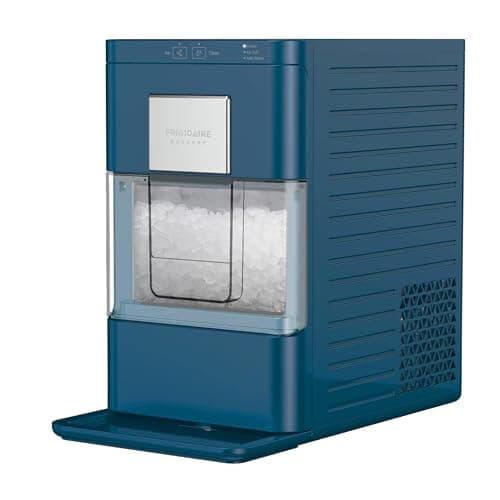 Frigidaire EFIC255 185 W published against a 44 lb/day rating. | Best cost per pound of ice |
#ad We earn a commission on purchases made through this link. How this is funded. Prices last checked October 19, 2026.
This page exists because of a gap we found while researching this site: roundups in this category do not publish running costs at all, and the pages that do are single-model, years old, and built on a wattage figure with no stated source. So here is the multi-model version, with every input cited.
First, the distinction everything else depends on
There are two kinds of electrical figure on an appliance and they are not interchangeable.
- A published power consumption, in watts. This is what the machine uses. Frigidaire publishes one for all three of its machines and NewAir publishes one for the NIM030SS00. When we have this, the cost figure is close to real.
- A nameplate rating, in volts and amps. Multiply them and you get volt-amps, which is the maximum the appliance may draw, used for sizing circuits. It is not consumption. A cycling compressor appliance draws less than its nameplate while running and nothing while idle. When this is all we have, the cost figure is a ceiling and we label it one.
This is why our tables head the column Max $/mo rather than "cost to run". The label carries the honesty.
The formula, in full
Worked, for the Frigidaire EFIC255 at its published 185 W: 0.185 kW × 4 hours = 0.74 kWh a day. × 30 = 22.2 kWh a month. × $0.18 = $4.00.
Worked, for the GE Profile Opal 2.0 at its 3.0 A nameplate: 120 V × 3.0 A = 360 VA. 0.36 kW × 4 = 1.44 kWh a day. × 30 = 43.2 kWh. × $0.18 = $7.78, as a ceiling.
Run it with your own numbers
Your electricity rate and your usage are not ours. Change them.
| Machine | Watts | kWh/month | $/month |
|---|---|---|---|
| Frigidaire EFIC189-SILVER | 105 (published W) | 12.6 | $2.27 |
| Frigidaire EFIC452 | 120 (published W) | 14.4 | $2.59 |
| Igloo ICEB26AQ (manual covers ICEB26AQ, ICEB26BK and ICEB26RR) | 120 (published W) | 14.4 | $2.59 |
| Cowsar Not stated by Cowsar | 136 (published W) | 16.3 | $2.94 |
| Iceman by Chefman RJ56-PB-V2 | 140 (published W) | 16.8 | $3.02 |
| VEVOR HZB-15N/S | 160 (published W) | 19.2 | $3.46 |
| NewAir NIM030SS00 | 170 (published W) | 20.4 | $3.67 |
| Gevi GIMN-1000B | 170 (published W) | 20.4 | $3.67 |
| Iceman by Chefman RJ56-PB18-SS | 170 (published W) | 20.4 | $3.67 |
| Silonn SLIM21 | 172.5 (nameplate) | 20.7 | $3.73 |
| Frigidaire EFIC255 | 185 (published W) | 22.2 | $4.00 |
| Frigidaire EFIC235 | 200 (published W) | 24.0 | $4.32 |
| GoveeLife H8120 | 210 (published W) | 25.2 | $4.54 |
| GE Profile P4NM series (Opal Mini Pro) | 240 (nameplate) | 28.8 | $5.18 |
| GE Profile P4NM20 series | 240 (nameplate) | 28.8 | $5.18 |
| GE Profile OPAL01 | 300 (nameplate) | 36.0 | $6.48 |
| AGLUCKY 15NB | 310 (published W) | 37.2 | $6.70 |
| NewAir NIM044BS00 | 310.5 (nameplate) | 37.3 | $6.71 |
| GE Profile XPIO13SCSS | 360 (nameplate) | 43.2 | $7.78 |
| GE Profile XPIO43SCSS | 360 (nameplate) | 43.2 | $7.78 |
Rows marked "nameplate" are ceilings derived from volts times amps, not measurements: the machine does not continuously draw its nameplate. Rows marked "published W" use a wattage the manufacturer printed. Default rate is 18.34¢/kWh from the Electric Power Monthly, Table 5.6.A, June 2026, rounded to $0.18.
The cheapest machine to run on this site's figures is a cheap bullet machine: the Frigidaire EFIC189 manual prints 105 W, about $2.27 a month on the scenario below. Among nugget machines the lowest published figure is Cowsar's 136 W, about $2.94. What that figure is worth, and what the brand does not publish, is on the Cowsar review.
Every machine we have data for
| Machine | Rated output | Bin | Electrical | Max $/mo |
|---|---|---|---|---|
| NewAir NIM030SS00 | 30 lbs/day [src] | Not published | 170 W [src] | $3.67(published W) |
| Frigidaire EFIC255 | 44 lbs/day [src] | 3 lbs [src] | 185 W [src] | $4.00(published W) |
| Frigidaire EFIC235 | 44 lbs/day [src] | Not published | 200 W [src] | $4.32(published W) |
| Frigidaire EFIC452 | 39.7 lbs/day [src] | Not published | 120 W [src] | $2.59(published W) |
| NewAir NIM044BS00 | 44 lbs/day [src] | 3.3 lbs [src] | 2.7 A [src] | $6.71(nameplate) |
| GE Profile OPAL01 | 24 lbs/day [src] | 3 lbs [src] | 2.5 A [src] | $6.48(nameplate) |
| GE Profile XPIO13SCSS | 38 lbs/day [src] | 3 lbs [src] | 3 A [src] | $7.78(nameplate) |
Read the parenthetical in the cost column. "(published W)" means the figure comes from a wattage the manufacturer printed; "(nameplate)" means we derived a ceiling because no wattage exists. Comparing one against the other tells you less than it looks like it does.
The Opal case, in detail
The electricity rate
Our default is $0.18/kWh, rounded from the EIA's Electric Power Monthly, Table 5.6.A: 18.34 cents per kWh, US residential average, June 2026.
A national average is a starting point, not an answer. State residential rates range from roughly 11 cents to over 40 cents, so somebody in Hawaii pays more than double what somebody in North Dakota pays for exactly the same machine. Put your own rate into the calculator above; it is on your bill.
We re-check the EIA figure twice a year. If it moves materially, the defaults on this site move with it and the change is noted here.
The duty cycle, and why we do not pretend to know it
Four running hours a day is our default scenario and it is an assumption, not a measurement. We do not know your household. What we will not do is bury that assumption and present a single confident monthly figure, which is exactly what the existing running-cost pages in this category do.
| Running hours/day | kWh/day | kWh/month | Ceiling $/month |
|---|---|---|---|
| 2 (light use) | 0.72 | 21.6 | $3.89 |
| 4 (our default) | 1.44 | 43.2 | $7.78 |
| 6 | 2.16 | 64.8 | $11.66 |
| 8 (heavy) | 2.88 | 86.4 | $15.55 |
| 12 | 4.32 | 129.6 | $23.33 |
| 24 (continuous, unrealistic) | 8.64 | 259.2 | $46.66 |
What actually drives your bill
- How often you empty the bin. This is the big one. The bin is not refrigerated, so the machine constantly replaces melted ice. Take ice out and it runs more. Leave it alone and it still runs, just less.
- Room temperature and inlet water temperature. The original Opal manual specifies an operating range of 55F to 90F. A hot kitchen makes the machine work harder for the same ice.
- Clearance. 3 to 4 inches per the manuals. A machine that cannot shed heat runs longer, and running longer is the same as costing more.
- Scale. A scaled freezing cylinder transfers heat worse, so the machine runs longer for less ice. Descaling is a running-cost measure as much as a maintenance one. See descaling.
- Hours, which you control entirely. Every figure on this page assumes four running hours a day. A machine left switched on cycles to replace the ice melting in its unrefrigerated bin, so the hours — and the bill — scale with that decision. Worked through on leaving a nugget ice maker on all the time.
What we are not claiming
We do not own a watt meter and we have not metered any of these machines. Every figure here is arithmetic on a published input, which means you can reproduce all of it with the same documents and a calculator. That reproducibility is the entire authority claim this site makes, and it is set out on our method page.
The picks in full
1. Best cost per pound of ice
Frigidaire Gallery Countertop Nugget Ice Maker
The only nugget machine here whose maker publishes an actual power consumption instead of a nameplate ceiling, and it is a low one.
- Rated output
- 44 lbs/day
- Bin capacity
- 3 lbs
- Electrical
- 185 W published
- Ceiling at 4 hrs/day, $0.18/kWh
- $4.00/month (from published watts)
#ad We earn a commission on purchases made through this link. How this is funded. Prices last checked October 19, 2026.
185 W published means the running-cost figure for this machine is not a derived ceiling — it is arithmetic on a number Frigidaire printed. That is the strongest cost data on the site.
It is rated at 20 kg a day, which is 44 lbs — higher than the Opal 2.0's 38. Both numbers are measured under ideal conditions the manual does not describe.
Ten inches wide and 16.5 tall makes it the narrowest full-size nugget machine in this set.
Skip this if
You need a manufacturer-published bin capacity. Frigidaire's specification table omits it, so the 3 lb figure on this page comes from a retail listing rather than the manual.
Questions people actually ask
How much does it cost to run a nugget ice maker per month?
Between about $3.67 and $7.78 a month at four running hours a day and 18 cents per kWh, depending on the machine. The NewAir NIM030SS00 publishes 170 W, which gives $3.67. The GE Profile Opal 2.0 publishes no wattage, only a 3.0 A rating that at 120 V is a 360 VA nameplate, giving a ceiling of $7.78. Those two numbers are not the same kind of figure and the page says which is which.
How many watts does a nugget ice maker use?
Where manufacturers publish a consumption figure, 170 W to 200 W is the range across the nugget and bullet machines we could source. Frigidaire publishes 185 W for the EFIC255 and NewAir 170 W for the NIM030SS00. GE publishes no wattage for the Opal line, only current ratings of 2.5 A on the original and 3.0 A on the 2.0.
Is 300 watts or 360 watts correct for the GE Opal?
Both, for different machines, and neither is a consumption figure. The original Opal (OPAL01) is rated 2.5 A, which at 120 V is 300 VA. The Opal 2.0 (XPIO13) is rated 3.0 A, which is 360 VA. A nameplate is the maximum an appliance may draw for circuit-sizing purposes, not what it uses while running.
Does leaving a nugget ice maker on all the time cost a lot?
It costs more than running it only when you need ice, because the machine keeps replacing the ice that melts in its unrefrigerated bin. The numbers on this page assume four running hours a day. A machine left on and regularly emptied will run far longer than that, and the same arithmetic scales linearly: double the hours, double the cost.
What electricity rate should I use for my own calculation?
Your own, from your bill. The US residential average was 18.34 cents per kWh in June 2026 per the EIA's Electric Power Monthly, but state rates run from roughly 11 cents to over 40 cents, so a national average is a starting point rather than an answer. The calculator on this page takes your rate directly.
Sources
- EIA Electric Power Monthly, Table 5.6.A, June 2026 (US residential average price) (read 2026-09-02)
- GE Profile Opal 2.0 Owner's Manual 49-9000029 Rev. 6, p.17 (3.0 A) (read 2026-09-02)
- FirstBuild Opal Use & Care manual, Ver. 2/13/2017, p.12 (2.5 A, 24 lbs/day) (read 2026-09-02)
- GE Appliances Opal support specification page (2.5 A, 24 lbs/day, model not stated) (read 2026-09-02)
- Frigidaire EFIC255 Use & Care Manual, p.12 (185 W) (read 2026-09-02)
- Frigidaire EFIC235 User Manual, p.9 (200 W) (read 2026-09-02)
- Frigidaire EFIC452 Use & Care Manual, p.10 (90-120 W) (read 2026-09-02)
- NewAir NIM030SS00 Owner's Manual, p.5 (170 W) (read 2026-09-02)
- NewAir NIM044BS00 Owner's Manual, p.5 (2.7 A) (read 2026-09-02)
Read next
- Electrical Requirements for a Nugget Ice Maker
Published current ratings, dedicated circuits, and what a nameplate figure really means.
- The Best Nugget Ice Makers
Six machines ranked on published specs, each with a sourced monthly running-cost ceiling.
- GE Profile Opal 2.0 (XPIO13SCSS)
3.0 A, 38 lbs a day, 1.6 lbs an hour. The best-documented machine in the category.
- Are Countertop Ice Makers Worth It?
When one earns its place and when it does not, with the cost computed rather than asserted.
- Frigidaire Gallery EFIC255
185 W published and 44 lbs a day rated. The best output-per-watt figure on the site.
- Do Countertop Ice Makers Keep Ice Frozen?
No. The bin is unrefrigerated and the meltwater recirculates. What to do instead.
- Frigidaire Gallery EFIC255 vs NewAir NIM030SS00
185 W against 170 W, both published. The only comparison here built on real consumption figures.
- Can You Leave a Nugget Ice Maker On All the Time?
Safe, yes. Sensible, usually not. What a machine left running actually does, and what it costs.