Reviews
Cowsar Countertop Nugget Ice Maker
The smallest nugget body and the lowest published wattage on this site, from a maker whose own retail listings contradict the capacity on its product page.
Disclosure: we earn a commission if you buy through our links. It never affects which machines we recommend or how we rank them, and we take no sponsored placements. Read the full disclosure.
Quick picks
| # | Machine | Best for | Price |
|---|---|---|---|
| 1 | 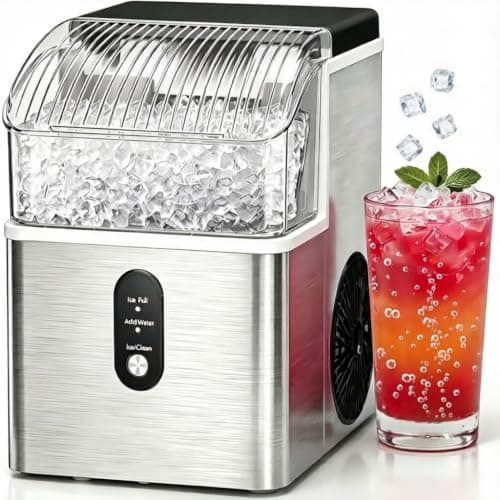 Cowsar Not stated by Cowsar 136 W on the maker's own page, in the shortest and lightest nugget body here. | Lowest published draw |
#ad We earn a commission on purchases made through this link. How this is funded. Prices last checked October 19, 2026.
What Cowsar publishes
| Spec | Cowsar Not stated by Cowsar |
|---|---|
| Model | Not stated by Cowsar |
| Ice type | Nugget |
| Rated output | 34 lbs/day [src] |
| Rated output per hour | Not published |
| Bin capacity | Not published |
| Published power | 136 W [src] |
| Nameplate current | Not published |
| Voltage | Not published |
| Dimensions (W x D x H) | 8.66" W x 11.3" D x 12.68" H [src] |
| Weight, empty | Not published |
| Clearance required | Not published |
| Operating range | Not published |
| Refrigerant | Not published |
| Noise | Not published |
| Warranty | Not published |
| Max $/mo | $2.94(published W) |
136 watts, the lowest published draw here
Cowsar's specification block prints Wattage: 136 watts. On this site's standard scenario of four running hours a day at 18 cents per kWh, that is about $2.94 a month — the lowest figure for any nugget machine here.
The comparisons are worth laying out, because this is the number most buyers never get at this price. The Gevi V2.0's manual prints 170 W, about $3.67. The Frigidaire Gallery EFIC255's manual prints 185 W, about $4.00. GE publishes no wattage at all for any Opal, only a current rating, so every Opal figure on this site is a ceiling rather than a bill.
Two caveats belong with the number. First, the source: 136 W sits in a product-page specification block, not in an owner's manual, so it carries the weaker tier and there is no manual to check it against. Second, efficiency is not the same as cheapness: at 34 lbs a day and 136 W the machine works out at about 4.0 watts per daily pound, which is close to the Frigidaire's 4.2 and not the step change the headline figure suggests. The arithmetic behind all of this is on the running-cost page.
The smallest nugget body on this site
The specification block gives 11.3"D x 8.66"W x 12.68"H, and the description adds a net weight of 20.68 lbs. Set against the rest of the nugget field, that is genuinely small.
| Machine | Width | Depth | Height | Weight |
|---|---|---|---|---|
| Cowsar | 8.66 in | 11.3 in | 12.68 in | 20.68 lbs (description copy) |
| GE Profile Opal Mini | 8.59 in | 15.59 in | 14.56 in | 27 lbs |
| Antarctic Star Z5815DN | 8.27 in | 15.55 in | 16.93 in | Not published |
| Gevi V2.0 | 9.6 in | 17.2 in | 16.7 in | 36.4 lbs |
| Frigidaire Gallery EFIC255 | 10 in | 14.6 in | 16.5 in | Not published |
Height is the measurement that rules machines out, because a standard counter-to-cabinet gap is about 18 inches and most nugget machines are 16.5 to 17 inches tall before you add the lid clearance to fill them. At 12.68 inches this one has room to spare. The full fitting argument is on nugget ice makers for small kitchens, and it is also why this is a sensible machine for a dorm room.
One important gap: Cowsar publishes no installation clearance. Every manual on this site that states one asks for between 3 and 6 inches, so budget for that air gap even though this maker never mentions it.
The number the brand cannot agree with itself about
Cowsar's product page says Capacity: 34 Pounds and first ice in 7 minutes. A catalog search on 22 September 2026 returned eight Cowsar nugget listings on sale at the same time. They claim 33 lbs a day, 35 lbs a day and 44 lbs a day, and first ice in 6 or 7 minutes, on machines whose photographs and descriptions are largely interchangeable. The listing this page links claims 35 lbs and 7 minutes.
There is a second reason to treat these figures loosely: this body is not only sold as a Cowsar. The VEVOR HZB-15N/S and the AGLUCKY 15NB publish dimensions within a tenth of an inch of these, with the same reservoir, weight and cleaning claims - and wattages of 160 W and 310 W against the 136 W here.
It is worth being fair about scale here. A household drinking three iced drinks a person per day needs a few pounds, not thirty-four, so the difference between 33 and 35 lbs is irrelevant in practice. What the contradiction actually tells you is how much weight to put on any unverifiable number from this brand — including, unfortunately, the 136 W.
What is not published at all
- No voltage or current. Unusual alongside a wattage, and it means there is no nameplate to size a circuit or an inverter from. The reasoning about both figures is on electrical requirements.
- No ice basket capacity. The number that decides how many glasses you get in a row, and the one most makers at this price omit.
- No operating temperature range, despite a display that shows the ambient temperature and description copy telling you to keep the environment suitable. Four machines here publish a range; this is not one of them, which is what keeps it off the garage page.
- No warranty term and no clearance figure. Both are standard omissions at this end of the market and both are worth knowing before you buy.
The cleaning cycle, and what it is not
Cowsar describes a self-cleaning cycle started by holding the Ice/Clean button for five seconds and running for about 15 minutes, with a reservoir of roughly 1.1 liters. That is a shorter cycle than Silonn's documented 30 minutes and much shorter than GE's 55-minute descale.
Length is not the point, though. A cycle run on plain water circulates water through the pump and lines, which is worth having, and does not dissolve mineral scale or remove biofilm. Those are two different jobs needing an acid and a detergent respectively, set out on descaling and how to clean a nugget ice maker. A 1.1 liter reservoir also means the standing water in this machine turns over faster than in a big-tank machine, which helps taste if you use it daily and does nothing if you do not.
Against the documented alternatives
Three machines sit near this one in price, and they line up neatly by how much each maker is willing to put in writing.
| Machine | Electrical figure | Source tier | Operating range |
|---|---|---|---|
| Cowsar | 136 W | Product page | Not published |
| Gevi V2.0 | 170 W plus a 3.0 A nameplate | Owner's manual | 50F to 90F |
| Frigidaire Gallery EFIC255 | 185 W | Owner's manual | Not published |
| Kismile | Not published | No specifications section at all | Not published |
If the decision is between the two cheapest, the honest framing is that Cowsar publishes a handful of checkable figures and Kismile publishes none. If you can stretch, the Gevi V2.0 is the machine at this end of the market with a real manual behind it.
Who should buy this
- Buy it if height is your constraint. At 12.68 inches it is the one nugget machine that fits under a low shelf or a wall cabinet without a fight.
- Buy it if you want the lowest published running cost in the nugget field, and you accept that the figure comes from a product page.
- Buy it if the machine has to move — 20.68 lbs is the lightest claimed weight of any nugget machine here, which matters for a dorm, a camper or a cupboard-to-counter routine.
- Skip it if the daily rating is what you are buying. The brand claims three different numbers across interchangeable listings and names no model.
- Skip it if you need a bin capacity, a clearance figure or an operating range. None of the three is published.
- Skip it if you want figures from a manual rather than a product page. The budget field ranked on what each maker publishes is on the budget nugget roundup.
The picks in full
1. Lowest published draw
Cowsar Countertop Nugget Ice Maker (34 lbs/24H)
The smallest nugget body and the lowest published wattage on this site, from a maker that publishes six figures on a product page and no model number anywhere.
- Rated output
- 34 lbs/day
- Bin capacity
- Not published
- Electrical
- 136 W published
- Ceiling at 4 hrs/day, $0.18/kWh
- $2.94/month (from published watts)
#ad We earn a commission on purchases made through this link. How this is funded. Prices last checked October 19, 2026.
Cowsar's product page carries a short specification block - brand, dimensions, capacity and wattage - and no model number. That makes the figures checkable only against the page itself, and there is no manual we could retrieve to compare them with.
Description copy on the same page adds a net weight of 20.68 lbs, a reservoir of about 1.1 liters (0.3 gallons), a 15-minute self-cleaning cycle on a five-second button hold, first ice in 7 minutes and an R600a compressor. Those sit outside the specification block, so this site records them as claims rather than figures.
Not published anywhere: voltage, current, ice basket capacity, installation clearance, warranty term and operating temperature range. The last one is odd, because the machine's own display shows the ambient temperature.
Skip this if
You want an electrical rating you can check against a manual, or a published bin capacity. Cowsar prints neither, and its own listings contradict its stated daily output.
Questions people actually ask
How much electricity does the Cowsar nugget ice maker use?
Cowsar publishes 136 watts, which at four running hours a day and 18 cents per kWh works out at about $2.94 a month. That is the lowest published figure for any nugget machine on this site, below the Gevi V2.0's 170 W and the Frigidaire Gallery EFIC255's 185 W. The caveat is the source: 136 W appears in a specification block on Cowsar's product page, not in an owner's manual, so it carries the weaker source tier.
How much ice does the Cowsar nugget ice maker make?
Cowsar's own page says 34 pounds in 24 hours. Its retail listings say 33 lbs on some machines and 35 lbs on others, including the one this page links, and the same listings disagree about whether first ice takes 6 or 7 minutes. No model number appears on either the page or the listings, so there is no way to tell whether those are different machines or the same machine described three ways.
How big is the Cowsar nugget ice maker?
8.66 inches wide, 11.3 deep and 12.68 tall, per the specification block, with description copy adding 20.68 lbs. That makes it the shortest and lightest nugget machine on this site: GE's Opal Mini is 14.56 inches tall and 27 lbs, and every full-size machine here is 16.5 inches or more. It is the one nugget machine that will sit under a low shelf without an argument.
Does Cowsar publish an operating temperature range?
No, which is the odd part. The machine's display shows the ambient temperature and the description tells you to keep the environment right for ice production, but no minimum or maximum is published anywhere on the page. Four machines on this site publish a range; this is not one of them, so a garage or a sunroom is an assumption rather than a documented condition.
Is the Cowsar worth buying over a Gevi or a Frigidaire?
It depends on whether you want the numbers or the paperwork. Cowsar is the cheapest of the three and publishes the lowest wattage, but only on a product page and with no model number. The Gevi V2.0's manual prints 170 W, a refrigerant charge, a footprint and a 50F to 90F range; the Frigidaire EFIC255's manual prints 185 W and a 44 lb daily rate. If you want figures you can check against a manual, buy one of those.
Does the Cowsar self-clean?
It has a cleaning cycle: hold the Ice/Clean button for five seconds and the machine runs for about 15 minutes, per Cowsar's description copy. As with every clean cycle in this category, a cycle run on plain water is a rinse rather than a clean. It moves water through the pump and lines but does not dissolve scale, which needs an acid, or remove biofilm, which needs detergent.
Sources
- Cowsar product page, 34lbs/24H Nugget Ice Makers Countertop (specification block) (read 2026-09-22)
- Gevi GIMN-1000B User Manual, p.17 (Technical Parameters) (read 2026-09-21)
- Frigidaire EFIC255 Use & Care Manual, p.12 (product specifications) (read 2026-09-02)
- GE Profile Opal Mini Owner's Manual 49-9000083 Rev. 0, p.15 (Ice Maker Product Specifications) (read 2026-09-13)
- EIA Electric Power Monthly, Table 5.6.A, June 2026 (US residential average price) (read 2026-09-02)
Read next
- Gevi V2.0 Nugget Ice Maker (GIMN-1000B)
170 W published, 3.0 A nameplate, R600a with a 24 g charge, and 6 inches of clearance.
- Kismile Nugget Ice Maker
No model number on the listing, no specification table in the manual, and two useful facts.
- Best Budget Nugget Ice Makers
The cheap end of the category, ranked by what their makers are willing to publish.
- What a Nugget Ice Maker Costs to Run
Per-model monthly costs with the wattage sourced, the duty cycle stated and the arithmetic shown.
- Nugget Ice Makers for Small Kitchens
Published dimensions plus required clearance, worked out as the counter space each machine really takes.
- Which Ice Maker Brand Should You Buy?
Brands ranked on what they publish, who supports them, and what you can actually buy today.