Reviews
AGLUCKY Countertop Nugget Ice Maker (15NB)
Identical published dimensions to the Cowsar, identical description copy, and a published wattage more than twice as high. This is the clearest badge-engineering case on the site.
Disclosure: we earn a commission if you buy through our links. It never affects which machines we recommend or how we rank them, and we take no sponsored placements. Read the full disclosure.
Quick picks
| # | Machine | Best for | Price |
|---|---|---|---|
| 1 | 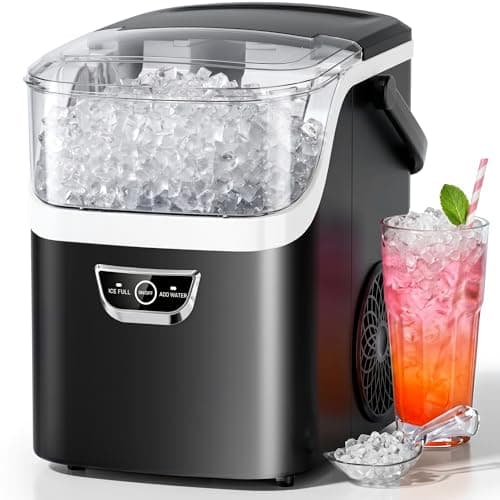 AGLUCKY 15NB A live listing with a model name and a specification block that its own siblings contradict. | Buy it on the badge, not the figures |
#ad We earn a commission on purchases made through this link. How this is funded. Prices last checked October 18, 2026.
What AGLUCKY publishes
| Spec | AGLUCKY 15NB |
|---|---|
| Model | 15NB |
| Ice type | Nugget |
| Rated output | 34 lbs/day [src] |
| Rated output per hour | Not published |
| Bin capacity | Not published |
| Published power | 310 W [src] |
| Nameplate current | Not published |
| Voltage | Not published |
| Dimensions (W x D x H) | 8.66" W x 11.3" D x 12.68" H [src] |
| Weight, empty | Not published |
| Clearance required | Not published |
| Operating range | Not published |
| Refrigerant | Not published |
| Noise | Not published |
| Warranty | 12 months [src] |
| Max $/mo | $6.70(published W) |
The same machine, three wattages
Put the three product pages side by side and the pattern is hard to miss. AGLUCKY publishes dimensions of 11.3"D x 8.66"W x 12.68"H and 310 watts. Cowsar publishes the same dimensions and 136 watts. VEVOR publishes 8.7 x 11.3 x 12.7 inches and 160 W.
| Brand | Published wattage | Monthly at 4 hrs/day | Daily rating on the page |
|---|---|---|---|
| AGLUCKY 15NB | 310 W | About $6.70 | 34 lbs |
| Cowsar | 136 W | About $2.94 | 34 lbs |
| VEVOR HZB-15N/S | 160 W | About $3.46 | 33 lbs, labeled a maximum |
Three explanations are possible and this site cannot choose between them from published data. The machines may differ internally despite identical external figures; one or more pages may simply be wrong; or a figure may describe something different, such as a peak draw rather than a running one. What is certain is that no one of these numbers should carry a purchase decision on its own.
The model codes point the same way. AGLUCKY's page names the machine 15NB, which belongs to the same HZB-15 family whose manuals also appear under Kismile and Antarctic Star badges, and Kismile publishes no specifications at all. The pattern at this end of the market is covered on the budget nugget roundup.
The model codes point the same way
AGLUCKY calls this machine 15NB, which belongs to the HZB-15 family. That family turns up elsewhere on this site: the manual behind our Kismile page covers an HZB-20EN, the Antarctic Star is a Z5815DN, and Cowsar manuals appear under both Z5815 and HZB-15 codes. Four badges, one naming scheme, and in two cases identical published dimensions.
That is normal manufacturing — an OEM sells the same platform to several brands — and it is not a reason to avoid these machines. It is a reason to stop treating their published figures as brand-specific engineering claims, and to buy on price, warranty and the offer you can verify instead.
34 lbs on the page, 35 on the listing
AGLUCKY's own page says Capacity: 34 Pounds. The retail listing for the same machine claims 35 lbs a day. It is a one-pound difference and it matters for exactly one reason: it shows the numbers are not coming from a controlled document.
In use, neither figure is the constraint. A household drinking three iced drinks a person a day needs a few pounds, not thirty-four, and what limits you is the basket — which AGLUCKY does not publish at all. For the machines that do, and the arithmetic, see how much ice you actually need.
What is published, and what it is worth
To be fair to the brand, the specification block is not empty. It names a model, a wattage, the dimensions, the capacity and a one-year warranty. Compared with Kismile — whose manual has no specifications section at all — that is progress.
- A model name. 15NB, which lets you find a manual for the family even though the listing does not name it.
- A warranty term. One year, stated on the page. No specification table in this category states one.
- A footprint. Useful, and it is the figure that proves the shared body.
- Description claims. A 1.1 liter reservoir, first ice in 7 minutes and a 15-minute self-clean on a five-second hold. Recorded here as claims, not figures, because they sit outside the block.
Not published anywhere: voltage, current, refrigerant, basket capacity and any operating temperature range. The last one keeps it off the garage page, and the missing nameplate means there is nothing to size a circuit from, which is the distinction drawn on electrical requirements.
How to buy a machine that comes in three badges
If the hardware is the same, the purchase decision moves off the spec sheet and onto the things that genuinely differ between badges. Those are worth listing, because they are what you are actually choosing between.
- The warranty term. AGLUCKY states one year on its product page. Cowsar and VEVOR state nothing on the pages we read. On an appliance with a compressor, a written term is worth more than a claimed wattage.
- Who answers the phone. A badge is mostly a support operation. Before you buy, check that the brand has a contact route that is not only the retailer's returns page.
- The offer itself. These three move independently on price and availability. Buying the cheapest badge with a live offer is rational precisely because the machines look identical.
- Parts, three years out. None of these brands publishes a parts list, and none names a model on its retail listing. AGLUCKY at least names 15NB on its own site, which is something to search with.
What none of that fixes is the documentation floor. If you want a machine whose figures come from a manual with a model number on the cover, that is a different purchase, and the candidates are on which ice maker brand to buy.
If 310 W is real
Take the figure at face value for a moment. At four running hours a day and 18 cents per kWh, 310 W is about $6.70 a month — more than double the Cowsar's figure for the same body, and close to the $7.78 ceiling this site quotes for a full-size GE Opal 2.0 running on a 3.0 A nameplate.
That would make this the most expensive cheap machine on the site to run. It would also be strange: a machine with the same compressor, fan and auger as the Cowsar should not draw twice the power. The honest position is the one this page takes — publish the maker's figure, publish the contradiction, and let a reader who cares about running cost buy from a maker who prints it in a manual. The arithmetic is on the running-cost page.
Who should buy this
- Buy it if it is the badge on this body with the best live offer. The machines appear to be the same; the prices move independently.
- Buy it if you want nugget ice cheaply and you are comfortable judging the machine after it arrives.
- Skip it if running cost is part of the decision. 310 W against 136 W for the same body means neither figure is trustworthy.
- Skip it if you need a bin capacity or an operating range. Neither is published.
- Skip it if you want a document rather than a page. The Gevi V2.0 publishes a manual technical table at a similar price, and the Frigidaire Gallery EFIC255 publishes 185 W with a 44 lb rating.
The picks in full
1. Buy it on the badge, not the figures
AGLUCKY Countertop Nugget Ice Maker
The clearest example on this site of one OEM body sold under several badges: identical published dimensions to the Cowsar, identical marketing copy, and a published wattage more than twice as high.
- Rated output
- 34 lbs/day
- Bin capacity
- Not published
- Electrical
- 310 W published
- Ceiling at 4 hrs/day, $0.18/kWh
- $6.70/month (from published watts)
#ad We earn a commission on purchases made through this link. How this is funded. Prices last checked October 18, 2026.
AGLUCKY's specification block carries a model name, a wattage, the dimensions and a capacity. It publishes no voltage, no current, no refrigerant, no basket capacity and no operating temperature range.
Its published dimensions, its 1.1 liter reservoir, its 7-minute first ice, its 15-minute self-clean and its 20.68 lb weight all match the Cowsar's word for word. The wattage does not: 310 W here against 136 W there.
At 310 W the monthly cost figure would be about $6.70 against the Cowsar's $2.94 for the same machine. This site publishes both and says plainly that the two cannot both be right.
Skip this if
You want figures that agree with each other. The daily rating on the listing contradicts the maker's own page, and the wattage contradicts the identical machine sold as a Cowsar.
Questions people actually ask
How much electricity does the AGLUCKY nugget ice maker use?
AGLUCKY publishes 310 watts on its product page, which at four running hours a day and 18 cents per kWh is about $6.70 a month. That figure is hard to take at face value: the Cowsar product page publishes 136 W for a machine with identical published dimensions, identical reservoir and weight claims and near-identical description copy, and VEVOR publishes 160 W for the same body. This site prints AGLUCKY's own figure and says plainly that the three cannot all be right.
How much ice does the AGLUCKY make?
Its product page says 34 pounds in 24 hours. The retail listing for the same machine says 35 lbs a day. Neither figure comes from a manual specification table, and the brand publishes no basket capacity at all, which is the number that actually decides how many glasses you can pour in a row.
Is the AGLUCKY the same machine as the Cowsar?
On everything either brand publishes, yes. Both give dimensions of 11.3 inches deep by 8.66 wide by 12.68 tall, a 20.68 lb weight, a reservoir of about 1.1 liters, first ice in 7 minutes and a 15-minute self-clean on a five-second button hold. The published wattage is the one figure that differs, and neither brand names a model number on its Amazon listing. Model codes in the wider family - Z5815 and HZB-15 variants - also turn up under Kismile and Antarctic Star badges.
Does AGLUCKY publish a warranty?
Yes, a one-year warranty policy on its product page. That is the same term Silonn states for the SLIM21 and a third of the three years GoveeLife states for its machine. No warranty term appears in any specification table in this category.
Should I buy an AGLUCKY or something better documented?
If the price is what decides it, buy whichever badge on this body has a live offer and treat every published figure as approximate. If you want figures you can check, the Gevi V2.0's manual prints a rated power, a nameplate current, a refrigerant charge and an operating range, and the Frigidaire EFIC255's manual prints 185 W with a 44 lb daily rating.
Sources
- AGLUCKY product page, Nugget Ice Maker Countertop (model 15NB), specification block (read 2026-09-27)
- Cowsar product page, 34lbs/24H Nugget Ice Makers Countertop (specification block) (read 2026-09-22)
- VEVOR product page, Countertop Nugget Ice Maker 33lbs/24H (model HZB-15N/S) (read 2026-09-27)
- Gevi GIMN-1000B User Manual, p.17 (Technical Parameters) (read 2026-09-21)
- EIA Electric Power Monthly, Table 5.6.A, June 2026 (US residential average price) (read 2026-09-02)
Read next
- Cowsar Countertop Nugget Ice Maker
136 W published, 34 lbs a day claimed, 12.68 inches tall, and no model number anywhere.
- VEVOR Countertop Nugget Ice Maker (HZB-15N/S)
160 W, 33 lbs a day, 1.5 lbs of storage, and the site's only published decibel figure.
- Kismile Nugget Ice Maker
No model number on the listing, no specification table in the manual, and two useful facts.
- Best Budget Nugget Ice Makers
The cheap end of the category, ranked by what their makers are willing to publish.
- Which Ice Maker Brand Should You Buy?
Brands ranked on what they publish, who supports them, and what you can actually buy today.
- What a Nugget Ice Maker Costs to Run
Per-model monthly costs with the wattage sourced, the duty cycle stated and the arithmetic shown.