Reviews
Gevi V2.0 Nugget Ice Maker (GIMN-1000B)
A budget-brand machine whose manual prints a real power consumption, a refrigerant charge and an operating range. The catch is the six inches of air it wants on every side.
Disclosure: we earn a commission if you buy through our links. It never affects which machines we recommend or how we rank them, and we take no sponsored placements. Read the full disclosure.
Quick picks
| # | Machine | Best for | Price |
|---|---|---|---|
| 1 | 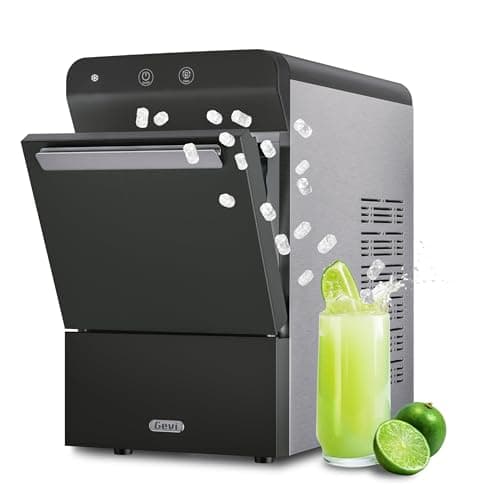 Gevi GIMN-1000B A published wattage, a refrigerant charge and an operating range, at a fraction of Opal money. | The documented budget pick |
#ad We earn a commission on purchases made through this link. How this is funded. Prices last checked October 19, 2026.
What Gevi publishes
| Spec | Gevi GIMN-1000B |
|---|---|
| Model | GIMN-1000B |
| Ice type | Nugget |
| Rated output | Not published |
| Rated output per hour | Not published |
| Bin capacity | Not published |
| Published power | 170 W [src] |
| Nameplate current | 3 A [src] |
| Voltage | 120 V [src] |
| Dimensions (W x D x H) | 9.6" W x 17.2" D x 16.7" H [src] |
| Weight, empty | 36.4 lbs [src] |
| Clearance required | 6" [src] |
| Operating range | 50F to 90F [src] |
| Refrigerant | R600a, 24 g charge [src] |
| Noise | Not published |
| Warranty | Not published |
| Max $/mo | $3.67(published W) |
The 170 W is the headline
Almost every running-cost figure in this category is a nameplate derivation. A manufacturer prints volts and amps, this site multiplies them, and the result is a ceiling the machine never continuously draws. Gevi prints both kinds of number on one table: a power source of 120V/60Hz/3.0A and a rated power of 170W.
At the site's standard four running hours a day and 18 cents per kWh, 170 W is about $3.67 a month. For comparison the Frigidaire EFIC255 publishes 185 W, about $4.00, and GE publishes no wattage for any Opal at all — the Opal 2.0's 3.0 A gives a 360 VA ceiling, about $7.78, which is a maximum rather than a bill.
Notice that Gevi's nameplate current is the same 3.0 A GE prints for the full-size Opal. If Gevi had stopped there, this page would be quoting a $7.78 ceiling for a machine that actually draws 170 W. That gap — more than double — is the entire argument for why a published wattage matters, and it is laid out on the running-cost page.
Six inches on every side
This is the number that should decide whether you buy it. Gevi's before-first-use section asks for 6 inches of clearance on all sides. GE asks 3 inches for the Opal 2.0 and 4 for the Mini and the Ultra; Frigidaire and Silonn publish no figure at all.
Work it through and the machine stops being compact. The body is 9.6 inches wide and 17.2 deep. Add the air gap Gevi asks for and you are committing roughly 21.6 inches of counter width and 23.2 inches of depth — deeper than a standard kitchen counter, which means it wants a spot with its back genuinely open rather than against a wall.
That is not a reason to dismiss it. Every machine in this category rejects heat from the same surfaces and most manufacturers simply do not tell you how much room they need, which is worse. But if your counter is the binding constraint, the machines that fit are on nugget ice makers for small kitchens.
50F to 90F, and the water as well
Gevi publishes an operating range of 50F to 90F, matching the Silonn SLIM21 and beating GE's 55F to 90F at the cold end by five degrees. That matters for a garage, a basement or an unheated porch, and the whole published field is on what temperature an ice maker needs.
The same page adds something no other manual here does: use water between 46F and 82F. It is a small instruction with a real mechanism behind it — water that arrives warm has to be chilled before it can be frozen, and water that arrives near freezing can slow the harvest — and it is the kind of detail that suggests the document was written by someone who knows the machine.
What Gevi does not print
The table has no ice-making rate, no water tank capacity and no basket capacity. The listing says 38 lbs a day; the specification table says nothing, so this site records the rate as Not published and does not promote the listing figure.
The missing basket figure is the more annoying omission day to day. Bin capacity, not daily output, is what limits a countertop machine in a real kitchen, and the reasoning is on how much ice you actually need.
The unusual parts of the table
Three entries on Gevi's table appear almost nowhere else in this category, and they are worth naming because they tell you something about the document rather than the machine.
- A refrigerant charge. R600a / 24g. Most manuals here name the refrigerant and stop; only NewAir's NIM030SS00 also prints the charge. R600a is isobutane, which is why every manual in this category carries a flammable-refrigerant warning.
- A climate class. ST/SN/N/T, which is the appliance-standard way of stating the ambient conditions a refrigeration product is rated for. No other manual on this site prints one.
- A housing material. SUS430, a ferritic stainless of the kind used for appliance panels. Trivial on its own, but a maker that prints the steel grade is a maker filling in a real engineering template rather than a marketing one.
Before you make ice you drink
Gevi's before-first-use section asks for two things this site agrees with: let the machine stand for two hours after it has been moved, and run the self-cleaning program twice with fresh water before you use the ice.
As always, a cycle run on plain water is a rinse rather than a clean. It moves water through the pump and lines, which is genuinely useful, but scale needs an acid and biofilm needs detergent. The distinction is on descaling and how to clean a nugget ice maker.
Who should buy this
- Buy it if you want nugget ice with a running cost you can actually calculate. 170 W published beats a 360 VA ceiling for planning, and it is the cheapest machine here that gives you one.
- Buy it if the machine is going somewhere cool. A published 50F floor is five degrees better than GE's and covers a basement or a shaded porch.
- Buy it if you would rather have a full specification table than a brand name. This is the most complete one from any budget maker on this site.
- Skip it if counter space is tight. Six inches of clearance on every side is the largest demand in this category and it is not negotiable without costing you ice.
- Skip it if you need to know the output before you buy. Gevi prints no rate, so 38 lbs a day is a claim you are taking on trust.
- Skip it if you want a documented bin size. The table omits both the basket and the tank, which are the two numbers you live with daily. The alternatives are ranked on the budget nugget roundup.
The picks in full
1. The documented budget pick
Gevi V2.0 Nugget Ice Maker
The best-documented budget nugget machine on this site, and the only one you can buy new besides the Frigidaire EFIC255 whose manual prints an actual power consumption.
- Rated output
- Not published
- Bin capacity
- Not published
- Electrical
- 170 W published
- Ceiling at 4 hrs/day, $0.18/kWh
- $3.67/month (from published watts)
#ad We earn a commission on purchases made through this link. How this is funded. Prices last checked October 19, 2026.
Gevi's technical parameters table prints a rated power, a nameplate current, the refrigerant and its 24 g charge, the housing steel grade and the climate class. For a machine at this price that is more than GE publishes.
It does not print an ice-making rate, a water tank capacity or a basket capacity. The 38 lbs a day on the retail listing is a claim, not a specification, and this site records the rate as Not published.
The 6 inch clearance is the practical catch. A machine 9.6 inches wide that wants 6 inches of air on each side occupies 21.6 inches of counter, which is wider than the largest machine here.
Skip this if
Your counter cannot give up six inches of air on every side, or you want a published ice rate. Gevi's table does not print one.
Questions people actually ask
How much electricity does the Gevi V2.0 use?
Its manual prints a rated power of 170 W alongside a separate 120V/60Hz/3.0A power source line. At four running hours a day and 18 cents per kWh, 170 W works out at about $3.67 a month. That figure is arithmetic on a published consumption rather than a nameplate ceiling, which puts it in a very small group on this site: only the Frigidaire EFIC255 at 185 W and the discontinued NewAir NIM030SS00 at 170 W publish the same kind of number.
How much ice does the Gevi V2.0 make?
Gevi does not publish a rate. The technical parameters table in its manual carries the power figures, the refrigerant, the weight and the dimensions, and no ice-making capacity at all. The 38 lbs a day on the retail listing is a claim rather than a specification, and this site records the rate as Not published for exactly the same reason it does for the GE Profile Opal Mini.
How much space does the Gevi V2.0 need?
More than its footprint suggests. The machine is 9.6 inches wide, 17.2 deep and 16.7 tall, but the manual asks for 6 inches of clearance on all sides. That is the largest air gap any manual on this site requires, and it turns a 9.6 inch machine into roughly 21.6 inches of counter once you give it what it asks for.
What temperature does the Gevi V2.0 need?
Its manual says to operate the machine between 50F and 90F, and to use water between 46F and 82F. The operating range matches the Silonn SLIM21 and is wider at the cold end than GE's 55F to 90F. The water-temperature instruction is unique here: no other manual on this site specifies what temperature the water going in should be.
Is the Gevi V2.0 the same as the Gevi Household V2.0?
The V2.0 name covers a family. The manual this page is built from is for model GIMN-1000B, which is sold as the Household V2.0, and Gevi also lists a GIMN-1102 and an IMNA0 with different figures. Check the model on the box against the manual before you rely on any number, because the brand reuses the V2.0 badge across machines that are not identical.
Does the Gevi V2.0 self-clean?
It has a cleaning program, and the manual tells you to run it twice with fresh water before you make ice you intend to drink. As with every clean cycle in this category, a cycle run on plain water is a rinse: it circulates water through the pump and lines but does not dissolve scale, which needs an acid, or remove biofilm, which needs detergent.
Sources
- Gevi GIMN-1000B User Manual, p.17 (Technical Parameters) (read 2026-09-21)
- Gevi GIMN-1000B User Manual, p.9 (Before First Use) (read 2026-09-21)
- Frigidaire EFIC255 Use & Care Manual, p.12 (product specifications) (read 2026-09-02)
- GE Profile Opal 2.0 Owner's Manual 49-9000029 Rev. 6, p.17 (read 2026-09-02)
- EIA Electric Power Monthly, Table 5.6.A, June 2026 (US residential average price) (read 2026-09-02)
Read next
- Gevi V2.0 vs Frigidaire Gallery EFIC255
170 W against 185 W, a published temperature range against a published ice rate.
- Frigidaire Gallery EFIC255
185 W published and 44 lbs a day rated. The best output-per-watt figure on the site.
- Best Budget Nugget Ice Makers
The cheap end of the category, ranked by what their makers are willing to publish.
- What a Nugget Ice Maker Costs to Run
Per-model monthly costs with the wattage sourced, the duty cycle stated and the arithmetic shown.
- What Temperature Does an Ice Maker Need?
Every published operating range in the category, and what happens above and below them.
- The Best Nugget Ice Makers
Six machines ranked on published specs, each with a sourced monthly running-cost ceiling.