Compare
Gevi V2.0 vs Frigidaire Gallery EFIC255
Two machines at similar money, and the only two nugget machines on sale new whose manuals print an actual wattage. The gap between them is not the ice, it is which questions each maker bothered to answer.
Disclosure: we earn a commission if you buy through our links. It never affects which machines we recommend or how we rank them, and we take no sponsored placements. Read the full disclosure.
Quick picks
| # | Machine | Best for | Price |
|---|---|---|---|
| 1 | 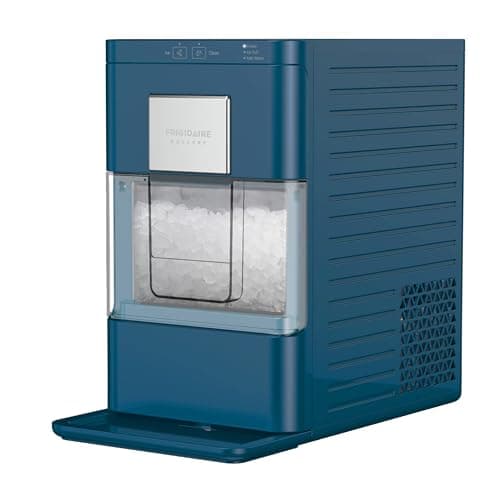 Frigidaire EFIC255 44 lbs a day published, 14.6 inches deep, and a clean cycle with a stated procedure. | More ice, less counter | |
| 2 | 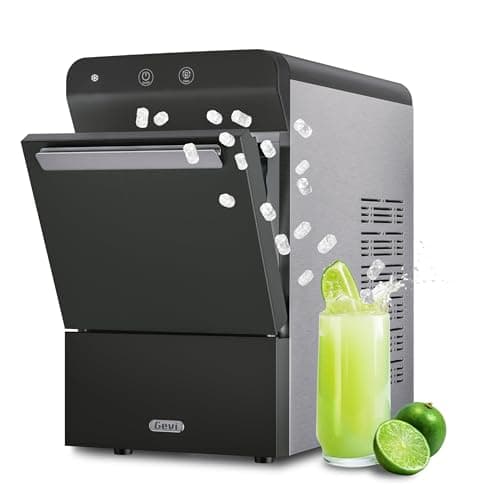 Gevi GIMN-1000B 170 W and a published 50F to 90F range, with a refrigerant charge printed as well. | Lower draw, wider window |
#ad We earn a commission on purchases made through this link. How this is funded. Prices last checked October 19, 2026.
Almost every comparison on this site ends with the same caveat: one or both cost figures are nameplate ceilings rather than consumption. Not this one. Both of these manufacturers printed a wattage, which makes this the second comparison on the site where the money is real rather than an upper bound.
They are also close in price, both make the same soft chewable ice by the same auger mechanism, and both are sold to the same buyer. So the decision comes down to which set of unanswered questions you can live with.
Side by side, on published figures
| Machine | Rated output | Bin | Electrical | Max $/mo |
|---|---|---|---|---|
| Gevi GIMN-1000B | Not published | Not published | 170 W [src] | $3.67(published W) |
| Frigidaire EFIC255 | 44 lbs/day [src] | 3 lbs [src] | 185 W [src] | $4.00(published W) |
The watts, and what they are worth
Gevi prints a rated power of 170W beside a separate 120V/60Hz/3.0A supply line. Frigidaire prints 185 W. At four running hours a day and 18 cents per kWh that is about $3.67 a month against $4.00.
Thirty-three cents a month is not a reason to choose anything. What matters is what the figures let you do: plan a shared circuit, size a generator, compare against a freezer. Notice also that Gevi's nameplate current is 3.0 A — the same as a full-size GE Opal. Without the printed wattage this page would be quoting a $7.78 ceiling for a machine that draws 170 W, which is the whole argument set out on the running-cost page.
One efficiency comparison is available and one is not. Frigidaire publishes both a wattage and a rate, so its 185 W against 44.1 lbs a day works out at roughly 4.2 watts per daily pound. Gevi publishes no rate, so the same division cannot be done, and this site will not do it from a listing figure.
Output: the one Frigidaire wins on paper
The EFIC255's manual states 20 kg per 24 hours, which converts to 44.1 lbs and is the highest rate printed in any manual on this site. Gevi's table has no rate line at all.
For most households neither number is the constraint. Both machines make far more in a day than a family drinks, and what actually limits you is how much finished ice the bin holds — which neither manufacturer publishes in a manual. The sizing argument is on how much ice you actually need.
Space: closer than it looks, then not close at all
| Gevi V2.0 | Frigidaire EFIC255 | |
|---|---|---|
| Body (W x D x H) | 9.6" x 17.2" x 16.7" | 10" x 14.6" x 16.5" |
| Published clearance | 6 in on all sides | Not published |
| Counter width with clearance | About 21.6 in | Not stated by the maker |
| Net weight | 36.4 lbs | Not published |
On the body alone the Gevi is narrower and the Frigidaire is shallower, and a 2.6 inch depth difference decides more kitchen arguments than a 0.4 inch width difference does. Add Gevi's 6 inches of clearance on all sides and the comparison stops being close: it is the largest air gap any manual on this site asks for.
Temperature: Gevi answers, Frigidaire does not
Gevi publishes an operating range of 50F to 90F and a water-temperature instruction of 46F to 82F, which no other manual here gives. Frigidaire publishes no operating range for the EFIC255 at all.
In a kitchen that is a non-issue for both. Anywhere else — a garage, a basement bar, a sunroom, a porch — it is the difference between a documented condition and an assumption, which is why the Gevi is the machine this site ranks first on ice makers for a garage.
Cleaning: one has a procedure, one has an instruction
Frigidaire documents a CLEAN button with a cycle of at least 20 minutes run on plain water, recommended before first use and after a long idle period. Gevi asks you to run its cleaning program twice with fresh water before first use and leaves the ongoing schedule to you.
Both are rinses rather than cleans, because a cycle on plain water moves water through the pump and lines without dissolving scale or removing biofilm. Neither maker states a descaling interval; the only manufacturer in this category who does is GE. The chemistry and the schedule are on descaling.
Which one belongs in which room
The specification gap between these two maps onto rooms more cleanly than onto budgets.
- A kitchen counter: the Frigidaire. It is 2.6 inches shallower, it publishes a rate so you can plan a party around it, and it does not demand six inches of air on a surface where you cannot spare it.
- A garage, a basement or a porch: the Gevi. It is the only one of the two with a published temperature floor, and a garage is the one room where a six-inch air gap is free. The ranking for that room is on ice makers for a garage.
- An apartment where the bill is yours: either, barely. Thirty-three cents a month apart, both under $50 a year at four hours a day. Choose on space and output instead.
What neither of them tells you
Two numbers are missing from both manuals, and they are the two you actually live with. Neither publishes a bin capacity — the 3 lb figure this site carries for the Frigidaire comes from a retail listing and is flagged as the weakest source tier, and Gevi publishes nothing at all. Neither publishes a noise figure, because nobody in this category does.
Gevi additionally publishes no ice rate, so on throughput the Frigidaire wins by default rather than by margin. If the choice comes down to how many glasses you can serve in a row, neither manufacturer has given you the number to decide it with, and the arithmetic you can do instead is on how much ice you actually need.
Which one to buy
- Buy the Frigidaire EFIC255 if throughput and counter depth matter, or if you want the documented rate and the documented clean cycle. It is the machine with the answer to "how much ice", and it is shallower on a counter.
- Buy the Gevi V2.0 if the machine is going anywhere other than a kitchen, if you want the lowest published draw in the category, or if you simply want the maker who filled in the whole engineering template — refrigerant charge, climate class and all.
- Buy neither if you need a documented bin size before you spend. Neither manual publishes one, and that is the number you live with daily. The machines that do publish it are on the nugget roundup.
The picks in full
1. More ice, less counter
Frigidaire Gallery Countertop Nugget Ice Maker
The only nugget machine here whose maker publishes an actual power consumption instead of a nameplate ceiling, and it is a low one.
- Rated output
- 44 lbs/day
- Bin capacity
- 3 lbs
- Electrical
- 185 W published
- Ceiling at 4 hrs/day, $0.18/kWh
- $4.00/month (from published watts)
#ad We earn a commission on purchases made through this link. How this is funded. Prices last checked October 19, 2026.
185 W published means the running-cost figure for this machine is not a derived ceiling — it is arithmetic on a number Frigidaire printed. That is the strongest cost data on the site.
It is rated at 20 kg a day, which is 44 lbs — higher than the Opal 2.0's 38. Both numbers are measured under ideal conditions the manual does not describe.
Ten inches wide and 16.5 tall makes it the narrowest full-size nugget machine in this set.
Skip this if
You need a manufacturer-published bin capacity. Frigidaire's specification table omits it, so the 3 lb figure on this page comes from a retail listing rather than the manual.
2. Lower draw, wider window
Gevi V2.0 Nugget Ice Maker
The best-documented budget nugget machine on this site, and the only one you can buy new besides the Frigidaire EFIC255 whose manual prints an actual power consumption.
- Rated output
- Not published
- Bin capacity
- Not published
- Electrical
- 170 W published
- Ceiling at 4 hrs/day, $0.18/kWh
- $3.67/month (from published watts)
#ad We earn a commission on purchases made through this link. How this is funded. Prices last checked October 19, 2026.
Gevi's technical parameters table prints a rated power, a nameplate current, the refrigerant and its 24 g charge, the housing steel grade and the climate class. For a machine at this price that is more than GE publishes.
It does not print an ice-making rate, a water tank capacity or a basket capacity. The 38 lbs a day on the retail listing is a claim, not a specification, and this site records the rate as Not published.
The 6 inch clearance is the practical catch. A machine 9.6 inches wide that wants 6 inches of air on each side occupies 21.6 inches of counter, which is wider than the largest machine here.
Skip this if
Your counter cannot give up six inches of air on every side, or you want a published ice rate. Gevi's table does not print one.
Questions people actually ask
Which is cheaper to run, the Gevi V2.0 or the Frigidaire EFIC255?
The Gevi, marginally. Its manual prints a rated power of 170 W against Frigidaire's 185 W, which at four running hours a day and 18 cents per kWh is about $3.67 a month against about $4.00. Both figures are arithmetic on a published consumption rather than a nameplate ceiling, which is what makes this comparison unusual: almost everywhere else on this site the cost column is an upper bound.
Which makes more ice?
Frigidaire, as far as anyone can prove. Its manual publishes 20 kg per 24 hours, which is 44.1 lbs. Gevi publishes no rate at all — its technical parameters table carries the power, the refrigerant, the weight and the size, and no ice-making capacity. The 38 lbs a day on the Gevi listing is a claim rather than a specification, so on published figures this is Frigidaire by default.
Which one fits a smaller counter?
Frigidaire, by a wide margin once clearance is counted. The bodies are close — 10 inches wide and 14.6 deep against 9.6 and 17.2 — but Gevi asks for 6 inches of air on every side while Frigidaire publishes no clearance figure at all. Giving the Gevi what its manual asks for means committing roughly 21.6 inches of width and 23.2 inches of depth.
Which is better in a cold room?
The Gevi, because it is the only one of the two that says anything. It publishes an operating range of 50F to 90F. Frigidaire publishes no range for the EFIC255, so a garage, a basement or an unheated porch is an assumption with the Frigidaire and a documented condition with the Gevi.
Which has the better documentation overall?
They are strong in different places. Gevi prints the refrigerant charge, the climate class, the housing grade, the operating range and the water temperature range. Frigidaire prints the ice rate, which is the number most buyers shop on, and a documented CLEAN cycle with a stated procedure. Neither publishes a bin capacity from a manual: the 3 lb figure this site carries for the EFIC255 comes from a retail listing and is flagged as the weakest source tier.
Sources
- Gevi GIMN-1000B User Manual, p.17 (Technical Parameters) (read 2026-09-21)
- Gevi GIMN-1000B User Manual, p.9 (Before First Use) (read 2026-09-21)
- Frigidaire EFIC255 Use & Care Manual, p.12 (product specifications) (read 2026-09-02)
- Frigidaire EFIC255 Use & Care Manual, p.8 (the CLEAN procedure) (read 2026-09-02)
- EIA Electric Power Monthly, Table 5.6.A, June 2026 (read 2026-09-02)
Read next
- Gevi V2.0 Nugget Ice Maker (GIMN-1000B)
170 W published, 3.0 A nameplate, R600a with a 24 g charge, and 6 inches of clearance.
- Frigidaire Gallery EFIC255
185 W published and 44 lbs a day rated. The best output-per-watt figure on the site.
- Frigidaire Gallery EFIC255 vs NewAir NIM030SS00
185 W against 170 W, both published. The only comparison here built on real consumption figures.
- What a Nugget Ice Maker Costs to Run
Per-model monthly costs with the wattage sourced, the duty cycle stated and the arithmetic shown.
- Best Budget Nugget Ice Makers
The cheap end of the category, ranked by what their makers are willing to publish.
- What Temperature Does an Ice Maker Need?
Every published operating range in the category, and what happens above and below them.