Nugget Ice Makers
The Best Nugget Ice Makers
Ranked on numbers the manufacturers publish themselves, with the arithmetic on the page and every gap in the data left visible instead of filled in.
Disclosure: we earn a commission if you buy through our links. It never affects which machines we recommend or how we rank them, and we take no sponsored placements. Read the full disclosure.
Quick picks
| # | Machine | Best for | Price |
|---|---|---|---|
| 1 | 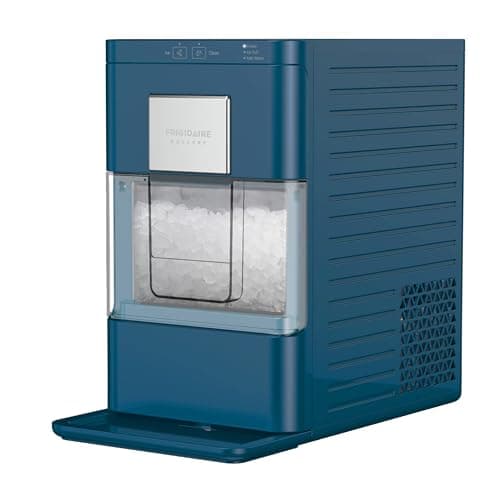 Frigidaire EFIC255 185 W published, the only real consumption figure in the category. | Best on electricity |
#ad We earn a commission on purchases made through this link. How this is funded. Prices last checked October 19, 2026.
There are two ways to rank nugget ice makers. One is to say you tested them. The other is to work from what the manufacturers publish and show your working. We do the second, because the first would not be true.
So this ranking is built on documents: owner's manuals, specification tables and manufacturer support pages, every one of them read on 2 September 2026 and linked from the value it produced. Where a manufacturer publishes nothing, the entry says Not published and stops there. That happens more than you would expect, and where it happens it is the single most useful thing on this page.
Every machine, every number, one table
Read this before the individual write-ups. Everything below is commentary on it.
| Machine | Rated output | Bin | Electrical | Max $/mo |
|---|---|---|---|---|
| GE Profile XPIO13SCSS | 38 lbs/day [src] | 3 lbs [src] | 3 A [src] | $7.78(nameplate) |
| Frigidaire EFIC255 | 44 lbs/day [src] | 3 lbs [src] | 185 W [src] | $4.00(published W) |
| NewAir NIM044BS00 | 44 lbs/day [src] | 3.3 lbs [src] | 2.7 A [src] | $6.71(nameplate) |
| NewAir NIM030SS00 | 30 lbs/day [src] | Not published | 170 W [src] | $3.67(published W) |
| GE Profile OPAL01 | 24 lbs/day [src] | 3 lbs [src] | 2.5 A [src] | $6.48(nameplate) |
The Euhomy, ecozy and KBice machines are not in that table because there is nothing to put in it. Their manuals carry no specification section. They still appear in the ranking below, because they are what a lot of people actually buy, but a row of five blanks would tell you less than a sentence does.
How this ranking was built
Four criteria, weighted in this order. They are the same four we use on every roundup, and they are set out in full on our method page.
- Documentation quality first. A machine whose maker publishes a full specification table is a machine you can make a decision about. One that publishes nothing is a gamble at any price.
- Then published output — pounds per day, and pounds per hour where a manufacturer prints it, which is almost nowhere.
- Then running cost, computed from the best electrical figure the manufacturer publishes and labeled with which kind of figure it was. See the running-cost method.
- Then practical fit — bin size, footprint, clearance, weight. The things that decide whether it works in your kitchen rather than in the abstract.
What is deliberately not in that list: noise, build quality, taste and reliability. We have not used these machines, so we have nothing honest to say about any of them, and repeating other people's impressions would just be laundering their claims through our page.
The 24-versus-38 pounds a day thing, resolved
If you have shopped for a nugget machine you have seen both figures attached to "the GE Opal", often on the same search results page, and you have probably concluded that somebody is lying. Nobody is. They are two different machines, and it took reading two manuals side by side to see it.
The same mix-up explains the wattage argument. People quote "300 W" for the Opal, and other people quote "360 W", and both camps are sure the other is wrong. 120 V times 2.5 A is 300 VA, which is the Opal 1.0. 120 V times 3.0 A is 360 VA, which is the Opal 2.0. Neither figure is a consumption measurement. Both are nameplate ceilings, and a nameplate is the maximum an appliance may draw, not what it draws while it runs.
The part every roundup leaves out
None of these machines refrigerates its ice bin. Not the Opal, not the Frigidaire, not the NewAirs, not the budget units. Ice drops into an unrefrigerated plastic bin, starts melting immediately, and the meltwater drains back to the reservoir where it gets frozen again.
The practical version: the machine is not a small freezer, it is a production line with a holding tray. Leave it on and the bin stays full because the machine keeps replacing what melted, not because anything is being kept cold. Turn it off and go to bed and you will find water in the morning.
That is worth knowing before you buy rather than after, which is why it has its own page: do countertop ice makers keep ice frozen.
What these actually cost to run
Every figure in the cost column of the table above uses the same arithmetic: watts, times four running hours a day, times thirty days, times the EIA's June 2026 US residential average of 18.34 cents per kWh, which we round to 18 cents and label as rounded.
Where the difference bites is which watts. Frigidaire prints 185 W in the EFIC255 manual and NewAir prints 170 W for the NIM030SS00. Those are consumption figures, so the resulting monthly cost is close to real. GE prints only a current rating, so its number is a ceiling derived from the nameplate and cannot be anything else. Comparing $4.00 against $7.78 is not comparing like with like, and the table says so in the column rather than hiding it in a footnote.
The full derivation, including how to plug in your own electricity rate and your own duty cycle, is on the running-cost page.
Who should buy what
If you want the machine everyone else has
Buy the Opal 2.0. It is the reference model, its documentation is the best in the category, replacement filters and GE's own descaling powder are everywhere, and every troubleshooting article on the internet is written about it. That last point is worth more than a spec sheet three years in.
If the electricity bill is the deciding factor
Buy the Frigidaire Gallery EFIC255. 185 W published, 44 lbs a day rated, and the narrowest full-size body here at ten inches. It is the only nugget machine you can buy new whose running cost is arithmetic on a consumption figure printed in its manual rather than a derived ceiling.
If you keep running out of ice
Buy the GoveeLife Smart Nugget Ice Maker Pro. Its product page lists a 3.5 lb basket and 60 lbs a day, the largest figures for any nugget machine in stock, plus a 4.9 liter side tank for fewer refills. Those figures come from GoveeLife's product page rather than a manual, and it is 21.3 inches deep, so measure first.
If the format matters more than the specs
Buy the KBice self-dispensing unit. Holding a glass under a chute instead of scooping from a bin is a real difference in daily use, and it is a bigger one than any number in the table if you have limited grip strength or you are filling tall tumblers. You are buying undocumented, and you should know that going in.
What we cannot tell you
Nobody in this category publishes a tested decibel rating. Not one of the manuals we read gives one. Other sites list dB figures for these machines; we are not going to repeat numbers whose origin we cannot check, so every noise field on this site reads Not published. That is a real gap and we would rather you knew it was a gap.
The same goes for warranty terms, which no specification table we read included, and for long-term reliability, which nobody can tell you honestly without years of units in the field.
One format is deliberately absent from this ranking. Machines that dispense ice through a chute rather than into a bin are a real alternative, but every one we could verify on sale publishes less than the machines above, so they are ranked separately on self-dispensing nugget ice makers.
The picks in full
1. Best on electricity
Frigidaire Gallery Countertop Nugget Ice Maker
The only nugget machine here whose maker publishes an actual power consumption instead of a nameplate ceiling, and it is a low one.
- Rated output
- 44 lbs/day
- Bin capacity
- 3 lbs
- Electrical
- 185 W published
- Ceiling at 4 hrs/day, $0.18/kWh
- $4.00/month (from published watts)
#ad We earn a commission on purchases made through this link. How this is funded. Prices last checked October 19, 2026.
185 W published means the running-cost figure for this machine is not a derived ceiling — it is arithmetic on a number Frigidaire printed. That is the strongest cost data on the site.
It is rated at 20 kg a day, which is 44 lbs — higher than the Opal 2.0's 38. Both numbers are measured under ideal conditions the manual does not describe.
Ten inches wide and 16.5 tall makes it the narrowest full-size nugget machine in this set.
Skip this if
You need a manufacturer-published bin capacity. Frigidaire's specification table omits it, so the 3 lb figure on this page comes from a retail listing rather than the manual.
Questions people actually ask
What is the best nugget ice maker?
On published specifications, the GE Profile Opal 2.0. Its owner's manual is the only one in this category that states both a daily rate (38 lbs) and an hourly rate (1.6 lbs), so you can work out when you will actually have a glass of ice rather than guessing. It is also the highest-rated current draw here at 3.0 A, so it is not the cheapest to run. If running cost matters more than documentation, three machines publish a real consumption figure: the Cowsar's product page prints 136 W, and the manuals for the Gevi V2.0 and the Frigidaire Gallery EFIC255 print 170 W and 185 W.
How much does a nugget ice maker cost to run per month?
Between about $2.94 and $7.80 a month at four running hours a day and 18 cents per kWh, depending on the machine. The lowest published figure belongs to the Cowsar at 136 W, about $2.94, though that comes from a product page rather than a manual; the Gevi V2.0 and the NewAir NIM030SS00 both publish 170 W in a manual, which works out to $3.67. The GE Profile Opal 2.0 has no published wattage, only a 3.0 A nameplate that at 120 V is 360 VA, giving a ceiling of $7.78. The second number is an upper bound, not a measurement, because a nameplate is the maximum the appliance may draw and not what it continuously uses.
Do nugget ice makers keep ice frozen?
No. On every countertop machine covered here the bin is unrefrigerated. Ice sits in it, melts, and the meltwater drains back into the reservoir to be frozen again. The machine keeps topping the bin up, so it looks like it is keeping ice frozen, but nothing in the bin is being kept cold. If you need ice to survive overnight, move it to your freezer.
How long does a nugget ice maker take to make ice?
GE publishes 1.6 lbs an hour for the Opal 2.0, which is the only per-hour figure any manufacturer in this set publishes. That works out to roughly 20 minutes for a large glass worth of ice from a cold start. No other machine here publishes an hourly rate, so for those the honest answer is that the manufacturer does not say.
Are cheap nugget ice makers worth buying?
They can be, but you are buying without information. Neither Euhomy nor ecozy nor KBice publishes a specification table for their nugget machines, so there is no rated output, no bin capacity and no electrical rating to compare against. If the price difference matters more to you than knowing what you are getting, that is a legitimate trade. If you want to check a number before you buy, buy from a maker that prints one.
Is the GE Opal 2.0 worth it over a budget machine?
It depends on whether documentation is worth money to you. The Opal 2.0 costs more and, by its own nameplate, draws more current than anything else here. What you get is the best-documented machine in the category, a manufacturer that publishes a service and cleaning procedure, and a rate figure specific enough to plan around. Those are real advantages, and they are also the only ones we can verify without owning the machine.
Sources
- GE Profile Opal 2.0 Owner's Manual 49-9000029 Rev. 6, p.17 (product specifications) (read 2026-09-02)
- FirstBuild Opal Use & Care manual, Ver. 2/13/2017, p.12 (product specifications) (read 2026-09-02)
- GE Appliances Opal support specification page (read 2026-09-02)
- Frigidaire EFIC255 Use & Care Manual, p.12 (product specifications) (read 2026-09-02)
- NewAir NIM044BS00 Owner's Manual, p.5 (specifications) (read 2026-09-02)
- NewAir NIM030SS00 Owner's Manual, p.5 (specifications) (read 2026-09-02)
- EIA Electric Power Monthly, Table 5.6.A, June 2026 (US residential average price) (read 2026-09-02)
Read next
- What a Nugget Ice Maker Costs to Run
Per-model monthly costs with the wattage sourced, the duty cycle stated and the arithmetic shown.
- Nugget Ice vs Bullet Ice
Two mechanisms, two products. What actually separates chewable ice from hollow cylinders.
- Frigidaire Gallery EFIC255 vs GE Profile Opal 2.0
185 W published versus a 360 VA nameplate. 44 lbs a day versus 38. A real contest.
- Do Countertop Ice Makers Keep Ice Frozen?
No. The bin is unrefrigerated and the meltwater recirculates. What to do instead.
- How to Clean a Nugget Ice Maker
A cross-brand cleaning procedure, and the cleaning-versus-descaling distinction nobody draws.
- Best Budget Nugget Ice Makers
The cheap end of the category, ranked by what their makers are willing to publish.
- Nugget Ice Makers for Small Kitchens
Published dimensions plus required clearance, worked out as the counter space each machine really takes.
- GE Profile Opal Mini (P4NM20 series)
2.0 A, a 2.6 lb bin, 8.59 inches wide, and no published ice rate at all.
- Smart Nugget Ice Makers
Which ice makers have WiFi, the four things the app really does, and whether it is worth the money.
- Which Ice Maker Brand Should You Buy?
Brands ranked on what they publish, who supports them, and what you can actually buy today.