Nugget Ice Makers
Smart Nugget Ice Makers
Two brands document WiFi in this category, and one of them makes most of the field. The useful question is not which machines connect, it is whether the four things the app actually does are worth what they add to the price.
Disclosure: we earn a commission if you buy through our links. It never affects which machines we recommend or how we rank them, and we take no sponsored placements. Read the full disclosure.
Quick picks
| # | Machine | Best for | Price |
|---|---|---|---|
| 1 | 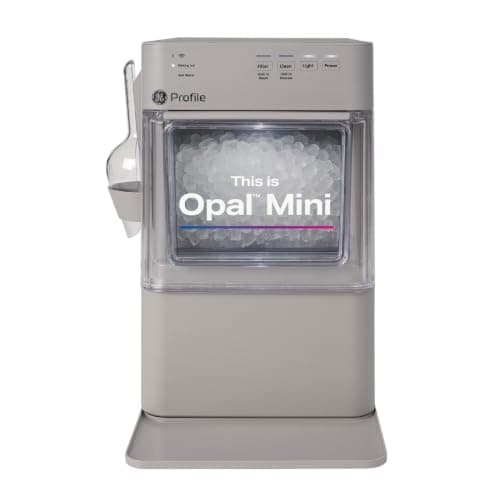 GE Profile P4NM20 series The full app feature set in the smallest, lowest-draw body GE makes. | Best connected machine overall | |
| 2 | 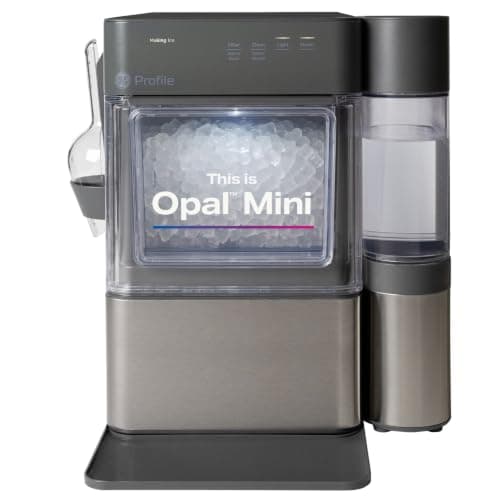 GE Profile P4NM series (Opal Mini Pro) Same app, same electrics, plus the side tank. | Connected, with fewer refills | |
| 3 | 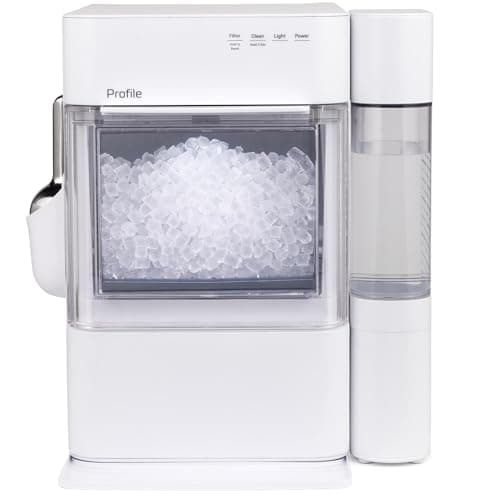 GE Profile XPIO43SCSS 3.0 lbs of storage and the only descaling interval printed in a manual. | Connected with the bigger bin | |
| 4 | 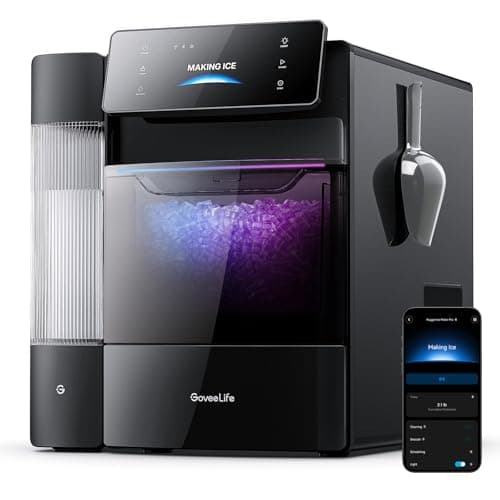 GoveeLife H8120 3.5 lbs and 60 lbs a day on GoveeLife's product page, plus Alexa and Google Home. | Connected, with the biggest basket |
#ad We earn a commission on purchases made through this link. How this is funded. Prices last checked October 19, 2026.
"Smart" is doing a lot of work on appliance boxes, so this page starts from what the manufacturer's own manual says the software does, and then asks whether any of it is worth money. Every machine ranked below is currently purchasable, and every figure comes from the manufacturer: a manual with a page number wherever we could read one, and a product page, labeled as such, where we could not.
How a machine earned a place here
- The connectivity is in the manufacturer's documentation, not in a retail bullet point. An app claimed only on a listing is not evidence.
- The manufacturer says what the app does. A WiFi logo is not a feature; filter tracking and descale alerts are.
- The machine is currently purchasable. Everything ranked below was verified on sale, new, when it was added: the GE machines on 13 September 2026 and the GoveeLife on 16 September.
- The machine is still good without the app. A connected appliance that is useless offline is a liability, not a feature. GE documents panel control for every cycle; GoveeLife does not say either way, which is one reason it ranks last.
One criterion deliberately absent: how well the app works. We have not used these machines and will not rate software we have not run. What follows is what GE and GoveeLife document, and what that documentation implies.
The connected field, on published figures
| Machine | Rated output | Bin | Electrical | Max $/mo |
|---|---|---|---|---|
| GE Profile P4NM20 series | Not published | 2.6 lbs [src] | 2 A [src] | $5.18(nameplate) |
| GE Profile P4NM series (Opal Mini Pro) | Not published | 2.6 lbs [src] | 2 A [src] | $5.18(nameplate) |
| GE Profile XPIO43SCSS | Not published | 3 lbs [src] | 3 A [src] | $7.78(nameplate) |
| GoveeLife H8120 | 60 lbs/day [src] | 3.5 lbs [src] | 210 W [src] | $4.54(published W) |
That table is the whole documented connected market in this category, and three of the four machines are GE's. GoveeLife is the only other maker that documents a connected nugget machine, and it does so on a product page rather than in a manual we could read. The reason the field is this thin is not mysterious: a radio, an app and a firmware pipeline are a real cost, and the budget end of this market competes on price.
The four things the app actually does
From the Opal Mini's control section, which is the most explicit GE has published:
- Filter tracking. The Filter light goes steady when the water filter needs replacing, and the app tracks it. On a machine whose scale problems start with mineral load, that is the preventive job people forget. Background on Opal water filters.
- Descale versus rinse alerting. The most useful one. The Clean light shows steady when the machine needs descaling and pulses slowly when it needs rinsing — two different jobs, distinguished for you. Most owners never learn the difference, which is why so much ice ends up tasting wrong.
- Ice scheduling. Tell it when you want ice and it makes a batch for then. Genuinely useful in a household with a predictable rhythm, irrelevant in one without.
- Bin lighting. On models with a lit bin, the app toggles brightness and color. This is decoration, and this page is not going to pretend otherwise.
Notice what is missing from that list. Nothing in it makes ice faster, holds more ice, or lowers the running cost. The app manages the machine; it does not improve it.
Whether it is worth the money
The honest answer depends entirely on what kind of owner you are, and the maintenance argument is the only one that holds up.
These machines recirculate standing water at room temperature. Left alone they scale up and grow biofilm, production slows, and the ice starts tasting like the inside of a machine. The fix is a schedule, and the single biggest reason people do not keep one is that nothing reminds them. A machine that distinguishes "descale me" from "rinse me" and pushes it to a phone is solving the actual failure mode of this entire product category.
If you would have kept that schedule anyway, you are paying for scheduling and a colored light. The maintenance reasoning is on descaling and mold and slime in a nugget ice maker.
GE Profile Opal Mini, the best connected buy
The Mini gets the full feature set in the smallest and lowest-draw body GE makes: 2.0 A at 120 V, a 2.6 lb bin, 8.59 by 15.59 by 14.56 inches and 27 lbs empty. It is also the machine whose manual documents the two-cycle cleaning behavior most clearly, with a 55-minute descale and a 3-minute rinse on the same button.
The honest cons: GE publishes no ice-making rate for it at all, so you are buying throughput on trust. The 2.6 lb bin is the smallest here. And it has a rear air filter GE says to check every two months, which is a maintenance job the other machines on this page do not have. Full detail on the Opal Mini review.
GE Profile Opal Mini Pro, if refilling is the problem
Mechanically the Mini with a side tank. Same 2.0 A, same 2.6 lb bin, same 4 inches of clearance, same app. The tank does not hold more ice, it lengthens the gap between trips to the sink — which is the thing that quietly decides whether a countertop ice maker stays in use.
The honest cons: GE publishes one specification table for the whole Mini range and never states what the side tank adds to the footprint, so there are no dimensions or weight for this variant on this site at all. You are buying a machine whose size is not published.
GE Profile Opal 2.0 Ultra, if the bin matters more
The full-size option. 3.0 lbs of bin against the Mini's 2.6, a side tank in the box, and the only manual in this entire category that states a descaling interval — every 4 weeks, depending on water hardness. For a household that empties the bin in one go, that extra glass and the bigger tank are the practical difference.
The honest cons: 3.0 A against the Mini's 2.0, so roughly $7.78 a month at the ceiling against $5.18. GE publishes no dimensions for it in the manual we read, so you cannot measure a counter against it. And no ice rate either. The head-to-head is on Opal Mini versus Opal 2.0 Ultra.
GoveeLife Smart Nugget Ice Maker Pro, for volume and voice
The only connected machine here from outside GE, and the biggest on paper: a 3.5 lb basket, 60 lbs a day, a 2.2 liter tank plus a 4.9 liter side tank, and control through GoveeLife's app, Alexa or Google Home. GoveeLife describes the app as handling timed ice-making, an ice production history, and cleaning and descaling reminders counted in hours of ice-making rather than in weeks.
The honest cons: every one of those figures comes from GoveeLife's product page rather than a manual we could read, so it ranks below three GE machines documented to a higher standard. The page does not say which functions work without the app. It is 21.3 inches deep and about 42 lbs, the deepest and widest machine on this site, and it publishes no current rating or clearance. Full detail on the GoveeLife review.
What the rest of the category does instead
It is worth being clear that non-connected is not a downgrade, because the alternative to an app is a light on a panel, and that works.
- Frigidaire. Neither the EFIC255 nor the EFIC235 publishes any connectivity. The EFIC255 does have a CLEAN button with a cycle of at least 20 minutes, so the maintenance is available, it is just not going to remind you.
- Silonn. The SLIM21 panel is four indicators and two buttons, with a 30-minute self-clean on a five-second hold and a manufacturer recommendation to run it weekly. That written interval does the same job an alert does, for a fraction of the price.
- The budget brands. Several advertise app control on individual models. None of them publishes documentation to check it against, which is the same problem their specification tables have and is covered on the budget nugget roundup.
The questions to ask before paying for it
Connectivity is the one feature in this category you cannot evaluate from a specification table, so these are the questions worth answering before the premium looks reasonable.
- Does the machine live somewhere with signal? A garage, a basement bar or a camper is exactly where an ice maker often ends up and exactly where household WiFi often stops. A connected machine out of range is an unconnected machine you paid extra for.
- Will you actually install the app? The alerting only works if the app is on a phone that gets looked at. If the machine is for a shared kitchen or an office, decide whose phone before you buy, because in practice the answer is often nobody.
- What happens when the app goes away? Appliance apps get discontinued. The reassuring answer for the GE machines is that every control runs from the panel, so the worst case is losing the reminders rather than losing the machine. GoveeLife's product page does not say, and that is worth confirming for any connected appliance.
- Would a written interval do the same job? Silonn prints "once per week" in its manual and charges nothing for it. A calendar reminder is free. If you will keep one, the alerting is a convenience rather than a saving.
None of that is an argument against connectivity. It is an argument for buying it deliberately, because the feature only pays back through behavior — yours.
What a good panel does without a radio
It is easy to read this page as connected-versus-primitive, and that is not the comparison. The unconnected machines here are not silent about maintenance; they simply put the information on the front of the machine instead of on a phone.
The Silonn SLIM21 panel carries a POWER light, an ADD WATER light that turns red when the reservoir is low, an ICE FULL light for when the basket is full, and S and L indicators for ice size — with the clean cycle on a five-second hold of the same ON/OFF button. Frigidaire's EFIC255 has a CLEAN button running a cycle of at least twenty minutes. Both tell you what you need to know while you are standing there.
What the panel cannot do is reach you when you are not in the room, which is the entire value of the app and also its entire limit.
Choosing, in three steps
- Decide whether you will keep a maintenance schedule without being told. If yes, buy on bin, size and price and ignore the radio entirely.
- If no, the alerting is the feature to buy, and it is the only one of the four that changes how long the machine lasts.
- Then choose the body. Small and cheap to run is the Mini; more capacity and a stated descale interval is the Ultra.
The picks in full
1. Best connected machine overall
GE Profile Opal Mini Nugget Ice Maker
The smallest and lowest-draw Opal GE has built, and the first one whose specification table omits the ice rate entirely.
- Rated output
- Not published
- Bin capacity
- 2.6 lbs
- Electrical
- 2 A at 120 V (240 VA nameplate)
- Ceiling at 4 hrs/day, $0.18/kWh
- $5.18/month (from the nameplate ceiling)
#ad We earn a commission on purchases made through this link. How this is funded. Prices last checked October 19, 2026.
2.0 A at 120 V is a 240 VA nameplate, against 360 VA for both full-size Opal 2.0 models. On the site's standard four-hours-a-day scenario that is roughly $5.18 a month as a ceiling rather than $7.78.
The 2.6 lb bin is smaller than the 3.0 lbs every full-size machine here publishes, which is about one tall glass less before the machine has to catch up.
GE's own specification table carries no ice-making rate for the Mini, exactly as it carries none for the Opal 2.0 Ultra. The 36 lbs a day in GE's press release and on the retail listing is a claim, not a published specification, and this site does not promote it to one.
Skip this if
You want a published ice-making rate. GE's specification table for the Mini prints no rate at all, so the 36 lbs a day on the box is a marketing figure with no spec-sheet backing.
2. Connected, with fewer refills
GE Profile Opal Mini Pro Nugget Ice Maker
The Opal Mini with a side tank bolted to it, sharing one specification table with the rest of the Mini range and adding the refill capacity the Mini lacks.
- Rated output
- Not published
- Bin capacity
- 2.6 lbs
- Electrical
- 2 A at 120 V (240 VA nameplate)
- Ceiling at 4 hrs/day, $0.18/kWh
- $5.18/month (from the nameplate ceiling)
#ad We earn a commission on purchases made through this link. How this is funded. Prices last checked October 19, 2026.
GE's specification table names the P4NM20, P4NM25 and P4NM27 series together, so the electrical rating, bin, clearance and operating range on this page are GE's figures for the range the Pro belongs to.
Dimensions and empty weight are deliberately absent. The one set GE prints is for the machine without a side tank, and a side tank plainly changes both, so carrying those figures across would be an assumption dressed as a specification.
The side tank is the entire reason this variant exists. It does not make the bin bigger — that is still 2.6 lbs — it makes the gap between refills longer.
Skip this if
You want its footprint in writing. GE publishes one specification table for the whole Mini range and never states what the side tank adds to the depth, so this page carries no dimensions or weight at all.
3. Connected with the bigger bin
GE Profile Opal 2.0 Ultra Nugget Ice Maker
Mechanically the 2.0 with a bigger tank and a wider clearance requirement, and GE does not publish a production rate for it in the manual we could read.
- Rated output
- Not published
- Bin capacity
- 3 lbs
- Electrical
- 3 A at 120 V (360 VA nameplate)
- Ceiling at 4 hrs/day, $0.18/kWh
- $7.78/month (from the nameplate ceiling)
#ad We earn a commission on purchases made through this link. How this is funded. Prices last checked October 19, 2026.
Same 3.0 A rating and same 37.6 lb empty weight as the standard 2.0, so the electricity math is identical.
It wants 4 inches of clearance rather than 3. If you are fitting this under a cabinet run, that inch is the difference between working and not.
We could not read an ice-making rate on the Ultra's specification page and are not going to substitute the 2.0's 38 lbs a day for it. That field says Not published, and it means it.
Skip this if
You need a published ice rate before you buy. The Ultra's owner's manual specification table did not print a legible ice-making rate in the copy we read, and we will not carry over the standard 2.0's number.
4. Connected, with the biggest basket
GoveeLife Smart Nugget Ice Maker Pro
The biggest published basket and daily figure of any nugget machine you can buy, and the only connected machine here from outside GE, documented on a product page rather than in a manual.
- Rated output
- 60 lbs/day
- Bin capacity
- 3.5 lbs
- Electrical
- 210 W published
- Ceiling at 4 hrs/day, $0.18/kWh
- $4.54/month (from published watts)
#ad We earn a commission on purchases made through this link. How this is funded. Prices last checked October 19, 2026.
GoveeLife's owner's manual exists but could not be retrieved for this page, so every value is from the maker's own product page and carries that lower source tier. Anything the page does not print, including refrigerant, clearance and an operating temperature range, reads Not published.
The product page describes two cleaning modes, a 10-minute quick clean and a 30-minute deep descale, with an app reminder after every 100 hours of ice-making. That is a usage-based interval rather than a calendar one.
GoveeLife advertises an average noise level 'as low as 40 dB' in its description copy with no test standard or measuring distance, so, as with Silonn's '35db', it is not recorded as a specification and the noise field reads Not published.
Skip this if
You want every specification backed by an owner's manual, or a machine that fits a normal counter. Every figure here is from GoveeLife's product page, and it is 21.3 inches deep and 42 lbs.
Questions people actually ask
Which nugget ice makers have WiFi?
GE's Opal line, and the GoveeLife Smart Nugget Ice Maker Pro, whose product page lists app, Alexa and Google Home control over 2.4 GHz Wi-Fi plus Bluetooth. The Opal Mini's owner's manual describes a WIFI indicator light and an app that handles product registration, updates, alerts, ice scheduling, product accessories and more. Frigidaire publishes no connectivity for the EFIC255 or EFIC235, and Silonn's SLIM21 has a four-light panel with no radio at all. Some budget brands advertise app control on individual models, but none of them publishes documentation we could verify it against.
What does the GE Opal app actually do?
Four things worth naming, from GE's own manual: it tracks the water filter and tells you when to replace it, it tells you when the machine needs descaling as opposed to rinsing, it lets you schedule ice so a batch is ready when you want it, and on models with a lit bin it controls the light color and brightness. It also handles registration and firmware updates. What it does not do is make ice faster or hold more of it.
Is WiFi on an ice maker worth it?
It is worth most to people who forget maintenance. The genuinely useful part is the alerting: these machines need descaling on a schedule, and a machine that tells you which job is due removes the single most common reason countertop ice makers start tasting wrong. If you are the kind of owner who descales on a calendar anyway, the app is a convenience rather than a reason to spend.
Does an ice maker need WiFi to work?
Not the GE machines. Every connected Opal here works exactly the same without ever joining a network — the controls are all on the panel and the cycles all run from buttons. The app is an addition, not a dependency, which also means a machine whose app is one day discontinued is still a working ice maker. GoveeLife's product page does not say which functions work without the app, so check that before buying its machine.
Do smart ice makers cost more to run?
Not meaningfully. The radio is a trivial load next to a compressor, and the published nameplates tell the story: the connected Opal Mini is rated 2.0 A, lower than any non-connected full-size machine on this site. Connectivity and running cost are unrelated in this category.
Sources
- GE Profile Opal Mini Owner's Manual 49-9000083 Rev. 0, p.10 (Ice Maker Controls) (read 2026-09-13)
- GE Profile Opal Mini Owner's Manual 49-9000083 Rev. 0, p.15 (specifications) (read 2026-09-13)
- GE Profile Opal 2.0 Ultra Owner's Manual 49-9000058 Rev. 6, p.16 (read 2026-09-02)
- Frigidaire EFIC255 Use & Care Manual, p.12 (product specifications) (read 2026-09-02)
- GoveeLife product page, Smart Nugget Ice Maker Pro (model H8120): Specs table and product description (read 2026-09-16)
- EIA Electric Power Monthly, Table 5.6.A, June 2026 (read 2026-09-02)
Read next
- GE Profile Opal Mini (P4NM20 series)
2.0 A, a 2.6 lb bin, 8.59 inches wide, and no published ice rate at all.
- GoveeLife Smart Nugget Ice Maker Pro (H8120)
60 lbs a day, a 3.5 lb basket and 210 W, all from GoveeLife's product page.
- GE Profile Opal Mini vs Opal 2.0 Ultra
2.0 A against 3.0 A, 2.6 lbs of bin against 3.0, and one published footprint between them.
- The Best Nugget Ice Makers
Six machines ranked on published specs, each with a sourced monthly running-cost ceiling.
- The Best Self-Cleaning Countertop Ice Makers
Which countertop ice makers have a real clean cycle, what it does, and which have no clean button at all.
- Water Filters for Nugget Ice Makers
What a filter actually does, when it earns its place, and when it is a purchase without a job.
- How to Descale a Nugget Ice Maker
Different chemistry from cleaning, and usually the fix for a machine making ice slowly.