Compare
GE Profile Opal Mini vs Opal 2.0 Ultra
The two ends of the Opal range, and the choice most people land on once they have decided they want GE's nugget ice. One is a third cheaper to run; the other holds more of everything.

Disclosure: we earn a commission if you buy through our links. It never affects which machines we recommend or how we rank them, and we take no sponsored placements. Read the full disclosure.
Quick picks
| # | Machine | Best for | Price |
|---|---|---|---|
| 1 | 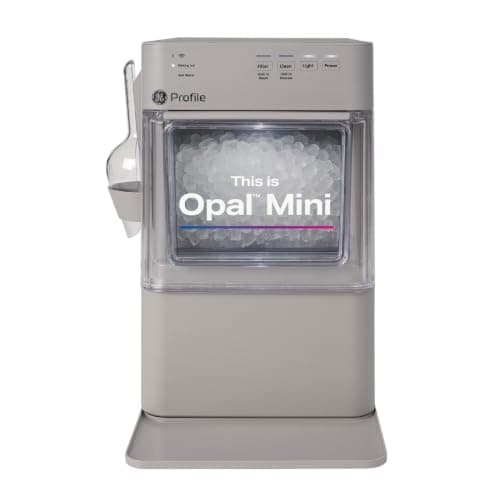 GE Profile P4NM20 series A third less nameplate, a smaller body, and it clears a cabinet gap. | Best for most kitchens | |
| 2 | 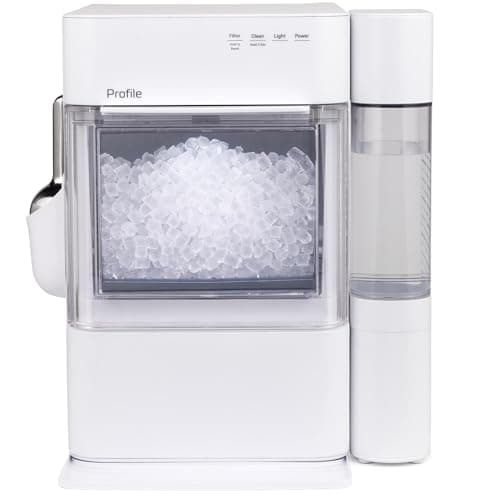 GE Profile XPIO43SCSS A bigger bin, a side tank and the only descaling interval GE states. | Best for a busy household |
#ad We earn a commission on purchases made through this link. How this is funded. Prices last checked October 19, 2026.
GE now sells Opals at both ends of a range that used to have one machine in the middle of it. This is the comparison that decision actually reduces to, and it is unusually clean: the two machines share a brand, an ice type, a clearance requirement and a documentation style, so what is left is size, capacity and current.
Both specification tables
| Spec | GE Profile P4NM20 series | GE Profile XPIO43SCSS |
|---|---|---|
| Model | P4NM20 series | XPIO43SCSS |
| Ice type | Nugget | Nugget |
| Rated output | Not published | Not published |
| Rated output per hour | Not published | Not published |
| Bin capacity | 2.6 lbs [src] | 3 lbs [src] |
| Published power | Not published | Not published |
| Nameplate current | 2 A [src] | 3 A [src] |
| Voltage | 120 V [src] | 120 V [src] |
| Dimensions (W x D x H) | 8.59" W x 15.59" D x 14.56" H [src] | Not published |
| Weight, empty | 27 lbs [src] | 37.6 lbs [src] |
| Clearance required | 4" [src] | 4" [src] |
| Operating range | 55F to 90F [src] | Not published |
| Refrigerant | Not published | Not published |
| Noise | Not published | Not published |
| Warranty | Not published | Not published |
| Max $/mo | $5.18(nameplate) | $7.78(nameplate) |
The one difference that shows up on a bill
The Mini is rated 2.0 A at 120V AC; the Ultra is 3.0 A. In nameplate terms that is 240 VA against 360 VA, and at four running hours a day and 18 cents per kWh it is roughly $5.18 a month against $7.78.
Two and a half dollars a month is not a purchasing argument on its own — it is about the price of one bag of ice a year. Where it does matter is off-grid: a third less nameplate is a third less inverter, and the Mini is the only Opal that starts to look reasonable behind a battery. The full arithmetic, with your own rate, is on the running-cost page.
Neither one tells you how fast it is
This is the frustrating part of comparing modern Opals, and it is the same on both sides. GE's specification table for the Ultra carries no legible ice-making rate, and the Mini's table omits the rate entirely.
The marketing figures are 36 lbs a day for the Mini and 38 for the Ultra, and it would be easy to present that as a two-pound difference. It is not a difference between specifications, it is a difference between two press releases, and this site will not rank machines on that. If a published rate is what you want before you spend, the only Opal that has one is the standard 2.0, whose manual prints 38 lbs per day and 1.6 lbs per hour.
Bin and tank: the Ultra's real advantage
- Bin. 3.0 lbs on the Ultra, 2.6 on the Mini. A tall glass is roughly half a pound, so that is one extra glass before the machine has to catch up.
- Side tank. The Ultra ships with one; the plain Mini does not. That does not change how much finished ice the machine holds, it changes how often somebody has to carry water to it — which in practice is the thing that decides whether a machine keeps getting used.
- If refills are the issue but size is too, GE sells the Mini Pro, which is the Mini with a side tank. It is covered on the Opal Mini review.
Size, and the clearance surprise
The Mini publishes 8.59 inches wide by 15.59 deep by 14.56 tall, and 27 lbs empty. The Ultra publishes a 37.6 lb empty weight and no dimensions at all in the manual we read, which means you cannot measure a counter against it from GE's own documentation.
So on footprint this is not a close comparison, it is a comparison where only one side shows its working. What can be said with confidence: the Mini is over ten pounds lighter and 14.56 inches tall, which clears a standard 18-inch counter-to-cabinet gap with room to open the lid. Very little else in this category does.
The surprise is the air gap. Both machines require 4 inches of clearance at the sides and back. The Mini is dramatically smaller and needs exactly as much room around it, so on a tight run of counter the advantage is narrower than the dimensions imply. Fitting numbers across the field are on nugget ice makers for small kitchens.
Maintenance: a wash, with one asterisk
Both machines carry GE's Clean button and both distinguish a descale from a rinse. The Ultra's manual is the only document in the whole category that states an interval — descale every 4 weeks, depending on water hardness — and the Mini's is the most specific about duration, with a 55-minute descale cycle and a 3-minute rinse.
The asterisk is the Mini's rear air filter, which GE says should be checked and cleaned at least every two months. The Ultra has no equivalent. It is a small recurring job, and it is the one ownership cost the Mini adds rather than removes. Cross-category comparison on the self-cleaning roundup.
Which one to buy
- Buy the Mini if one or two people drink the ice, if the machine has to live under a cabinet, or if you want the lowest-draw Opal there is. It is the better default.
- Buy the Ultra if the bin emptying matters more than the counter space, if you want the side tank in the box, or if you want the one GE manual that commits to a maintenance schedule.
- Buy neither yet if a published ice rate is what you are actually shopping on. Neither of these publishes one.
If you are comparing trims rather than sizes, the other GE matchup is Opal 2.0 against Opal 2.0 Ultra.
The picks in full
1. Best for most kitchens
GE Profile Opal Mini Nugget Ice Maker
The smallest and lowest-draw Opal GE has built, and the first one whose specification table omits the ice rate entirely.
- Rated output
- Not published
- Bin capacity
- 2.6 lbs
- Electrical
- 2 A at 120 V (240 VA nameplate)
- Ceiling at 4 hrs/day, $0.18/kWh
- $5.18/month (from the nameplate ceiling)
#ad We earn a commission on purchases made through this link. How this is funded. Prices last checked October 19, 2026.
2.0 A at 120 V is a 240 VA nameplate, against 360 VA for both full-size Opal 2.0 models. On the site's standard four-hours-a-day scenario that is roughly $5.18 a month as a ceiling rather than $7.78.
The 2.6 lb bin is smaller than the 3.0 lbs every full-size machine here publishes, which is about one tall glass less before the machine has to catch up.
GE's own specification table carries no ice-making rate for the Mini, exactly as it carries none for the Opal 2.0 Ultra. The 36 lbs a day in GE's press release and on the retail listing is a claim, not a published specification, and this site does not promote it to one.
Skip this if
You want a published ice-making rate. GE's specification table for the Mini prints no rate at all, so the 36 lbs a day on the box is a marketing figure with no spec-sheet backing.
2. Best for a busy household
GE Profile Opal 2.0 Ultra Nugget Ice Maker
Mechanically the 2.0 with a bigger tank and a wider clearance requirement, and GE does not publish a production rate for it in the manual we could read.
- Rated output
- Not published
- Bin capacity
- 3 lbs
- Electrical
- 3 A at 120 V (360 VA nameplate)
- Ceiling at 4 hrs/day, $0.18/kWh
- $7.78/month (from the nameplate ceiling)
#ad We earn a commission on purchases made through this link. How this is funded. Prices last checked October 19, 2026.
Same 3.0 A rating and same 37.6 lb empty weight as the standard 2.0, so the electricity math is identical.
It wants 4 inches of clearance rather than 3. If you are fitting this under a cabinet run, that inch is the difference between working and not.
We could not read an ice-making rate on the Ultra's specification page and are not going to substitute the 2.0's 38 lbs a day for it. That field says Not published, and it means it.
Skip this if
You need a published ice rate before you buy. The Ultra's owner's manual specification table did not print a legible ice-making rate in the copy we read, and we will not carry over the standard 2.0's number.
Questions people actually ask
Is the Opal Mini or the Opal 2.0 Ultra better?
They solve different problems. The Mini is smaller, lighter and rated at 2.0 A against the Ultra's 3.0 A, so it costs roughly a third less to run at its ceiling. The Ultra holds 3.0 lbs of ice against the Mini's 2.6, comes with a side tank for fewer refills, and is the only machine in the Opal range whose manual states a descaling interval. If one or two people are drinking the ice, the Mini is the better buy; for a household that empties the bin at once, the Ultra is.
Does the Opal Mini make less ice than the Ultra?
Nobody can answer that from published data, which is the honest state of it. GE publishes no ice-making rate in the specification table of either machine. The Mini's box says 36 lbs a day and the Ultra's listing says 38, but neither figure appears in a manual specification table, so this site records both as Not published rather than ranking two marketing numbers against each other.
Which Opal is cheaper to run?
The Mini. It is rated 2.0 A at 120 V, a 240 VA nameplate, where the Ultra is 3.0 A and 360 VA. At four running hours a day and 18 cents per kWh that is about $5.18 a month against $7.78 — a difference of roughly $2.60. Both figures are nameplate ceilings rather than measured consumption, because GE publishes no wattage for any Opal.
Do the Opal Mini and Opal 2.0 Ultra need the same clearance?
Yes, four inches at the sides and back, per both manuals. That is the surprise of this comparison: the much smaller machine wants exactly as much air around it as the big one, so the Mini's footprint advantage on a tight counter is smaller than its dimensions suggest.
Sources
- GE Profile Opal Mini Owner's Manual 49-9000083 Rev. 0, p.15 (read 2026-09-13)
- GE Profile Opal 2.0 Ultra Owner's Manual 49-9000058 Rev. 6, p.16 (read 2026-09-02)
- GE Profile Opal 2.0 Owner's Manual 49-9000029 Rev. 6, p.17 (read 2026-09-02)
- EIA Electric Power Monthly, Table 5.6.A, June 2026 (read 2026-09-02)
Read next
- GE Profile Opal Mini (P4NM20 series)
2.0 A, a 2.6 lb bin, 8.59 inches wide, and no published ice rate at all.
- GE Profile Opal 2.0 Ultra (XPIO43SCSS)
The 2.0 with a bigger tank and an extra inch of clearance. No published ice rate.
- GE Profile Opal 2.0 vs Opal 2.0 Ultra
Identical on current, weight and bin. The Ultra wants 4 inches of clearance and publishes no ice rate.
- Smart Nugget Ice Makers
Which ice makers have WiFi, the four things the app really does, and whether it is worth the money.
- The Best Nugget Ice Makers
Six machines ranked on published specs, each with a sourced monthly running-cost ceiling.
- Nugget Ice Makers for Small Kitchens
Published dimensions plus required clearance, worked out as the counter space each machine really takes.
- GE Profile Opal Mini vs Frigidaire Gallery EFIC255
Frigidaire publishes the rate and the watts. GE publishes the clearance and the temperature range. Neither publishes both.