Reviews
GE Profile Opal Mini (P4NM20 series)
The smallest and cheapest-to-run Opal GE has built. It is also the first one whose specification table leaves the ice rate out entirely, which makes the number on the box a claim rather than a spec.
Disclosure: we earn a commission if you buy through our links. It never affects which machines we recommend or how we rank them, and we take no sponsored placements. Read the full disclosure.
Quick picks
| # | Machine | Best for | Price |
|---|---|---|---|
| 1 | 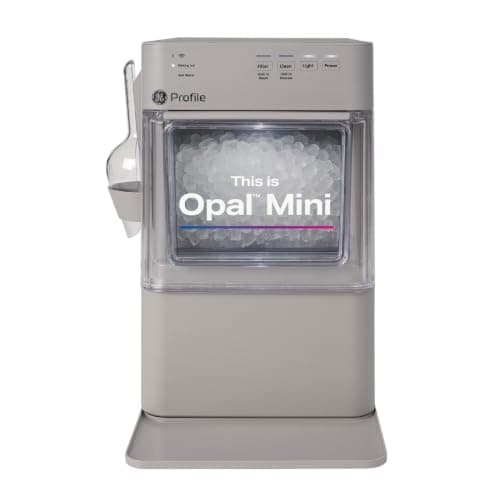 GE Profile P4NM20 series The smallest Opal, the lowest draw of any Opal, and a full published specification table. | The one to buy | |
| 2 | 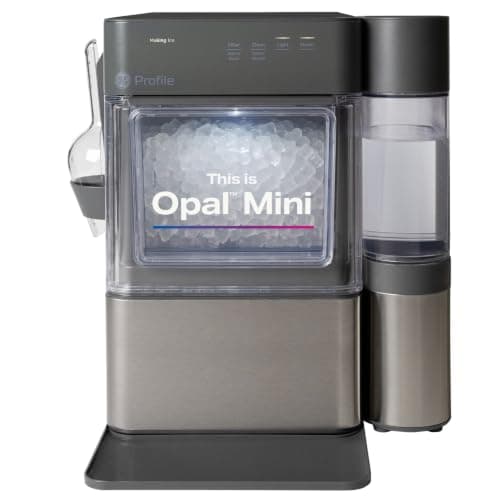 GE Profile P4NM series (Opal Mini Pro) The same machine with a side tank, for a longer gap between fills. | If refilling annoys you |
#ad We earn a commission on purchases made through this link. How this is funded. Prices last checked October 18, 2026.
What GE publishes
| Spec | GE Profile P4NM20 series |
|---|---|
| Model | P4NM20 series |
| Ice type | Nugget |
| Rated output | Not published |
| Rated output per hour | Not published |
| Bin capacity | 2.6 lbs [src] |
| Published power | Not published |
| Nameplate current | 2 A [src] |
| Voltage | 120 V [src] |
| Dimensions (W x D x H) | 8.59" W x 15.59" D x 14.56" H [src] |
| Weight, empty | 27 lbs [src] |
| Clearance required | 4" [src] |
| Operating range | 55F to 90F [src] |
| Refrigerant | Not published |
| Noise | Not published |
| Warranty | Not published |
| Max $/mo | $5.18(nameplate) |
The number GE did not print
Every box, every listing and GE's own press release says the Opal Mini produces 36 lbs. of nugget ice per day. The specification table in the owner's manual says nothing at all about the rate. There is no daily figure and no hourly figure, in a table that otherwise runs to voltage, current, bin, dimensions, clearance, operating environment and empty weight.
That matters because of what the full-size machine does. The Opal 2.0's manual prints 38 lbs per day and 1.6 lbs per hour in exactly that table, and it is the only rate in this entire category that comes from a specification rather than a marketing department. On the Mini, GE dropped it.
2.0 A, and why that is the headline
The manual rates the Mini at 120V AC/60Hz and 2.0 A. At 120 V that is a 240 VA nameplate, against 360 VA for both full-size Opal 2.0 models — a third less.
On this site's standard scenario of four running hours a day at 18 cents per kWh, that is about $5.18 a month as a ceiling, where the Opal 2.0 is $7.78. As always with GE, this is a nameplate rather than a published consumption, so it is an upper bound the machine does not continuously draw. The arithmetic is on the running-cost page.
It also makes the Mini the most plausible Opal to put behind an inverter, which is the one place a third less nameplate genuinely changes a decision rather than a bill.
The 2.6 lb bin
Bin capacity is the number that actually limits a countertop ice maker at home, and the Mini gives up some. GE publishes 2.6 lbs of ice storage against the 3.0 lbs every full-size Opal publishes.
A tall glass of nugget ice is roughly half a pound, so 2.6 lbs is about five glasses and 3.0 lbs is about six. One glass, in other words. For one or two people that is invisible; for a household that empties the bin at once it is the difference between everyone being served and someone waiting. The sizing arithmetic is on how much ice you actually need.
Worth noting against the retail listing: the Amazon page describes a "2 lb Bin" where the manual says 2.6 lbs. The manual is the higher-tier source and is what this page carries.
Small machine, big air gap
At 8.59 inches wide, 15.59 deep and 14.56 tall and 27 lbs empty, this is the smallest and lightest Opal GE has built. Two numbers there are genuinely useful.
- 14.56 inches tall. A standard counter-to-cabinet gap is about 18 inches, and almost every nugget machine is 16.5 to 17 inches tall — they fit, but you cannot open the lid where they stand. The Mini can.
- 27 lbs empty. Against 37.6 lbs for both full-size Opal 2.0 models. That is the difference between a machine you shuffle and one you carry.
- But 4 inches of clearance. The Mini wants the same air gap as the Opal 2.0 Ultra and one inch more than the standard 2.0. A smaller machine that demands more room around it is a genuinely counterintuitive result, and on a tight counter it eats much of what the smaller body gives back.
Fitting numbers across the nugget field are on nugget ice makers for small kitchens.
55F to 90F, in writing
The Mini's table publishes an operating environment of 55F to 90F. That is worth calling out because hardly anyone in this category publishes one — the Mini is one of only four machines on this site to do it, alongside the first-generation Opal, the Silonn SLIM21 and the Gevi V2.0, and GE publishes no range at all for the current full-size Opal 2.0.
If the machine is going anywhere other than a kitchen — a garage, a porch, a camper — this is the line that decides it, and the wider question is covered on what temperature an ice maker needs.
Two cycles, and one of them takes 55 minutes
The Mini's care section is the most specific in the Opal range. It documents two distinct cycles on the same Clean button, with two distinct light behaviors telling you which one is due.
- Descale, 55 minutes. Hold Clean for three seconds. GE's procedure asks for one sachet of its citric descaler in a full internal reservoir of hot water. The Clean light shows a steady glow when a descale is due.
- Rinse, 3 minutes. Tap Clean rather than holding it. GE recommends three rinses in total after a descale, draining and refilling between them. The Clean light pulses slowly when a rinse is what is needed.
A machine that distinguishes between "needs descaling" and "needs rinsing" with two different light behaviors is doing something no other machine on this site does, and the distinction is exactly the one most owners get wrong. How the cycles compare across the category is on the self-cleaning roundup, and the chemistry is on descaling.
The part nothing else here has
The Mini has a rear air filter, and GE says it should be checked and cleaned at least every 2 months, with a caution not to run the machine without it because dirt and lint can clog the condenser and reduce performance.
No other machine documented on this site has one. It is a small, genuine ownership cost — a recurring two-monthly job nobody buying on price will have factored in — and it is also a sensible piece of engineering on a machine that wants four inches of clearance to reject its heat.
Mini, Mini Pro, and which one
GE sells the Mini in two shapes that matter here. The plain Mini is a top-fill reservoir machine. The Mini Pro adds a side water tank, and that is the whole difference: it does not make the bin bigger, it makes the gap between refills longer.
GE publishes one specification table covering the P4NM20, P4NM25 and P4NM27 series together, so the electrical rating, the bin, the clearance and the operating range are shared. What GE never states is what the side tank adds to the footprint, which is why this site carries no dimensions or weight for the Pro at all rather than reusing the Mini's.
Buy the Pro if carrying water to the machine is the thing that will stop you using it. Buy the Mini if counter space is tighter than your patience.
Who should buy this
- Buy it if you want nugget ice from the brand with the best documentation and the smallest body it comes in, and one or two people are drinking it.
- Buy it if the machine has to fit under a cabinet and still open. At 14.56 inches tall it is one of the few that genuinely does.
- Buy it if running cost or an inverter is in the picture. 240 VA is the lowest nameplate of any Opal.
- Skip it if you want a published ice rate before you spend. GE prints one for the full-size 2.0 and not for this, and that is a real difference in what you can know.
- Skip it if your counter is tight at the back. Four inches of clearance on an 8.59 inch machine is a lot of the advantage handed back.
- Skip it if you serve a crowd. 2.6 lbs is about five glasses before the machine has to catch up, and the wider field is on the nugget roundup.
The picks in full
1. The one to buy
GE Profile Opal Mini Nugget Ice Maker
The smallest and lowest-draw Opal GE has built, and the first one whose specification table omits the ice rate entirely.
- Rated output
- Not published
- Bin capacity
- 2.6 lbs
- Electrical
- 2 A at 120 V (240 VA nameplate)
- Ceiling at 4 hrs/day, $0.18/kWh
- $5.18/month (from the nameplate ceiling)
#ad We earn a commission on purchases made through this link. How this is funded. Prices last checked October 18, 2026.
2.0 A at 120 V is a 240 VA nameplate, against 360 VA for both full-size Opal 2.0 models. On the site's standard four-hours-a-day scenario that is roughly $5.18 a month as a ceiling rather than $7.78.
The 2.6 lb bin is smaller than the 3.0 lbs every full-size machine here publishes, which is about one tall glass less before the machine has to catch up.
GE's own specification table carries no ice-making rate for the Mini, exactly as it carries none for the Opal 2.0 Ultra. The 36 lbs a day in GE's press release and on the retail listing is a claim, not a published specification, and this site does not promote it to one.
Skip this if
You want a published ice-making rate. GE's specification table for the Mini prints no rate at all, so the 36 lbs a day on the box is a marketing figure with no spec-sheet backing.
2. If refilling annoys you
GE Profile Opal Mini Pro Nugget Ice Maker
The Opal Mini with a side tank bolted to it, sharing one specification table with the rest of the Mini range and adding the refill capacity the Mini lacks.
- Rated output
- Not published
- Bin capacity
- 2.6 lbs
- Electrical
- 2 A at 120 V (240 VA nameplate)
- Ceiling at 4 hrs/day, $0.18/kWh
- $5.18/month (from the nameplate ceiling)
#ad We earn a commission on purchases made through this link. How this is funded. Prices last checked October 18, 2026.
GE's specification table names the P4NM20, P4NM25 and P4NM27 series together, so the electrical rating, bin, clearance and operating range on this page are GE's figures for the range the Pro belongs to.
Dimensions and empty weight are deliberately absent. The one set GE prints is for the machine without a side tank, and a side tank plainly changes both, so carrying those figures across would be an assumption dressed as a specification.
The side tank is the entire reason this variant exists. It does not make the bin bigger — that is still 2.6 lbs — it makes the gap between refills longer.
Skip this if
You want its footprint in writing. GE publishes one specification table for the whole Mini range and never states what the side tank adds to the depth, so this page carries no dimensions or weight at all.
Questions people actually ask
How much ice does the GE Profile Opal Mini make?
GE does not publish a rate in the Mini's specification table. The 36 lbs a day you will see on the box, on the retail listing and in GE's own press release is a marketing figure with no spec-sheet backing, and GE's manual adds its own caveat that the actual quantity of ice produced will vary with environmental conditions. The full-size Opal 2.0 does publish a rate, 38 lbs per day and 1.6 lbs per hour, which is the only rate in the Opal range that comes from a specification table.
How much power does the Opal Mini use?
Its manual rates it at 2.0 A at 120V AC, which is a 240 VA nameplate. That is the lowest of any Opal on this site, against 360 VA for both full-size Opal 2.0 models. At four running hours a day and 18 cents per kWh that works out to roughly $5.18 a month as a ceiling. It is a nameplate, not a consumption measurement, so treat it as an upper bound rather than a bill.
How big is the Opal Mini?
8.59 inches wide, 15.59 deep and 14.56 tall, per the specification table, and 27 lbs empty. That makes it the narrowest and lightest Opal GE has made, and at 14.56 inches tall it is one of very few nugget machines that clears a standard 18-inch counter-to-cabinet gap with room to lift the lid. It still wants 4 inches of clearance at the sides and back.
Does the Opal Mini need a water line?
No. It is a top-fill reservoir machine like every other Opal, so you pour water in and it recirculates, including the meltwater from its own bin. The Mini Pro variant adds a side tank, which holds more water and lengthens the gap between refills, but it is still not a plumbed connection.
What is the difference between the Opal Mini and the Opal Mini Pro?
The side tank. GE publishes one specification table covering the P4NM20, P4NM25 and P4NM27 series together, so the electrical rating, the 2.6 lb bin, the 4 inch clearance and the 55F to 90F operating range are shared. The Pro adds a side water tank for fewer refills. GE does not publish what the side tank adds to the machine's depth, so this site carries no dimensions for the Pro at all.
Sources
- GE Profile Opal Mini Owner's Manual 49-9000083 Rev. 0, p.15 (Ice Maker Product Specifications) (read 2026-09-13)
- GE Profile Opal Mini Owner's Manual 49-9000083 Rev. 0, p.10 (Care and Cleaning) (read 2026-09-13)
- GE Appliances support page for model P4NM20BZLG (read 2026-09-13)
- GE Appliances press release announcing the Opal Mini range (read 2026-09-13)
- GE Profile Opal 2.0 Owner's Manual 49-9000029 Rev. 6, p.17 (read 2026-09-02)
- EIA Electric Power Monthly, Table 5.6.A, June 2026 (US residential average price) (read 2026-09-02)
Read next
- GE Profile Opal Mini vs Opal 2.0 Ultra
2.0 A against 3.0 A, 2.6 lbs of bin against 3.0, and one published footprint between them.
- The Best Ice Makers for a Dorm Room
What fits on a dorm dresser, what the housing contract allows, and who carries the water.
- GE Profile Opal 2.0 (XPIO13SCSS)
3.0 A, 38 lbs a day, 1.6 lbs an hour. The best-documented machine in the category.
- GE Profile Opal 2.0 Ultra (XPIO43SCSS)
The 2.0 with a bigger tank and an extra inch of clearance. No published ice rate.
- Smart Nugget Ice Makers
Which ice makers have WiFi, the four things the app really does, and whether it is worth the money.
- Nugget Ice Makers for Small Kitchens
Published dimensions plus required clearance, worked out as the counter space each machine really takes.
- The Best Nugget Ice Makers
Six machines ranked on published specs, each with a sourced monthly running-cost ceiling.
- GE Profile Opal Mini vs Frigidaire Gallery EFIC255
Frigidaire publishes the rate and the watts. GE publishes the clearance and the temperature range. Neither publishes both.