Guides
How Much Ice Do You Actually Need?
Everyone shops on pounds per day. Almost nobody is limited by pounds per day. Here is the number that actually constrains a countertop machine.
Disclosure: we earn a commission if you buy through our links. It never affects which machines we recommend or how we rank them, and we take no sponsored placements. Read the full disclosure.
Quick picks
| # | Machine | Best for | Price |
|---|---|---|---|
| 1 | 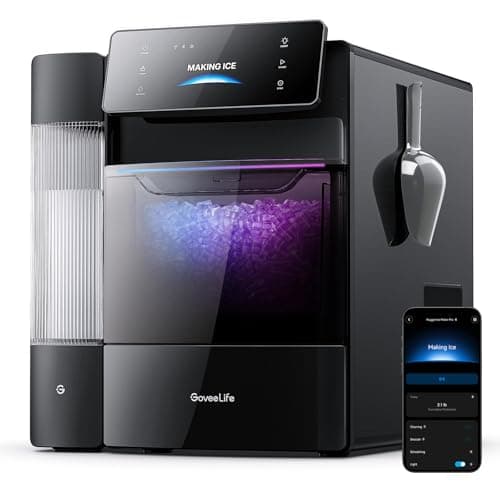 GoveeLife H8120 3.5 lbs, the biggest basket in stock, from GoveeLife's product page rather than a manual. | Largest bin you can buy | |
| 2 | 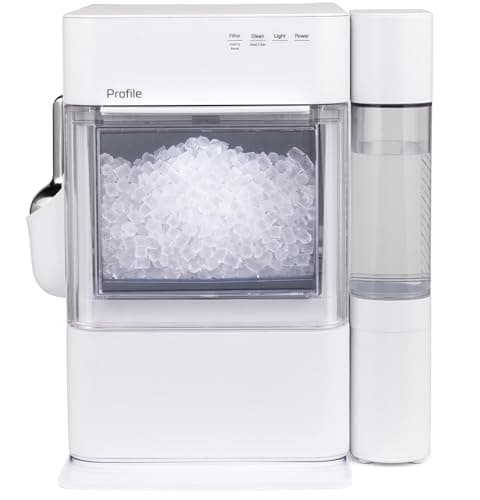 GE Profile XPIO43SCSS 3.0 lbs, the biggest bin a manual documents for a machine still in stock. | Largest bin in a manual | |
| 3 | 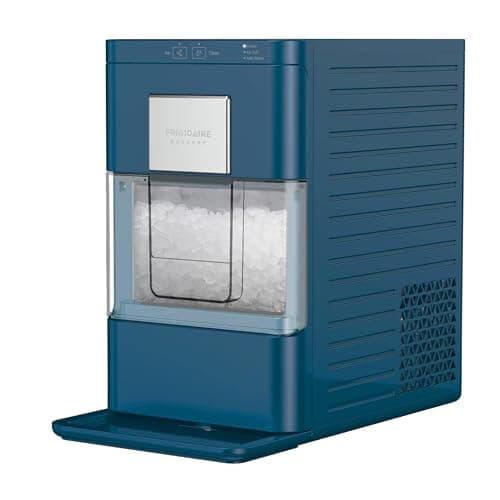 Frigidaire EFIC255 44 lbs a day on 185 W published. | Most ice per watt, from a manual |
#ad We earn a commission on purchases made through this link. How this is funded. Prices last checked October 18, 2026.
The conversion nobody publishes
Manufacturers give you pounds per day. You think in glasses. The bridge is about half a pound per tall glass of nugget ice, which is the figure that turns a spec sheet into a decision.
Run it and the numbers stop looking impressive: the Opal 2.0's 38 lbs a day is about 76 glasses. Nobody drinks 76 glasses of iced anything.
What real households actually need
| Household | Iced drinks a day | Ice needed | Verdict |
|---|---|---|---|
| One person | 2 to 3 | 1 to 1.5 lbs | Any machine is over-specified |
| Two people | 4 to 6 | 2 to 3 lbs | Any machine is over-specified |
| Family of four | 8 to 12 | 4 to 6 lbs | Any machine is over-specified |
| Heavy iced-drink household | 15 to 20 | 7 to 10 lbs | Still inside every machine's rating |
| Party of 20 | In one evening | 20 to 30 lbs | Make in advance and freeze it |
The pattern is stark. Every machine in this category is rated at several times daily household demand, so choosing between a 30 lb machine and a 44 lb one on output alone is choosing between two numbers that are both larger than your need.
The constraint that actually binds
Bin capacity. And it is remarkably uniform: 3.0 lbs on the Opal 2.0, 3.0 lbs on the original Opal, 3.0 lbs on the Opal 2.0 Ultra, and 3.3 lbs on NewAir's NIM044BS00. Only two machines move it at all: that NewAir, which is no longer sold new, and the GoveeLife Smart Nugget Ice Maker Pro, whose product page lists 3.5 lb.
Three pounds is about six tall glasses. That is what the machine can hand you at once. Beyond that you are waiting for it to produce more, at whatever rate it produces, into a bin that is meanwhile melting because it is not refrigerated.
| Machine | Rated output | Bin | Electrical | Max $/mo |
|---|---|---|---|---|
| NewAir NIM044BS00 | 44 lbs/day [src] | 3.3 lbs [src] | 2.7 A [src] | $6.71(nameplate) |
| GE Profile XPIO13SCSS | 38 lbs/day [src] | 3 lbs [src] | 3 A [src] | $7.78(nameplate) |
| Frigidaire EFIC255 | 44 lbs/day [src] | 3 lbs [src] | 185 W [src] | $4.00(published W) |
| NewAir NIM030SS00 | 30 lbs/day [src] | Not published | 170 W [src] | $3.67(published W) |
Why does nobody build a bigger bin? Because it would not help. The bin is unrefrigerated, so a larger one just holds more ice that is melting. That is explained on do countertop ice makers keep ice frozen.
Why the hourly rate is the useful spec
Once you know the bin is the limit, the question becomes: how fast does it refill? That is an hourly figure, and GE's 1.6 lbs per hour for the Opal 2.0 is the only one any manufacturer in this category publishes.
1.6 lbs an hour is about three glasses an hour. So after you empty a full bin, the Opal 2.0 gives you roughly one glass every twenty minutes until it is full again. That is the number that describes real use, and every other manufacturer leaves you to guess it.
Sizing for entertaining
The usual planning figure is a pound to a pound and a half of ice per guest for an evening: drinks, refills and what melts in the bucket. Twenty guests is 20 to 30 pounds.
No countertop machine holds that, and none produces it during the event. What works is running the machine over the preceding day or two, harvesting the bin into lidded containers in the freezer each time it fills, and serving from the freezer stock. Two or three harvests a day for two days covers a party comfortably.
How to shop, given all this
- Ignore rated daily output unless you are choosing between 30 lbs and 44 lbs for a genuinely heavy household. Both are more than you need.
- Compare bin capacity. It is 3 lbs almost everywhere, and 3.3 lbs on one machine.
- Prefer a published hourly rate if you can get one. Only GE publishes it.
- Then choose on running cost and footprint, which are the two specs that actually differ meaningfully across the category.
The picks in full
1. Largest bin you can buy
GoveeLife Smart Nugget Ice Maker Pro
The biggest published basket and daily figure of any nugget machine you can buy, and the only connected machine here from outside GE, documented on a product page rather than in a manual.
- Rated output
- 60 lbs/day
- Bin capacity
- 3.5 lbs
- Electrical
- 210 W published
- Ceiling at 4 hrs/day, $0.18/kWh
- $4.54/month (from published watts)
#ad We earn a commission on purchases made through this link. How this is funded. Prices last checked October 18, 2026.
GoveeLife's owner's manual exists but could not be retrieved for this page, so every value is from the maker's own product page and carries that lower source tier. Anything the page does not print, including refrigerant, clearance and an operating temperature range, reads Not published.
The product page describes two cleaning modes, a 10-minute quick clean and a 30-minute deep descale, with an app reminder after every 100 hours of ice-making. That is a usage-based interval rather than a calendar one.
GoveeLife advertises an average noise level 'as low as 40 dB' in its description copy with no test standard or measuring distance, so, as with Silonn's '35db', it is not recorded as a specification and the noise field reads Not published.
Skip this if
You want every specification backed by an owner's manual, or a machine that fits a normal counter. Every figure here is from GoveeLife's product page, and it is 21.3 inches deep and 42 lbs.
2. Largest bin in a manual
GE Profile Opal 2.0 Ultra Nugget Ice Maker
Mechanically the 2.0 with a bigger tank and a wider clearance requirement, and GE does not publish a production rate for it in the manual we could read.
- Rated output
- Not published
- Bin capacity
- 3 lbs
- Electrical
- 3 A at 120 V (360 VA nameplate)
- Ceiling at 4 hrs/day, $0.18/kWh
- $7.78/month (from the nameplate ceiling)
#ad We earn a commission on purchases made through this link. How this is funded. Prices last checked October 18, 2026.
Same 3.0 A rating and same 37.6 lb empty weight as the standard 2.0, so the electricity math is identical.
It wants 4 inches of clearance rather than 3. If you are fitting this under a cabinet run, that inch is the difference between working and not.
We could not read an ice-making rate on the Ultra's specification page and are not going to substitute the 2.0's 38 lbs a day for it. That field says Not published, and it means it.
Skip this if
You need a published ice rate before you buy. The Ultra's owner's manual specification table did not print a legible ice-making rate in the copy we read, and we will not carry over the standard 2.0's number.
3. Most ice per watt, from a manual
Frigidaire Gallery Countertop Nugget Ice Maker
The only nugget machine here whose maker publishes an actual power consumption instead of a nameplate ceiling, and it is a low one.
- Rated output
- 44 lbs/day
- Bin capacity
- 3 lbs
- Electrical
- 185 W published
- Ceiling at 4 hrs/day, $0.18/kWh
- $4.00/month (from published watts)
#ad We earn a commission on purchases made through this link. How this is funded. Prices last checked October 18, 2026.
185 W published means the running-cost figure for this machine is not a derived ceiling — it is arithmetic on a number Frigidaire printed. That is the strongest cost data on the site.
It is rated at 20 kg a day, which is 44 lbs — higher than the Opal 2.0's 38. Both numbers are measured under ideal conditions the manual does not describe.
Ten inches wide and 16.5 tall makes it the narrowest full-size nugget machine in this set.
Skip this if
You need a manufacturer-published bin capacity. Frigidaire's specification table omits it, so the 3 lb figure on this page comes from a retail listing rather than the manual.
Questions people actually ask
How much does a glass of ice weigh?
Roughly half a pound for a tall glass filled with nugget ice. That is the conversion that makes every rated output figure meaningful: a machine rated at 38 lbs a day is nominally producing about 76 glasses of ice, which no household drinks.
How many pounds of ice per day does a family need?
A family of four having two or three iced drinks each is roughly 4 to 6 pounds a day. Every countertop machine we cover is rated between 30 and 44 pounds a day, so rated output is comfortably beyond household demand and is almost never the binding constraint.
What actually limits a countertop ice maker?
Bin capacity. Every machine in this category publishes 3 to 3.3 pounds, which is about six or seven tall glasses. Once the bin is full the machine stops, and once you empty it you wait for it to refill at its own rate. For bursts of demand, that is the number that matters.
How much ice do I need for a party?
The usual planning figure is about a pound to a pound and a half of ice per guest for an evening, which puts twenty guests at 20 to 30 pounds. No countertop machine holds anything close to that, so the answer is to make ice in advance over a day or two and store it in the freezer.
Sources
- GoveeLife product page, Smart Nugget Ice Maker Pro (model H8120): Specs table and product description (read 2026-09-16)
- GE Profile Opal 2.0 Owner's Manual 49-9000029 Rev. 6, p.17 (38 lbs/day, 1.6 lb/hr, 3.0 lb bin) (read 2026-09-02)
- NewAir NIM044BS00 Owner's Manual, p.5 (3.3 lb bucket capacity) (read 2026-09-02)
- Frigidaire EFIC255 Use & Care Manual, p.12 (20 kg/24h) (read 2026-09-02)
Read next
- Do Countertop Ice Makers Keep Ice Frozen?
No. The bin is unrefrigerated and the meltwater recirculates. What to do instead.
- The Best Ice Makers for Home Use
Sized by household: which home ice maker fits one person, a family, or a home bar.
- The Best Nugget Ice Makers
Six machines ranked on published specs, each with a sourced monthly running-cost ceiling.
- How Long Does a Nugget Ice Maker Take?
First ice and full bin times, built from the one published hourly rate in the category.
- Are Countertop Ice Makers Worth It?
When one earns its place and when it does not, with the cost computed rather than asserted.
- Countertop vs Undercounter Ice Makers
Plug in versus install. Which class of ice maker actually solves your problem.
- The Best Ice Makers for an Office
Throughput at the rush, who refills it, and who cleans it. The three things an office machine is actually judged on.
- Can You Use a Countertop Ice Maker for an Ice Bath?
A plunge needs 20 to 100 lbs. The best machine here makes 60 a day and holds 3.5. The arithmetic, honestly.