Guides
Are Countertop Ice Makers Worth It?
Sometimes. Here is the case for and against, with the running cost computed rather than asserted and the limitations named before the benefits.
Disclosure: we earn a commission if you buy through our links. It never affects which machines we recommend or how we rank them, and we take no sponsored placements. Read the full disclosure.
Quick picks
| # | Machine | Best for | Price |
|---|---|---|---|
| 1 | 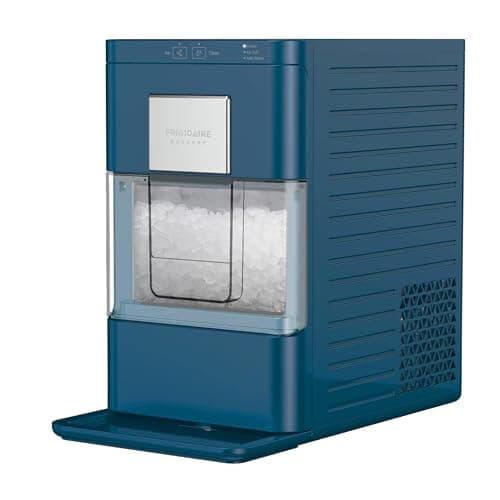 Frigidaire EFIC255 44 lbs a day of chewable ice at a published 185 W. | Best case for buying one |
#ad We earn a commission on purchases made through this link. How this is funded. Prices last checked October 19, 2026.
The honest version of this question depends entirely on what you think you are buying. A lot of the disappointment in this category comes from people buying a small freezer and receiving an ice production line, so it is worth being clear about which is which before the money moves.
The case for
- You want an ice type your freezer cannot make. This is the strongest reason and the one that actually motivates most purchases. A freezer makes solid cubes. It does not make chewable nugget ice, and nothing you can buy for the freezer will.
- You buy bagged ice regularly. Running costs are low enough that the comparison is essentially purchase price against bags bought. A weekly bag habit clears the break-even inside a year or two on a mid-priced machine.
- Your fridge ice maker cannot keep up. Built-in ice makers are slow and their bins are small. A countertop machine rated at 38 to 44 lbs a day is a genuine capacity upgrade for entertaining.
- You need ice somewhere there is no freezer. A garage bar, an office, a workshop, an RV. Plug in, fill, done.
The case against
- It will not keep your ice. The bin is not refrigerated on any machine we cover. Ice melts and the meltwater recirculates. If your problem is that ice runs out, this fixes it only while the machine is switched on. Full explanation on do countertop ice makers keep ice frozen.
- It occupies real counter space. Bodies run 9.7 to 11.3 inches wide and 14 to 17.6 deep, and the manuals ask for 3 to 4 inches of clearance around them. Call it 16 inches of counter run for a 10-inch machine.
- It needs maintenance or it degrades. Scale slows production, biofilm ruins the taste, and both are inevitable on a machine that recirculates standing water. This is a chore you are taking on, not a one-off setup.
- You cannot find out how loud it is. No manufacturer in this category publishes a decibel rating. On an appliance that lives in the room you sit in, that is a real gap and we cannot close it for you.
The money, computed
| Machine | Rated output | Bin | Electrical | Max $/mo |
|---|---|---|---|---|
| Frigidaire EFIC452 | 39.7 lbs/day [src] | Not published | 120 W [src] | $2.59(published W) |
| NewAir NIM030SS00 | 30 lbs/day [src] | Not published | 170 W [src] | $3.67(published W) |
| Frigidaire EFIC255 | 44 lbs/day [src] | 3 lbs [src] | 185 W [src] | $4.00(published W) |
| Frigidaire EFIC235 | 44 lbs/day [src] | Not published | 200 W [src] | $4.32(published W) |
| GE Profile XPIO13SCSS | 38 lbs/day [src] | 3 lbs [src] | 3 A [src] | $7.78(nameplate) |
The spread across the entire category is about five dollars a month. Electricity is not the argument here in either direction; anyone telling you these machines are expensive to run, or notably cheap, is working from a number they did not compute.
Rate source: EIA Electric Power Monthly, Table 5.6.A, June 2026, 18.34 cents per kWh US residential average, rounded to 18 cents. Full method on the running-cost page.
Who should definitely not buy one
- Anyone who needs ice to survive overnight. Buy nothing; use your freezer.
- Anyone who needs ice a few times a year. Bagged ice is cheaper and takes no counter space.
- Anyone who will not clean it. A neglected recirculating machine produces ice that tastes of the machine, and then stops producing ice at all.
- Anyone with no counter to spare. The clearance requirement is not negotiable and a machine in a cabinet runs longer, costs more and makes less ice.
The honest summary
If you are here because you love chewable ice and you are tired of driving to get it, buy one. That is a real want, a countertop nugget machine is the only thing that satisfies it at home, and the running cost is trivial next to the purchase price.
If you are here because your household runs out of ice, buy one and plan to harvest into the freezer, because the machine will not hold ice for you.
If you are here because you saw one and it looked clever, wait. The maintenance is real and the melt is real, and both are easier to accept when you actually wanted the thing in the first place.
The picks in full
1. Best case for buying one
Frigidaire Gallery Countertop Nugget Ice Maker
The only nugget machine here whose maker publishes an actual power consumption instead of a nameplate ceiling, and it is a low one.
- Rated output
- 44 lbs/day
- Bin capacity
- 3 lbs
- Electrical
- 185 W published
- Ceiling at 4 hrs/day, $0.18/kWh
- $4.00/month (from published watts)
#ad We earn a commission on purchases made through this link. How this is funded. Prices last checked October 19, 2026.
185 W published means the running-cost figure for this machine is not a derived ceiling — it is arithmetic on a number Frigidaire printed. That is the strongest cost data on the site.
It is rated at 20 kg a day, which is 44 lbs — higher than the Opal 2.0's 38. Both numbers are measured under ideal conditions the manual does not describe.
Ten inches wide and 16.5 tall makes it the narrowest full-size nugget machine in this set.
Skip this if
You need a manufacturer-published bin capacity. Frigidaire's specification table omits it, so the 3 lb figure on this page comes from a retail listing rather than the manual.
Questions people actually ask
Are countertop ice makers worth the money?
They are worth it if you want a specific kind of ice your freezer cannot make, if you buy bagged ice regularly, or if your fridge's ice maker cannot keep up. They are not worth it if what you want is ice that keeps, because no countertop machine refrigerates its bin, or if you need ice only a few times a year.
How much does a countertop ice maker add to your electricity bill?
Between roughly $2.59 and $7.78 a month at four running hours a day and 18 cents per kWh, depending on the machine and whether the manufacturer publishes a consumption figure or only a nameplate rating. That is less than most people expect, and it is not usually the deciding factor.
What are the downsides of a countertop ice maker?
Four real ones. The bin is not refrigerated so ice melts continuously. It occupies counter space plus 3 to 4 inches of clearance. It needs regular cleaning and descaling or it slows down and the ice tastes wrong. And nobody in the category publishes a tested decibel rating, so you cannot know how loud it will be before it arrives.
Is a countertop ice maker cheaper than buying bagged ice?
It depends on volume. Running costs are low, so the comparison is really the purchase price against how much bagged ice you buy. Someone buying a bag most weeks will pass the break-even inside a year or two. Someone buying ice for two parties a year will not.
Sources
- EIA Electric Power Monthly, Table 5.6.A, June 2026 (US residential average price) (read 2026-09-02)
- Frigidaire EFIC255 Use & Care Manual, p.12 (185 W) (read 2026-09-02)
- NewAir NIM030SS00 Owner's Manual, p.5 (170 W) (read 2026-09-02)
- Frigidaire EFIC452 Use & Care Manual, p.10 (90-120 W) (read 2026-09-02)
- GE Profile Opal 2.0 Owner's Manual 49-9000029 Rev. 6, p.17 (3.0 A) (read 2026-09-02)
Read next
- Do Countertop Ice Makers Keep Ice Frozen?
No. The bin is unrefrigerated and the meltwater recirculates. What to do instead.
- What a Nugget Ice Maker Costs to Run
Per-model monthly costs with the wattage sourced, the duty cycle stated and the arithmetic shown.
- How Much Ice Do You Actually Need?
Why rated output is the wrong number to shop on, and what bin capacity really limits.
- The Best Countertop Ice Makers
The whole countertop category ranked by ice type, with sourced specs and running costs.
- Countertop vs Undercounter Ice Makers
Plug in versus install. Which class of ice maker actually solves your problem.
- Why Are Nugget Ice Makers So Expensive?
One component explains the price gap: a motor-driven auger inside a refrigerated cylinder.