Countertop Ice Makers
The Best Ice Makers for an Office
Two questions decide this and neither is about ice. Who refills it, and who cleans it. A machine with no answer to either becomes the thing nobody touches by March.
Disclosure: we earn a commission if you buy through our links. It never affects which machines we recommend or how we rank them, and we take no sponsored placements. Read the full disclosure.
Quick picks
| # | Machine | Best for | Price |
|---|---|---|---|
| 1 | 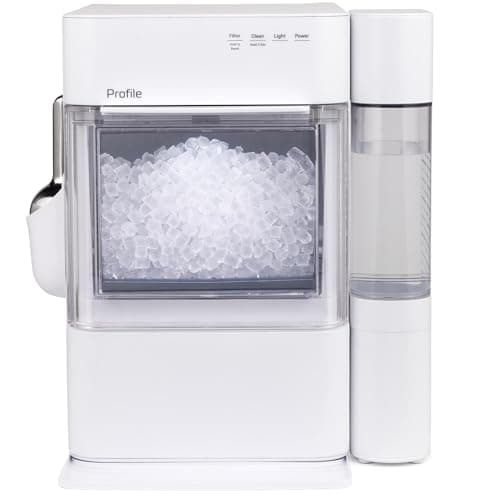 GE Profile XPIO43SCSS A side tank and four filters in the box, plus the only descaling interval printed in a manual. | Fewest refills | |
| 2 | 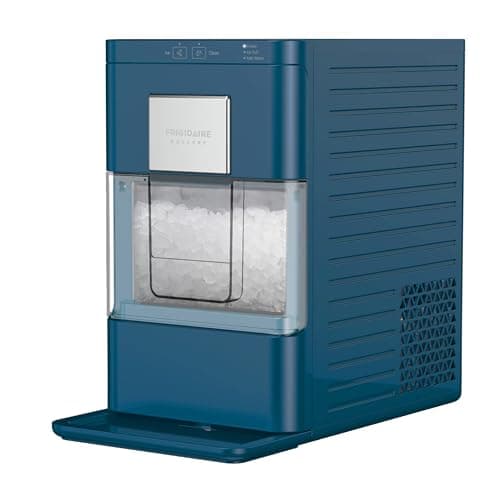 Frigidaire EFIC255 44 lbs a day on 185 W published, in the narrowest full-size body here. | Most ice per watt, from a manual |
#ad We earn a commission on purchases made through this link. How this is funded. Prices last checked October 19, 2026.
An office ice maker is not judged the way a kitchen one is. Nobody at work cares about the running cost, the footprint is somebody else's problem, and the daily output number on the box is irrelevant because no office drinks 44 lbs of ice a day.
What decides whether an office machine is loved or quietly unplugged is much narrower: can it keep up at 12:30, does refilling it depend on a volunteer, and will anyone ever clean it. This page is ordered by those three questions, and every figure comes from a manufacturer manual with the page number attached.
What an office actually demands
- Recovery at the rush, not daily output. Everyone breaks at the same time. The number that matters is how fast the bin refills after it is emptied, and exactly one machine in this category publishes it.
- A refill design that does not need a volunteer. A water line, or failing that the largest reservoir available. This is the single biggest predictor of whether the machine is still in use in six months.
- A documented clean cycle, ideally with an interval. Shared appliances get cleaned when somebody is told to, on a schedule, by a manufacturer who put it in writing.
- Somewhere to put it, with clearance. Office kitchenettes are tight and the 3 to 4 inches these manuals require at the sides and rear is how the heat leaves.
- Noise you can live beside, honestly caveated. Nobody publishes a decibel figure in this category, so nobody can rank it, and this page will not invent one.
- A weekend plan. Not a feature — a habit. It is the difference between a machine that lasts and one that smells by spring.
The four picks on published figures
| Machine | Rated output | Bin | Electrical | Max $/mo |
|---|---|---|---|---|
| NewAir NIM030SS00 | 30 lbs/day [src] | Not published | 170 W [src] | $3.67(published W) |
| GE Profile XPIO13SCSS | 38 lbs/day [src] | 3 lbs [src] | 3 A [src] | $7.78(nameplate) |
| GE Profile XPIO43SCSS | Not published | 3 lbs [src] | 3 A [src] | $7.78(nameplate) |
| Frigidaire EFIC255 | 44 lbs/day [src] | 3 lbs [src] | 185 W [src] | $4.00(published W) |
The lunchtime rush is a bin problem
Rated daily output is the most quoted number in this category and the least useful one at work. A machine rated at 44 lbs a day is producing under two pounds an hour, and an office of a dozen people can empty a three-pound bin in the first four minutes of a lunch break.
| Machine | Published bin | Roughly | Published refill rate |
|---|---|---|---|
| GE Profile Opal 2.0 | 3.0 lbs | About 6 glasses | 1.6 lbs per hour |
| GE Profile Opal 2.0 Ultra | 3.0 lbs | About 6 glasses | Not published |
| NewAir NIM030SS00 | Not published | Not calculable | Not published |
| Frigidaire Gallery EFIC255 | 3 lbs, from a retail listing | About 6 glasses | Not published |
| NewAir NIM044BS00 | 3.3 lbs | About 7 glasses | Not published |
Read the last column and the point lands. Only GE publishes a rate per hour — 1.6 lbs per hour alongside its 38 lbs a day — and that single figure is the only way in this entire category to answer "the bin is empty, when can the next four people get ice" from published data rather than by standing there watching.
At 1.6 lbs an hour, a fully emptied Opal is roughly twenty minutes from being able to serve one more tall glass and about two hours from a full bin. For an office that is the honest expectation to set, and it is why the practical answer for a larger office is to run the machine into a freezer tub each morning rather than expecting people to serve themselves from the bin at noon. The sizing arithmetic is on how much ice you actually need.
The volunteer problem
Every machine in this category is reservoir-fed by default: you pour water into a tank and the machine recirculates it, including the meltwater from its own bin. At home that is somebody's appliance and it gets filled. In an office it is nobody's appliance, and the empty-reservoir light becomes part of the furniture.
There are only two structural answers to that, and both are on this page.
- Plumb it. The NewAir NIM030SS00 manual includes a section on installing an automatic water line and states the machine can be connected to an external water source using a 1/4 inch PE tube. In an office kitchenette that already has a sink and often a filtered tap, this is the fix, and it removes the chore rather than assigning it. Whether it is worth doing is argued on do you need a water line.
- Make the tank bigger. GE's Opal 2.0 Ultra ships with a side tank, which does not change how much finished ice the machine holds but does change how often somebody has to think about it.
Everything else is a rota, and rotas for appliances do not survive contact with a real office.
Nobody cleans the office ice maker
This is the part that actually ends office ice makers, and it is worth being blunt about. These machines hold standing water at room temperature and recirculate it. Left alone, that produces the slippery film that makes ice taste wrong, which is covered on mold and slime in a nugget ice maker. At home one person notices. At work everyone notices and nobody acts.
So the practical criterion is not "does it self-clean" — none of them do, in the sense people mean. It is whether the manufacturer documented a cycle short enough that somebody will actually run it, and whether they put an interval in writing that a facilities schedule can be built on.
| Machine | The cycle | What goes in | Stated interval |
|---|---|---|---|
| NewAir NIM030SS00 | Hold CLEAN about 3 seconds, 8 minutes | Water AND detergent, then rinse cycles until it is gone | Not stated |
| GE Profile Opal 2.0 Ultra | Press Clean, a rinse cycle | The water in the tank | Descale every 4 weeks |
| GE Profile Opal 2.0 | Hold Clean 3 seconds | Descaling solution or a bleach mixture, plus an 18-hour soak | Not stated |
| Frigidaire Gallery EFIC255 | Press CLEAN, at least 20 minutes | Water | Before first use and after a long idle period |
Two rows in that table matter for a workplace. NewAir's is the only manual in the category that tells you to put water and detergent through the cycle rather than plain water, which is the difference between rinsing a machine and cleaning it. And GE's Ultra manual is the only one that names an interval, which is the only thing a facilities schedule can actually be written against.
NewAir NIM030SS00, for a shared kitchen
This is the machine that answers both of the questions this page is built on. It can be plumbed, so nobody has to volunteer to fill it, and its clean cycle is the only one in the category the manufacturer treats as actual cleaning: hold CLEAN for about three seconds, run for eight minutes with water and detergent, then drain and repeat with clean water until the detergent is gone. Eight minutes is short enough that somebody will actually do it.
It also publishes a rated power of 170 W, an actual consumption figure rather than a nameplate ceiling, which makes it the cheapest machine here to run at roughly $3.67 a month.
The honest cons: NewAir publishes no bin capacity for it at all, so the one number an office most needs to plan around is missing. Its 30 lbs a day comes from the manual's title rather than its specification table. And at 17.64 inches deep before clearance it is the deepest machine on this page, which is a real constraint on a narrow kitchenette counter.
GE Profile Opal 2.0, for the rush
If the problem you are solving is a queue at 12:30, this is the machine whose maker gives you something to plan with. GE publishes 38 lbs per day and 1.6 lbs per hour, and the hourly figure is unique in this category. Nothing else lets you answer a recovery question from a spec sheet.
It is also the best-documented machine on the site by a distance: rate, hourly rate, bin, current, empty weight and a published clearance requirement, all in one table. In a workplace where somebody will eventually ask facilities whether it can go in a particular alcove, that matters more than it does at home.
The honest cons: it is the largest electrical load here, a 360 VA nameplate, about $7.78 a month as a ceiling — and GE publishes no wattage at all, so that is an upper bound rather than a measurement. Its cleaning procedure is the most demanding on the page, involving an 18-hour soak for a proper descale, which is exactly the kind of job an office never gets round to.
GE Profile Opal 2.0 Ultra, for the fewest refills
Mechanically this is the Opal 2.0 — same 3.0 A, same 3.0 lb bin, same 37.6 lbs empty. What it adds is the side tank and four filters in the box, and in an office the side tank is the point: fewer trips to the sink means fewer opportunities for nobody to make the trip.
Its manual is also the only document in this category that commits to a maintenance schedule, stating that descaling should be performed every 4 weeks depending on water hardness. If you are the person who has to put an ice maker on a cleaning rota, that sentence is worth more than any spec on the sheet.
The honest cons: it needs 4 inches of clearance rather than 3, which in a built-in kitchenette can be decisive. GE publishes no ice-making rate for it at all, so the one thing the standard 2.0 does better than everything else — telling you the recovery rate — is missing here. And you are paying for a bundle rather than a better machine, as set out on Opal 2.0 versus Opal 2.0 Ultra.
Frigidaire Gallery EFIC255, on a budget
If the office is small and the budget is a line item somebody has to justify, this is the machine with the strongest numbers per dollar: 185 W published against a 20 kg per 24 hour rating, which is 44 lbs a day and the best output-per-watt figure on this site. A published consumption figure also means the roughly $4.00 a month is close to real rather than a ceiling.
At 10 inches wide it is the narrowest full-size machine here, which on a cramped kitchenette counter competing with a kettle and a microwave is a genuine advantage.
The honest cons: Frigidaire publishes no bin capacity in its specification table at all — the 3 lb figure this site carries comes from a retail listing and is flagged as the weakest source tier. Its CLEAN cycle runs at least 20 minutes on plain water, which rinses rather than cleans, and there is no water-line option, so the volunteer problem is unsolved.
The weekend, which is where office machines die
No bin in this category is refrigerated. The ice sits in an insulated but unpowered compartment, melts, and the meltwater drains back to the reservoir to be frozen again. That design is efficient and it has one consequence that is specific to a workplace.
Left switched on over a weekend, the machine simply keeps replacing what melts, and on Monday the bin looks full. Switched off on Friday with a full reservoir, it spends two and a half days as a warm sealed tank of standing water, which is precisely the condition biofilm needs. The second is what most offices do.
The fix costs five minutes on a Friday: empty the bin, drain the reservoir, leave the lid open. That single habit prevents more office ice-maker complaints than any feature on this page, and the full procedure — including what to do over a shutdown week — is on how to drain and store an ice maker. Why the bin behaves this way is on do countertop ice makers keep ice frozen.
What it costs the business, briefly
Somebody will ask, so here it is. At four running hours a day and 18 cents per kWh, the machines on this page range from about $3.67 a month for the NewAir to about $7.78 for either Opal at its nameplate ceiling. In an office running eight or more hours the figures roughly double.
That is a rounding error against what the same office spends on coffee, and it is not a reason to choose between these machines. It is on the page because the alternative — bagged ice, delivered or fetched — is a recurring line item that people do notice. The full arithmetic, with your own rate, is on the running-cost page.
Choosing, in three steps
- Decide who refills it before you decide which machine. If the answer is nobody, buy the one that can be plumbed and plumb it.
- Then decide who cleans it, and prefer a manufacturer that wrote down both a short cycle and an interval. A rota needs a number to hang on.
- Only then compare ice. Every machine here makes far more in a day than an office drinks; what differs is how fast the bin comes back after the rush.
If the machine is really for a household rather than a workplace, the general ranking is on the best ice makers for home, and if the counter is the binding constraint, the fitting numbers are on nugget ice makers for small kitchens. The same volunteer and cleaning problems turn up in a shared student hall, where the sink is also down the corridor: ice makers for a dorm room.
The picks in full
1. Fewest refills
GE Profile Opal 2.0 Ultra Nugget Ice Maker
Mechanically the 2.0 with a bigger tank and a wider clearance requirement, and GE does not publish a production rate for it in the manual we could read.
- Rated output
- Not published
- Bin capacity
- 3 lbs
- Electrical
- 3 A at 120 V (360 VA nameplate)
- Ceiling at 4 hrs/day, $0.18/kWh
- $7.78/month (from the nameplate ceiling)
#ad We earn a commission on purchases made through this link. How this is funded. Prices last checked October 19, 2026.
Same 3.0 A rating and same 37.6 lb empty weight as the standard 2.0, so the electricity math is identical.
It wants 4 inches of clearance rather than 3. If you are fitting this under a cabinet run, that inch is the difference between working and not.
We could not read an ice-making rate on the Ultra's specification page and are not going to substitute the 2.0's 38 lbs a day for it. That field says Not published, and it means it.
Skip this if
You need a published ice rate before you buy. The Ultra's owner's manual specification table did not print a legible ice-making rate in the copy we read, and we will not carry over the standard 2.0's number.
2. Most ice per watt, from a manual
Frigidaire Gallery Countertop Nugget Ice Maker
The only nugget machine here whose maker publishes an actual power consumption instead of a nameplate ceiling, and it is a low one.
- Rated output
- 44 lbs/day
- Bin capacity
- 3 lbs
- Electrical
- 185 W published
- Ceiling at 4 hrs/day, $0.18/kWh
- $4.00/month (from published watts)
#ad We earn a commission on purchases made through this link. How this is funded. Prices last checked October 19, 2026.
185 W published means the running-cost figure for this machine is not a derived ceiling — it is arithmetic on a number Frigidaire printed. That is the strongest cost data on the site.
It is rated at 20 kg a day, which is 44 lbs — higher than the Opal 2.0's 38. Both numbers are measured under ideal conditions the manual does not describe.
Ten inches wide and 16.5 tall makes it the narrowest full-size nugget machine in this set.
Skip this if
You need a manufacturer-published bin capacity. Frigidaire's specification table omits it, so the 3 lb figure on this page comes from a retail listing rather than the manual.
Questions people actually ask
What size ice maker do I need for an office?
Size it by the rush, not by the headcount. A tall glass takes roughly half a pound of ice, and every countertop machine in this category holds between 3.0 and 3.3 lbs at a time, which is about six or seven glasses before the bin is empty and people are waiting on production. For an office of more than about eight people who all break at once, plan on the machine being a producer that you decant into a freezer, not the thing people queue at.
Can a countertop ice maker be plumbed in at an office?
One of the machines covered here can. The NewAir NIM030SS00 manual includes a section on installing an automatic water line and states it can be connected to an external water source with a 1/4 inch PE tube. Everything else in this category is reservoir-only, which in an office means somebody has to notice it is empty and carry water to it, and that somebody usually turns out to be nobody.
How often does an office ice maker need cleaning?
More often than it will get it. The only manufacturer-stated interval in this category is GE's, which says to descale the Opal 2.0 Ultra every 4 weeks depending on water hardness. Beyond descaling, these machines recirculate standing water at room temperature, so a monthly clean is a fair baseline and the single most effective habit is emptying the reservoir whenever the machine will sit unused, which in an office means Friday afternoon.
Are countertop ice makers loud enough to be a problem in an office?
No manufacturer in this category publishes a tested decibel rating, so this site does not print one and cannot rank machines on noise. What can be said is that these machines cycle rather than hum: a compressor runs, a harvest mechanism moves, and ice drops into a bin. In a kitchen or a break area that is unremarkable. Directly beside a desk or a meeting room it is not, and no spec sheet will tell you which side of that line you are on.
Will an office ice maker keep ice over the weekend?
No. Not one machine in this category refrigerates its bin. Ice sits in an insulated but unpowered compartment, melts, and the meltwater drains back into the reservoir to be frozen again. Left running over a weekend the machine simply keeps replacing what melted; switched off on Friday it is a tank of standing water by Monday. Draining it before the weekend is the habit that prevents most office ice-maker complaints.
Sources
- GE Profile Opal 2.0 Owner's Manual 49-9000029 Rev. 6, p.17 (read 2026-09-02)
- GE Profile Opal 2.0 Owner's Manual 49-9000029 Rev. 6, p.7 (Care and Cleaning) (read 2026-09-02)
- GE Profile Opal 2.0 Ultra Owner's Manual (Care and Cleaning, p.7) (read 2026-09-02)
- Frigidaire EFIC255 Use & Care Manual, p.12 (product specifications) (read 2026-09-02)
- Frigidaire EFIC255 Use & Care Manual, p.8 (the CLEAN procedure) (read 2026-09-02)
- NewAir NIM030SS00 Owner's Manual, p.5 (specifications) (read 2026-09-02)
- NewAir NIM030SS00 Owner's Manual, p.16 (Cleaning & Maintenance) (read 2026-09-06)
- NewAir NIM044BS00 Owner's Manual, p.5 (specifications) (read 2026-09-02)
- EIA Electric Power Monthly, Table 5.6.A, June 2026 (read 2026-09-02)
Read next
- The Best Ice Makers for Home Use
Sized by household: which home ice maker fits one person, a family, or a home bar.
- How Much Ice Do You Actually Need?
Why rated output is the wrong number to shop on, and what bin capacity really limits.
- The Best Self-Cleaning Countertop Ice Makers
Which countertop ice makers have a real clean cycle, what it does, and which have no clean button at all.
- How to Drain and Store a Nugget Ice Maker
Drain, dry, stow upright, and the manufacturer-stated wait before you switch it on again.
- Do You Need a Water Line?
No. What refilling actually involves, and what a side tank or plumbing buys you.
- Do Countertop Ice Makers Keep Ice Frozen?
No. The bin is unrefrigerated and the meltwater recirculates. What to do instead.