Guides
Do You Need a Water Line?
No, and on a countertop machine you mostly cannot have one. Here is what refilling actually involves and what the alternatives buy you.

Disclosure: we earn a commission if you buy through our links. It never affects which machines we recommend or how we rank them, and we take no sponsored placements. Read the full disclosure.
Quick picks
| # | Machine | Best for | Price |
|---|---|---|---|
| 1 | 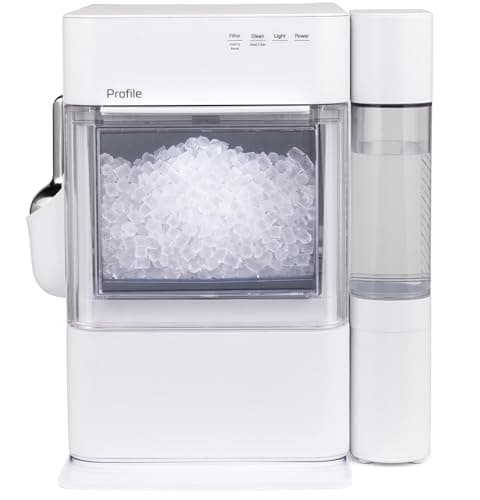 GE Profile XPIO43SCSS A bigger tank is the real answer to refilling, at four inches of clearance. | Largest reservoir option |
#ad We earn a commission on purchases made through this link. How this is funded. Prices last checked October 19, 2026.
How often you actually refill
Less often than the specs suggest, and the reason is the same recirculation that stops the bin keeping ice.
Water does not leave a countertop machine when ice melts; it drains back to the reservoir and gets frozen again. What genuinely leaves the system is the ice you take out and use, plus a little evaporation. So a machine rated at 38 lbs a day does not need 38 lbs of water a day poured into it unless you are removing 38 lbs of ice a day, which nobody is.
In practice, a machine in normal household use wants topping up about once a day. Which brings up the thing worth doing instead of topping up.
Empty it, do not top it up
Topping up means the oldest water in the machine never leaves. On a recirculating system at room temperature, that is exactly the condition biofilm needs, and stale reservoir water is the most common reason home nugget ice tastes worse than the drive-through version.
Draining and refilling takes the same thirty seconds as topping up and solves a problem instead of feeding one. Details on what grows in these machines.
What the alternatives actually buy
| Option | What it does | What it costs |
|---|---|---|
| Standard reservoir | Fill it daily in regular use | Nothing. This is the default |
| Side tank / larger reservoir | More water held, so you fill less often | The Opal 2.0 Ultra wants 4 inches of clearance rather than 3 |
| Bigger ice bin | More finished ice held before the machine stops | NewAir's 3.3 lbs is the only upgrade available, and it is modest |
| Undercounter machine | Plumbed. Nobody fills anything, ever | A different appliance class, plus installation |
The middle two are the realistic answers for most people. The last one is a different purchase entirely and is compared on countertop versus undercounter.
The clearance cost of the bigger tank
Worth flagging because it is buried in a manual. The Opal 2.0 Ultra — the larger-tank model — asks for 4 inches of installation clearance where the standard Opal 2.0 and the original both ask for 3 inches.
If you are fitting the machine into a defined space, that extra inch can matter more than the extra water does. Measure before you order.
And whatever you fill it with, filter it
A machine that recirculates its own water concentrates whatever you put in. Hard water becomes scale on the freezing cylinder, which slows the machine and eventually makes it squeal.
That is covered on what water to use and whether a filter is worth fitting.
The picks in full
1. Largest reservoir option
GE Profile Opal 2.0 Ultra Nugget Ice Maker
Mechanically the 2.0 with a bigger tank and a wider clearance requirement, and GE does not publish a production rate for it in the manual we could read.
- Rated output
- Not published
- Bin capacity
- 3 lbs
- Electrical
- 3 A at 120 V (360 VA nameplate)
- Ceiling at 4 hrs/day, $0.18/kWh
- $7.78/month (from the nameplate ceiling)
#ad We earn a commission on purchases made through this link. How this is funded. Prices last checked October 19, 2026.
Same 3.0 A rating and same 37.6 lb empty weight as the standard 2.0, so the electricity math is identical.
It wants 4 inches of clearance rather than 3. If you are fitting this under a cabinet run, that inch is the difference between working and not.
We could not read an ice-making rate on the Ultra's specification page and are not going to substitute the 2.0's 38 lbs a day for it. That field says Not published, and it means it.
Skip this if
You need a published ice rate before you buy. The Ultra's owner's manual specification table did not print a legible ice-making rate in the copy we read, and we will not carry over the standard 2.0's number.
Questions people actually ask
Do countertop nugget ice makers need to be plumbed in?
No. Every countertop machine we cover is reservoir-fed: you pour water into a tank and the machine recirculates it, including the meltwater from its own bin. None of the manufacturer specification tables we read describes a plumbed inlet.
How often do you have to refill a nugget ice maker?
Less often than the rated output implies, because meltwater drains back to the reservoir rather than leaving the machine. What actually leaves is the ice you remove and use, plus evaporation. In regular household use, topping up daily is normal.
What is a side tank on an ice maker?
A larger external reservoir that feeds the internal one, so you fill it less often. The GE Profile Opal 2.0 with Side Tank is exactly this. It is a capacity feature, not a plumbing feature, and it does not connect to your water supply.
Can I connect a countertop ice maker to my water line anyway?
Not safely or sensibly on a machine that was not designed for it. These machines have no inlet valve, no drain and no overflow protection for a pressurized supply. If plumbed ice is the requirement, that is what undercounter machines are for.
Sources
- GE Profile Opal 2.0 Owner's Manual 49-9000029 Rev. 6, p.17 (read 2026-09-02)
- GE Profile Opal 2.0 Ultra Owner's Manual 49-9000058 Rev. 6, p.16 (4 in clearance) (read 2026-09-02)
- FirstBuild Opal Use & Care manual, Ver. 2/13/2017, p.12 (read 2026-09-02)
Read next
- Nugget Ice Makers With a Water Line
What a water-line connection really means on a countertop machine, and the alternatives.
- Countertop vs Undercounter Ice Makers
Plug in versus install. Which class of ice maker actually solves your problem.
- Do Countertop Ice Makers Keep Ice Frozen?
No. The bin is unrefrigerated and the meltwater recirculates. What to do instead.
- What Water to Use in a Nugget Ice Maker
Tap, filtered or distilled: what each does to scale, taste and maintenance.
- Water Filters for Nugget Ice Makers
What a filter actually does, when it earns its place, and when it is a purchase without a job.
- How Much Ice Do You Actually Need?
Why rated output is the wrong number to shop on, and what bin capacity really limits.
- How Much Water Does a Nugget Ice Maker Use?
Recirculation, three published reservoir volumes in the whole category, and why minerals concentrate.
- The Best Ice Makers for an Office
Throughput at the rush, who refills it, and who cleans it. The three things an office machine is actually judged on.