Nugget Ice Makers
Nugget Ice Makers With a Water Line
Countertop machines are reservoir-fed by design. Here is what a water-line connection means in this category, what a side tank does instead, and when plumbing is the answer.

Disclosure: we earn a commission if you buy through our links. It never affects which machines we recommend or how we rank them, and we take no sponsored placements. Read the full disclosure.
Quick picks
| # | Machine | Best for | Price |
|---|---|---|---|
| 1 | 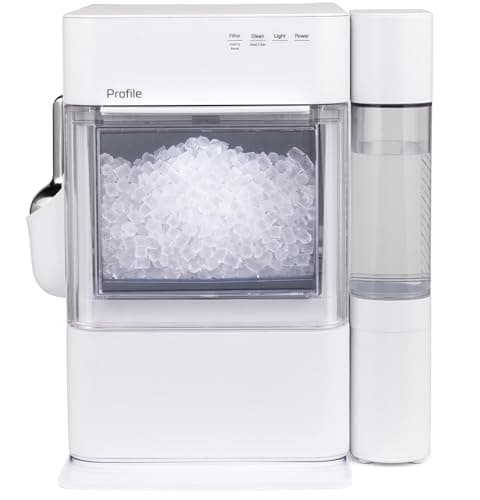 GE Profile XPIO43SCSS Same mechanicals with a bigger reservoir, at the cost of an inch of clearance. | Largest capacity option |
#ad We earn a commission on purchases made through this link. How this is funded. Prices last checked October 19, 2026.
Search volume for countertop ice makers with a water line is real and steady, which tells you what people actually want: to stop refilling. The listings answer that demand with the phrase "water line" attached to machines that mostly do not have one. So this page is about what the words mean.
Three different things get called a water connection
- An internal reservoir. Every countertop machine here. You lift a lid and pour. Ice melts in the bin and the meltwater drains back to the reservoir, so the water is recirculated rather than consumed.
- A side tank. An external reservoir sitting beside the machine that gravity-feeds the internal one. The GE Profile Opal 2.0 with Side Tank is exactly this. More capacity, same filling job, done less often.
- A plumbed inlet. A hose from your water supply, usually with a shutoff and sometimes a drain. Standard on undercounter machines. Not a feature of the countertop machines whose specification tables we read.
The middle one is what most people who search for a water line actually want, and it is available today. The third one is a different purchase entirely, covered on countertop versus undercounter.
Why recirculation changes the refill question
Because the bin is not refrigerated, ice melts continuously and the meltwater goes back into the reservoir. That is bad news for keeping ice and good news for refilling: the water you put in is not consumed at anything like the rated production figure. What actually leaves the system is the ice you take out and use, and a little evaporation.
Practically, a machine making 38 pounds a day on paper does not need 38 pounds of water a day poured into it unless you are removing 38 pounds of ice a day. Almost nobody is. This is also why the water in a neglected machine goes stale and why regular emptying matters more than people expect. See the cleaning procedure and what grows in a machine you do not empty.
Buying capacity instead of plumbing
| Machine | Rated output | Bin | Electrical | Max $/mo |
|---|---|---|---|---|
| NewAir NIM044BS00 | 44 lbs/day [src] | 3.3 lbs [src] | 2.7 A [src] | $6.71(nameplate) |
| GE Profile XPIO13SCSS | 38 lbs/day [src] | 3 lbs [src] | 3 A [src] | $7.78(nameplate) |
| Frigidaire EFIC255 | 44 lbs/day [src] | 3 lbs [src] | 185 W [src] | $4.00(published W) |
Two levers reduce refills without any plumbing. A bigger bin means the machine holds more finished ice before it stops. NewAir's 3.3 lb bin is the largest printed in a manual here, and GoveeLife's product page lists 3.5 lb for its Smart Nugget Ice Maker Pro. A bigger reservoir, which is what the side-tank models and the Opal 2.0 Ultra offer, means more water sitting ready.
The Ultra is worth a specific note: the manual gives the same 3.0 A rating, the same 3.0 lb bin and the same 37.6 lb weight as the standard 2.0, but asks for 4 inches of clearance rather than 3. If your plan involves an alcove or a cabinet run, measure before you commit.
If you plumb it, filter it. If you fill it, still filter it
A machine fed from a water line inherits whatever is in your supply, including hardness that will scale the freezing cylinder. A machine fed from a jug inherits whatever you pour into it. Either way, the water going in is the single biggest determinant of how often you will be descaling.
We cover the specifics on what water to use and filters worth having.
The verdict
If refilling is your objection to a countertop machine, buy a side tank model and a large bin, and accept that you are filling something once a day rather than never. If never is the requirement, budget for an undercounter machine and an installer, because no countertop unit in this category will get you there.
The picks in full
1. Largest capacity option
GE Profile Opal 2.0 Ultra Nugget Ice Maker
Mechanically the 2.0 with a bigger tank and a wider clearance requirement, and GE does not publish a production rate for it in the manual we could read.
- Rated output
- Not published
- Bin capacity
- 3 lbs
- Electrical
- 3 A at 120 V (360 VA nameplate)
- Ceiling at 4 hrs/day, $0.18/kWh
- $7.78/month (from the nameplate ceiling)
#ad We earn a commission on purchases made through this link. How this is funded. Prices last checked October 19, 2026.
Same 3.0 A rating and same 37.6 lb empty weight as the standard 2.0, so the electricity math is identical.
It wants 4 inches of clearance rather than 3. If you are fitting this under a cabinet run, that inch is the difference between working and not.
We could not read an ice-making rate on the Ultra's specification page and are not going to substitute the 2.0's 38 lbs a day for it. That field says Not published, and it means it.
Skip this if
You need a published ice rate before you buy. The Ultra's owner's manual specification table did not print a legible ice-making rate in the copy we read, and we will not carry over the standard 2.0's number.
Questions people actually ask
Can a countertop nugget ice maker connect to a water line?
Some models advertise a water-line kit, but the machines covered here are reservoir-fed by design and none of the manufacturer specification tables we read mentions a plumbed inlet. The GE Profile Opal 2.0 ships with a side tank instead, which is a larger external reservoir rather than a plumbing connection. If you need genuinely plumbed ice, an undercounter ice maker is the correct appliance class.
What does the Opal side tank actually do?
It holds more water beside the machine and feeds the internal reservoir, so you refill less often. It does not connect to your plumbing and it does not change how the machine makes ice. It is a convenience feature, not a plumbing feature.
Is an undercounter ice maker better than a countertop one?
For plumbing and for volume, yes, and it costs several times as much and requires installation. Undercounter machines connect to a water supply and a drain, which is what makes them genuinely hands-off. Countertop machines are appliances you fill; undercounter machines are appliances you install. We compare the two classes properly on the countertop versus undercounter page.
How often do you have to refill a nugget ice maker?
It depends on the reservoir and how much ice you are pulling. Since ice melts in the unrefrigerated bin and drains back to the reservoir, water is not lost as fast as production figures suggest. What leaves the system is the ice you actually take out and use, plus evaporation. In practice, daily topping up is normal for a machine in regular use.
Sources
- GE Profile Opal 2.0 Owner's Manual 49-9000029 Rev. 6, p.17 (product specifications) (read 2026-09-02)
- FirstBuild Opal Use & Care manual, Ver. 2/13/2017, p.12 (product specifications) (read 2026-09-02)
- GE Appliances Opal support specification page (read 2026-09-02)
- Frigidaire EFIC255 Use & Care Manual, p.12 (product specifications) (read 2026-09-02)
- NewAir NIM044BS00 Owner's Manual, p.5 (specifications) (read 2026-09-02)
- NewAir NIM030SS00 Owner's Manual, p.5 (specifications) (read 2026-09-02)
- EIA Electric Power Monthly, Table 5.6.A, June 2026 (US residential average price) (read 2026-09-02)
Read next
- Do You Need a Water Line?
No. What refilling actually involves, and what a side tank or plumbing buys you.
- Countertop vs Undercounter Ice Makers
Plug in versus install. Which class of ice maker actually solves your problem.
- The Best Nugget Ice Makers
Six machines ranked on published specs, each with a sourced monthly running-cost ceiling.
- Do Countertop Ice Makers Keep Ice Frozen?
No. The bin is unrefrigerated and the meltwater recirculates. What to do instead.
- Water Filters for Nugget Ice Makers
What a filter actually does, when it earns its place, and when it is a purchase without a job.
- GE Profile Opal 2.0 Ultra (XPIO43SCSS)
The 2.0 with a bigger tank and an extra inch of clearance. No published ice rate.