Nugget Ice Makers
Self-Dispensing Nugget Ice Makers
A chute instead of a scoop is the only real format change in this category. It is also the corner of the market with the thinnest documentation and the highest turnover, so this page starts with what you can actually buy.
Disclosure: we earn a commission if you buy through our links. It never affects which machines we recommend or how we rank them, and we take no sponsored placements. Read the full disclosure.
Quick picks
| # | Machine | Best for | Price |
|---|---|---|---|
| 1 | 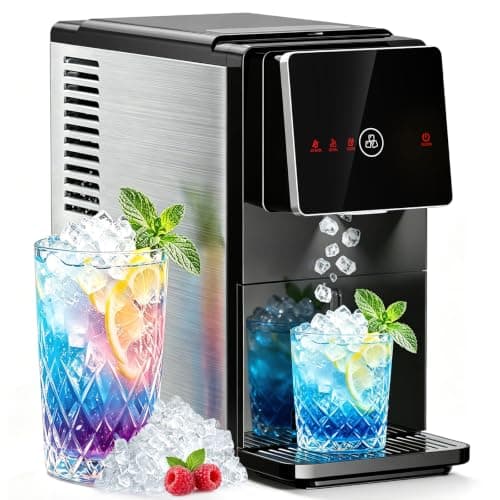 Antarctic Star Z5815DN A model number, a 33 lb rating, a published footprint and R600a, which is more than the rest manage. | Best documented dispensing machine | |
| 2 | 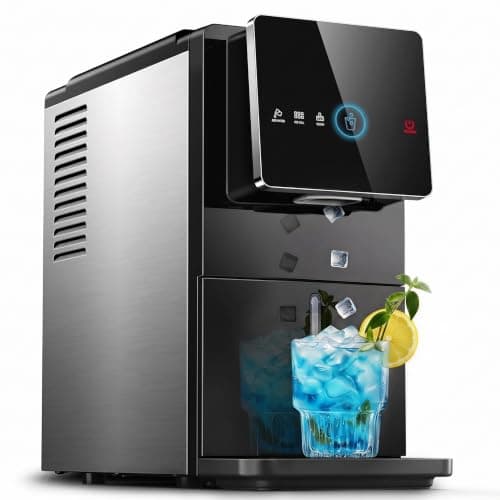 Silonn Not stated on the listing From the budget brand that documents its bullet machine properly, though not this one. | The other one in stock |
#ad We earn a commission on purchases made through this link. How this is funded. Prices last checked October 19, 2026.
Almost every countertop nugget machine finishes the same way: ice falls into an open, unrefrigerated bin and you lift the lid and scoop it out. A dispensing machine replaces that last step with a chute. It is the only genuine format difference in a category where every machine otherwise works the same way.
It is also the corner of the market where the least is published and the most churns. So this page is ordered by what can be verified: what is on sale, what each maker documents, and what the format costs you.
How these were judged
- It has to be on sale, new, today. Every machine ranked below had a live offer when this page was written on 21 September 2026. Dispensing machines go out of stock constantly and this site does not rank what you cannot buy.
- The maker has to publish something. A model number, a footprint, a refrigerant — anything that can be cited and checked. Ranking is by how much of that exists, because with dispensing machines it is the only axis with evidence on it.
- The dispensing has to be the mechanism, not a shape. A tilted bin with a flap is not a dispenser. The machines here push ice out on demand.
- The ice is not a differentiator. Every one of these uses the same auger process, so nobody earns a place here on ice quality, and this site has not tasted any of them.
- No invented numbers. Where a maker publishes no wattage, this page carries no running cost. Where it publishes no bin capacity, this page says so rather than estimating from a photograph.
What each dispensing maker publishes
| Machine | Offer status | What the maker publishes | Running cost |
|---|---|---|---|
| Antarctic Star Z5815DN | On sale, new | Model, 33 lbs a day, footprint, R600a | Not calculable |
| Silonn auto-drop nugget | On sale, new | Nothing we could retrieve for this model | Not calculable |
| Marsail dispensing nugget | On sale, new | Nothing we could retrieve | Not calculable |
| CyberChill dispensing nugget | On sale, new | Nothing we could retrieve | Not calculable |
| ecozy dispensing nugget | Scarce | ecozy publishes no specification table for any model | Not calculable |
| KBice self-dispensing | No current offer | No specification section in its manual | Not calculable |
Compare that with the documented end of the category, where GE prints a 2.0 A rating for the Opal Mini and Frigidaire prints 185 W for the EFIC255. The gap is not a coincidence: dispensing machines are sold on a feature, and the brands selling them compete on price rather than on paperwork.
The hygiene argument, honestly
This is the strongest case for the format, and it is worth stating precisely because it is easy to oversell.
A conventional nugget machine stores finished ice in a bin that is insulated but not refrigerated, opened by hand and reached into with a scoop. The ice is at the mercy of whatever touches it. A chute removes the lid, the hand and the scoop from that path, which is a real improvement in a house with children or in a shared kitchen.
What it does not touch is the water path. These machines still recirculate standing water at room temperature, still grow biofilm if they are neglected, and still scale up in hard water. A dispensing machine that is never descaled will make ice that tastes wrong just as fast as a bin machine will, which is the subject of mold and slime in a nugget ice maker.
There is one extra cleaning job in return: the chute itself. It is the part of a dispensing machine that is hardest to see into, it is wet, and no maker on this page documents how to clean it. Plan to wipe it regularly and to run whatever cycle the machine has on a schedule, using the cross-brand procedure on how to clean a nugget ice maker.
What the chute costs you in capacity
A dispensing machine has to store finished ice somewhere the chute mechanism can reach it, and that storage is smaller than an open bin in the same body. This is where the missing documentation actually bites.
Not one dispensing maker here publishes a storage capacity. On the documented side of the category every full-size machine publishes about 3 lbs, and the Opal 2.0's 3.0 lbs is roughly six tall glasses at about half a pound each. Nobody can tell you the equivalent number for these machines, so the honest planning assumption is that you will be waiting for ice sooner. In practice that shows up at exactly the moment you notice it: four people in a kitchen, four tall glasses, and a machine that has to catch up rather than a bin you can see the bottom of. A conventional machine at least lets you look. The arithmetic for how much you actually need is on how much ice you actually need.
Antarctic Star Z5815DN, the documented one
The only dispensing machine here whose maker publishes a specification block at all: a model number, a 33 lb daily rating, a footprint of 8.27 by 15.55 by 16.93 inches and R600a as the refrigerant. At 8.27 inches wide it is the narrowest nugget machine on this site.
The honest cons: no voltage, no current and no wattage, so there is no running-cost figure for it anywhere on this site. No operating temperature range, which rules it out of a garage on the evidence available. No published capacity behind the chute. And the daily rating comes from a product page rather than a manual, which is the weaker source tier. The full write-up is on the Antarctic Star review.
Silonn auto-drop, the other one in stock
Silonn is the brand this site holds up as proof that a budget maker can document a machine properly: its SLIM21 bullet model publishes voltage, ice-making and harvesting currents, working power, rate, basket capacity, weight and size in one table. None of that exists for the auto-drop nugget model in anything we could retrieve.
The honest cons: everything about it is a listing claim — the 40 lbs a day, the eight-minute first ice, the 20-minute clean cycle. It is ranked second here purely because the brand has a track record of publishing elsewhere and the machine has a live offer, not because there is evidence to weigh.
What to check before you buy one
Because the specifications are thin, the checks that matter here are physical rather than numerical, and most of them can be done from the listing photographs.
- How tall a glass fits under the chute. This is the single most practical question about a dispensing machine and not one maker states it. A pint glass and a travel tumbler are very different heights, and a chute sized for a tumbler is a chute you will be holding a glass sideways under.
- Whether you can still get at the ice by hand. If the mechanism jams or the machine is switched off with ice in it, you want a lid or a hatch rather than a sealed cabinet.
- Whether the chute comes apart for cleaning. It is the wettest, least visible part of the machine and no maker here documents a procedure for it.
- Where the drip goes. Dispensing machines drip after a pour. A removable tray is worth more day to day than a claimed daily rating.
- Whether the offer is real. This is the corner of the category most likely to show an out-of-stock or third-party-only listing, so check before you commit.
None of those checks needs a specification table, which is just as well, because you are not going to get one.
The machine that used to be the answer
Ask about dispensing nugget machines anywhere and someone will name the KBice. It is the unit that made the format popular, and it has no current offer on the retailer this site links to. Our page on it stays up as a documented reference rather than a recommendation, because a top pick that leads to a dead listing is worse than no pick at all.
That churn is itself a reason for caution. Dispensing machines come from brands with short model lifecycles, which affects spare parts, firmware and the odds of finding a replacement chute in three years. The longevity argument is on how long nugget ice makers last.
If dispensing is not essential
Be honest with yourself about the scoop. For most households it is a minor annoyance rather than a problem, and trading a full specification table for it is a bad deal.
The documented alternatives at similar money publish what these do not: the GE Profile Opal Mini prints its current, bin, clearance and operating range; the Frigidaire Gallery EFIC255 prints a real wattage and a daily rate. Neither dispenses, and both tell you what you are buying.
Choosing, in three steps
- Decide whether the chute is worth giving up a specification table for. If it is for children or for hands that struggle with a scoop, it probably is.
- Check the offer before you commit. This is the part of the category most likely to be out of stock, and a dispensing machine with no seller is not a purchase.
- Plan your maintenance around a part you cannot see. The chute is wet, it is enclosed, and nobody documents how to clean it, so put the clean cycle on a schedule from day one.
The picks in full
1. Best documented dispensing machine
Antarctic Star Self-Dispensing Nugget Ice Maker
A dispensing machine you can actually buy, documented to the level of a retail specification block and no further.
- Rated output
- 33 lbs/day
- Bin capacity
- Not published
- Electrical
- Not published
- Ceiling at 4 hrs/day, $0.18/kWh
- Not published
#ad We earn a commission on purchases made through this link. How this is funded. Prices last checked October 19, 2026.
The specification block on Antarctic Star's own product page carries the model, the 33 lb rating, the footprint and the refrigerant. It stops there: no voltage, no current, no wattage, no weight, no operating temperature range and no warranty term.
Dispensing is the whole reason to consider it. Ice drops from a chute into a glass instead of being scooped out of an open bin, which is the one genuine hygiene advantage available in this category.
The 1.8 liter tank and the 10 to 15 minute first batch come from the page's marketing copy rather than its specification block, so this site records them as claims rather than figures.
Skip this if
You want an electrical figure. Antarctic Star publishes no voltage, no current and no wattage, so this page carries no running-cost figure at all.
2. The other one in stock
Silonn Auto Drop Nugget Ice Maker
The dispensing machine from the one budget brand that publishes a full specification table for its other products, and publishes nothing for this one.
- Rated output
- Not published
- Bin capacity
- Not published
- Electrical
- Not published
- Ceiling at 4 hrs/day, $0.18/kWh
- Not published
#ad We earn a commission on purchases made through this link. How this is funded. Prices last checked October 19, 2026.
Silonn is the brand this site holds up as proof that a budget maker can publish a real specification table: the SLIM21 bullet machine prints nine values in one table. None of that exists for the auto-drop nugget model in anything we could retrieve.
The listing claims 40 lbs a day, ice in 8 minutes and a 20-minute self-clean cycle on a five-second button hold. Those are retail-listing claims and this site does not promote them to specifications.
It is included because it is one of only two self-dispensing nugget machines we could verify on sale new, not because it is well documented.
Skip this if
You expected the documentation Silonn gives its bullet machine. The SLIM21's manual prints voltage, current, working power, rate, basket and size; nothing we could retrieve does that for this model.
Questions people actually ask
What is a self-dispensing nugget ice maker?
A machine that pushes finished ice out through a chute into your glass instead of dropping it into an open bin you scoop from. The ice-making mechanism is identical to any other nugget machine: flakes are frozen onto a chilled cylinder and compressed by an auger into soft pellets. What changes is only how the ice gets from the machine to the glass.
Is a dispensing ice maker more hygienic?
In one specific way, yes. A conventional bin is opened by hand, reached into with a scoop, and left at room temperature between uses, so whatever is on the scoop or the hand goes in with the ice. A chute removes that step. It does not make the machine self-cleaning: the water path still recirculates standing water, still scales up and still needs descaling on a schedule.
Which self-dispensing nugget ice makers can you actually buy?
Fewer than the search results suggest. On 21 September 2026 we verified two dispensing nugget machines on sale new with a live offer: an Antarctic Star model and a Silonn auto-drop model. Several others showed as scarce or unavailable, and the best-known dispensing machine of the last few years, the KBice self-dispensing unit, has no current offer at all.
What does a dispensing ice maker give up?
Capacity and documentation, mostly. The chute and its mechanism take internal volume, and not one dispensing maker on this page publishes how much finished ice sits behind the chute — which is the number that decides how many glasses you can fill in a row. None of them publishes an electrical rating either, so none carries a running-cost figure on this site.
Do dispensing machines make different ice?
No. Every machine on this page uses the same auger-and-cylinder mechanism as a GE Opal or a Frigidaire, so the ice is the same soft chewable nugget. If anything the ice is slightly more compacted by the time it reaches the glass, because it has been pushed through a chute rather than lifted out with a scoop.
Is a dispensing nugget ice maker worth the money?
It is worth it if the scoop is the part of the routine you want gone: for children fetching their own drinks, for anyone who finds reaching into a bin awkward, or for a shared kitchen where nobody washes the scoop. It is not worth it if you want a documented machine, because in this category dispensing and documentation currently do not come together.
Sources
- Antarctic Star product page, 33LBS/24H Countertop Nugget Ice Maker (Z5815DN) (read 2026-09-21)
- GE Profile Opal Mini Owner's Manual 49-9000083 Rev. 0, p.15 (Ice Maker Product Specifications) (read 2026-09-13)
- Frigidaire EFIC255 Use & Care Manual, p.12 (product specifications) (read 2026-09-02)
- GE Profile Opal 2.0 Owner's Manual 49-9000029 Rev. 6, p.17 (read 2026-09-02)
- EIA Electric Power Monthly, Table 5.6.A, June 2026 (read 2026-09-02)
Read next
- Antarctic Star Self-Dispensing Nugget Ice Maker (Z5815DN)
Dispenses into the glass, 8.27 inches wide, 33 lbs a day claimed, and no published watts.
- KBice Self Dispensing Nugget Ice Maker
A dispensing format nothing else here offers, with no published specifications.
- The Best Nugget Ice Makers
Six machines ranked on published specs, each with a sourced monthly running-cost ceiling.
- Mold and Slime in a Nugget Ice Maker
Why biofilm grows in these machines, how to remove it, and the habit that prevents it.
- How Much Ice Do You Actually Need?
Why rated output is the wrong number to shop on, and what bin capacity really limits.
- The Best Self-Cleaning Countertop Ice Makers
Which countertop ice makers have a real clean cycle, what it does, and which have no clean button at all.