Reviews
Antarctic Star Self-Dispensing Nugget Ice Maker (Z5815DN)
One of only two self-dispensing nugget machines this site could verify on sale new. Ice drops into the glass rather than into an open bin, and the specification block stops well short of an electrical rating.

Disclosure: we earn a commission if you buy through our links. It never affects which machines we recommend or how we rank them, and we take no sponsored placements. Read the full disclosure.
Quick picks
| # | Machine | Best for | Price |
|---|---|---|---|
| 1 | 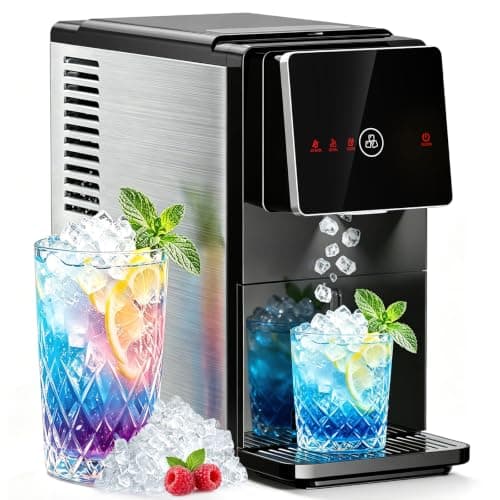 Antarctic Star Z5815DN A chute instead of a scoop, from the only dispensing maker here that publishes a model number and a footprint. | The dispensing pick in stock |
#ad We earn a commission on purchases made through this link. How this is funded. Prices last checked October 19, 2026.
What Antarctic Star publishes
| Spec | Antarctic Star Z5815DN |
|---|---|
| Model | Z5815DN |
| Ice type | Nugget |
| Rated output | 33 lbs/day [src] |
| Rated output per hour | Not published |
| Bin capacity | Not published |
| Published power | Not published |
| Nameplate current | Not published |
| Voltage | Not published |
| Dimensions (W x D x H) | 8.27" W x 15.55" D x 16.93" H [src] |
| Weight, empty | Not published |
| Clearance required | Not published |
| Operating range | Not published |
| Refrigerant | R600a [src] |
| Noise | Not published |
| Warranty | Not published |
| Max $/mo | Not published |
What the chute actually changes
Every other nugget machine on this site finishes its work by dropping ice into an open bin that you reach into. That bin is the least hygienic part of the appliance: it is at room temperature, it is exposed every time the lid comes off, and whatever is on the scoop or on your hand goes in with it.
A dispensing machine closes that loop. Ice leaves through a chute into the glass, one-handed, without a scoop. Three groups of people get real value from that: households where children fetch their own drinks, anyone with limited hand strength or reach, and any shared space where the scoop is the thing nobody washes.
What it does not change is the ice. The auger mechanism that compresses flakes into pellets is the same one every machine in this category uses, and the result is the same soft chewable nugget, as explained on nugget ice versus bullet ice.
The narrowest body here, but not the smallest
At 8.27 inches wide this is the narrowest nugget machine on this site — narrower than the GE Profile Opal Mini's 8.59 inches. That is genuinely useful in a gap between a toaster and a backsplash.
The rest of the dimensions temper it. At 15.55 inches deep and 16.93 tall it is deeper and considerably taller than the Mini, so it will not slide under a shelf that the Mini clears. And because Antarctic Star publishes no clearance figure at all, you should assume the 3 to 6 inches that every documented machine in this category asks for. The fitting numbers for the whole field are on nugget ice makers for small kitchens.
The electrical gap
The specification block carries the model, the 33 lb rating, the footprint and R600a as the refrigerant. It does not carry a voltage, a current rating or a wattage, which is the one omission with money attached: without any of the three there is no honest way to produce a running-cost figure, so this page carries none.
To put the missing number in context, the machines here that publish one run from the Gevi V2.0's 170 W to the 360 VA nameplate GE prints for a full-size Opal, which is roughly $3.67 to $7.78 a month at four running hours a day. A dispensing machine is unlikely to sit outside that band, but "unlikely to sit outside a band" is an assumption, and this site does not print assumptions as figures. The arithmetic it would use is on the running-cost page.
Two other absences matter day to day. There is no published capacity for the finished ice behind the chute, which is exactly the number that decides how many glasses you can fill in a row, and there is no operating temperature range, which is the figure that decides whether the machine belongs in a garage or a sunroom.
What is claimed rather than specified
- A first batch in 10 to 15 minutes. Marketing copy on the same page. Nobody in this category publishes a first-ice time in a specification table, so treat it as a claim.
- A 1.8 liter detachable water tank. Also description copy rather than a specification. For scale, Silonn is the only maker here that prints a reservoir volume in a manual, at 0.32 gallons or 1.2 liters.
- A built-in self-cleaning function. The page names it but does not document what the cycle does or how long it runs, and a cycle on plain water is a rinse rather than a clean. The cross-brand procedure is on how to clean a nugget ice maker.
Matching the listing to the documentation
Antarctic Star publishes more than one nugget machine and the names do not travel well between its own site and a retail listing. The page this review is built from is the 33 lbs/24H countertop nugget machine, which carries the model Z5815DN and describes one-touch dispensing; the brand also lists 34 lb and 44 lb machines elsewhere, and the retail listing this page links names a capacity and a dispensing mechanism but not a model.
We matched them on the two attributes both documents state — 33 lbs a day and self-dispensing — and this page says so rather than implying a tighter link than exists. If you buy one, check the rating plate against the model above before trusting any figure here, because in this corner of the market a brand can revise a machine without renaming it.
The cleaning job nobody documents
Every countertop ice maker needs descaling and a periodic clean, because they all recirculate standing water at room temperature. A dispensing machine adds one more surface to that job, and it is the one you cannot see: the chute.
It is enclosed, it stays damp, and no maker in this format publishes a procedure for it. The practical routine is to run whatever cleaning cycle the machine has on a schedule, wipe the visible part of the chute when you refill, and descale on the interval your water hardness demands rather than when the ice starts tasting wrong. The reasoning behind both jobs is on mold and slime in a nugget ice maker and descaling.
Against the dispensing machine this site already covers
The other dispensing nugget machine on this site is the KBice, which was the best-known unit of its type and is no longer on sale new. That is the awkward truth about this corner of the category: the format has fans, and the machines keep going out of stock.
What has replaced it is a set of near-identical dispensing machines from brands with thin documentation, of which Antarctic Star is the one that publishes the most. The whole field, and what each maker does and does not publish, is on self-dispensing nugget ice makers.
Who should buy this
- Buy it if the scoop is the part you want gone — for children, for shared kitchens, or for anyone who finds reaching into a bin awkward.
- Buy it if your gap is narrow. 8.27 inches is the narrowest body here.
- Buy it if you want a dispensing machine at all. The field is small and most of it publishes even less than this.
- Skip it if you need a running cost. No voltage, no current, no watts, so no figure.
- Skip it if you serve several people at once. The capacity behind the chute is not published, and on a conventional machine you would at least know the bin size.
- Skip it if the machine is going somewhere hot or cold. With no published operating range, a garage or a porch is a gamble — the machines that do publish one are on what temperature an ice maker needs.
The picks in full
1. The dispensing pick in stock
Antarctic Star Self-Dispensing Nugget Ice Maker
A dispensing machine you can actually buy, documented to the level of a retail specification block and no further.
- Rated output
- 33 lbs/day
- Bin capacity
- Not published
- Electrical
- Not published
- Ceiling at 4 hrs/day, $0.18/kWh
- Not published
#ad We earn a commission on purchases made through this link. How this is funded. Prices last checked October 19, 2026.
The specification block on Antarctic Star's own product page carries the model, the 33 lb rating, the footprint and the refrigerant. It stops there: no voltage, no current, no wattage, no weight, no operating temperature range and no warranty term.
Dispensing is the whole reason to consider it. Ice drops from a chute into a glass instead of being scooped out of an open bin, which is the one genuine hygiene advantage available in this category.
The 1.8 liter tank and the 10 to 15 minute first batch come from the page's marketing copy rather than its specification block, so this site records them as claims rather than figures.
Skip this if
You want an electrical figure. Antarctic Star publishes no voltage, no current and no wattage, so this page carries no running-cost figure at all.
Questions people actually ask
What does self-dispensing mean on a nugget ice maker?
Ice leaves the machine through a chute when you press a button or hold a glass under it, instead of sitting in an open bin you reach into with a scoop. The practical difference is hygiene and convenience rather than ice quality: nothing goes into the ice storage except the machine's own ice, and you can fill a glass one-handed. The ice itself is identical, because the auger mechanism that makes it is the same.
How much ice does the Antarctic Star nugget ice maker make?
Antarctic Star's product page lists a capacity of 33 pounds in its specification block. That figure sits alongside a marketing claim of a first batch in 10 to 15 minutes. Neither figure is backed by a manual specification table we could retrieve, so the daily rating carries the weaker source tier and the first-batch claim is recorded here as a claim rather than a figure.
What does the Antarctic Star ice maker cost to run?
Unknown. The product page publishes no voltage, no current and no wattage, so there is no honest way to compute a monthly figure and this page carries none. For context, the machines on this site that do publish an electrical figure land between about $3.67 and $7.78 a month at four running hours a day and 18 cents per kWh.
How big is the Antarctic Star nugget ice maker?
8.27 inches wide, 15.55 deep and 16.93 tall per the product page. That width makes it the narrowest nugget machine on this site, narrower than the GE Profile Opal Mini's 8.59 inches, although it is over an inch deeper and more than two inches taller than the Mini. No clearance figure is published, so plan for the 3 to 6 inches every documented machine in this category asks for.
Is a dispensing ice maker better than a bin?
For hygiene and one-handed use, yes. For capacity, usually not: a dispensing machine gives up internal volume to the chute and the mechanism, and Antarctic Star does not publish how much finished ice this one holds. If several people are being served in a row, a published bin capacity on a conventional machine tells you more than an unpublished one behind a chute.
Sources
- Antarctic Star product page, 33LBS/24H Countertop Nugget Ice Maker (Z5815DN) (read 2026-09-21)
- GE Profile Opal Mini Owner's Manual 49-9000083 Rev. 0, p.15 (Ice Maker Product Specifications) (read 2026-09-13)
- Frigidaire EFIC255 Use & Care Manual, p.12 (product specifications) (read 2026-09-02)
- EIA Electric Power Monthly, Table 5.6.A, June 2026 (US residential average price) (read 2026-09-02)
Read next
- Self-Dispensing Nugget Ice Makers
Machines that dispense into the glass, what each maker publishes, and what the chute costs you.
- KBice Self Dispensing Nugget Ice Maker
A dispensing format nothing else here offers, with no published specifications.
- GE Profile Opal Mini (P4NM20 series)
2.0 A, a 2.6 lb bin, 8.59 inches wide, and no published ice rate at all.
- The Best Nugget Ice Makers
Six machines ranked on published specs, each with a sourced monthly running-cost ceiling.
- Nugget Ice Makers for Small Kitchens
Published dimensions plus required clearance, worked out as the counter space each machine really takes.
- How Much Ice Do You Actually Need?
Why rated output is the wrong number to shop on, and what bin capacity really limits.