Compare
Frigidaire Gallery EFIC255 vs GE Profile Opal 2.0
The most-searched matchup in the category, and the one where the published specs actually disagree in an interesting way.

Disclosure: we earn a commission if you buy through our links. It never affects which machines we recommend or how we rank them, and we take no sponsored placements. Read the full disclosure.
Quick picks
| # | Machine | Best for | Price |
|---|---|---|---|
| 1 | 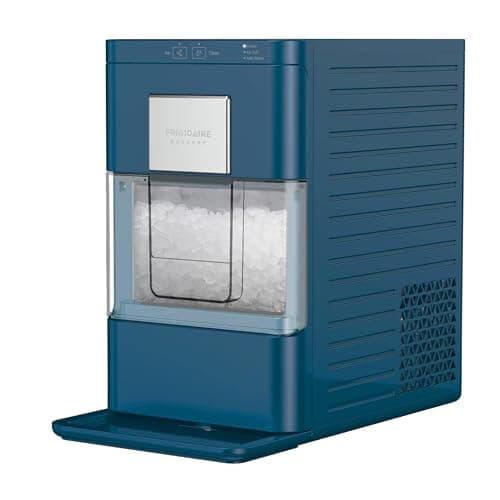 Frigidaire EFIC255 185 W published, 44 lbs a day rated, ten inches wide. | Wins on cost and output |
#ad We earn a commission on purchases made through this link. How this is funded. Prices last checked October 18, 2026.
Side by side, from the manuals
| Spec | Frigidaire EFIC255 | GE Profile XPIO13SCSS |
|---|---|---|
| Model | EFIC255 | XPIO13SCSS |
| Ice type | Nugget | Nugget |
| Rated output | 44 lbs/day [src] | 38 lbs/day [src] |
| Rated output per hour | Not published | 1.6 lbs/hour [src] |
| Bin capacity | 3 lbs [src] | 3 lbs [src] |
| Published power | 185 W [src] | Not published |
| Nameplate current | Not published | 3 A [src] |
| Voltage | 115 V [src] | 120 V [src] |
| Dimensions (W x D x H) | 10" W x 14.6" D x 16.5" H [src] | 16.5" H x 13.43" W x 17.5" D [src] |
| Weight, empty | Not published | 37.6 lbs [src] |
| Clearance required | Not published | 3" [src] |
| Operating range | Not published | Not published |
| Refrigerant | R600a [src] | Not published |
| Noise | Not published | Not published |
| Warranty | Not published | Not published |
| Max $/mo | $4.00(published W) | $7.78(nameplate) |
The electrical comparison is not apples to apples
This is the part every other comparison gets wrong, so it is worth being precise.
Frigidaire publishes Power Consumption: 185 W. That is a consumption figure: what the machine uses.
GE publishes Current: 3.0 A and no wattage. At 120 V that is 360 VA, which is a nameplate: the maximum the appliance may draw, used for sizing a circuit. A cycling compressor appliance draws less than its nameplate while running and nothing while idle.
So "$4.00 against $7.78" overstates the gap. The honest statement is: the Frigidaire's monthly cost is about $4.00, and the GE's is no more than $7.78 and probably materially less. Frigidaire still almost certainly wins — a 185 W consumption figure and a 360 VA ceiling are not close — but the size of the win is not knowable from published data.
The full arithmetic and the reasoning behind the ceiling approach is on the running-cost page.
Output: 44 versus 38, with a caveat both ways
Frigidaire states 20 kg per 24 hours (44.1 lbs). GE states 38 lbs per day and adds 1.6 lb per hour, which nobody else in this category publishes.
That hourly figure is the more useful number for a real kitchen. A daily rating describes a machine running flat out into an empty bin for 24 hours, which never happens at home. An hourly rating tells you roughly when the next glass arrives — about three glasses an hour on the Opal, at half a pound a glass.
GE also attaches an explicit disclaimer to its whole table: "Technical data and performance information provided for reference only." Frigidaire attaches none, which does not make Frigidaire's number more reliable — it makes GE's more candid.
Documentation, where GE wins outright
| Specification | Frigidaire EFIC255 | GE Opal 2.0 |
|---|---|---|
| Rated output per day | Yes (20 kg/24h) | Yes (38 lbs) |
| Rated output per hour | No | Yes (1.6 lb/hr) |
| Power consumption | Yes (185 W) | No |
| Current rating | No | Yes (3.0 A) |
| Bin capacity | No | Yes (3.0 lbs) |
| Empty weight | No | Yes (37.6 lbs) |
| Installation clearance | No | Yes (3 in) |
| Refrigerant | Yes (R600a) | No |
| Dimensions | Yes | On the product page, not the manual |
| Noise rating | No | No |
The bin-capacity omission is the one that will bother you in use. Bin size is what actually limits a countertop machine day to day, and Frigidaire does not print it. The 3 lb figure you see for the EFIC255 — including on our own spec table — comes from a retail listing, and we flag it as our weakest source tier.
Footprint
The Frigidaire is narrower and shallower: 10 by 14.6 inches against 13.43 by 17.5. On a tight counter run that is a real difference, roughly three and a half inches of width and three of depth.
GE is the only one of the two publishing a clearance requirement, at 3 inches. Frigidaire publishes none, but the same physics applies — the hot air has to go somewhere — so budget for it either way.
The tiebreak
If the two machines are close on price where you shop, the deciding question is what you want to be true in three years. The Opal ecosystem — filters, descaling powder, published procedures, an enormous body of troubleshooting information written by other owners — is deeper than anything Frigidaire has in this category. That is not a spec, and it is worth money.
If the Frigidaire is meaningfully cheaper, take the cheaper machine and the lower bill, and accept a thinner spec sheet.
The picks in full
1. Wins on cost and output
Frigidaire Gallery Countertop Nugget Ice Maker
The only nugget machine here whose maker publishes an actual power consumption instead of a nameplate ceiling, and it is a low one.
- Rated output
- 44 lbs/day
- Bin capacity
- 3 lbs
- Electrical
- 185 W published
- Ceiling at 4 hrs/day, $0.18/kWh
- $4.00/month (from published watts)
#ad We earn a commission on purchases made through this link. How this is funded. Prices last checked October 18, 2026.
185 W published means the running-cost figure for this machine is not a derived ceiling — it is arithmetic on a number Frigidaire printed. That is the strongest cost data on the site.
It is rated at 20 kg a day, which is 44 lbs — higher than the Opal 2.0's 38. Both numbers are measured under ideal conditions the manual does not describe.
Ten inches wide and 16.5 tall makes it the narrowest full-size nugget machine in this set.
Skip this if
You need a manufacturer-published bin capacity. Frigidaire's specification table omits it, so the 3 lb figure on this page comes from a retail listing rather than the manual.
Questions people actually ask
Is the Frigidaire nugget ice maker better than the GE Opal?
On published specifications, Frigidaire wins twice: 44.1 lbs a day rated against GE's 38, and 185 W of published power consumption against GE's 360 VA nameplate ceiling. GE wins on documentation, publishing a per-hour ice rate, a bin capacity, a clearance requirement and an empty weight that Frigidaire's specification table omits. Which matters more depends on whether you value a lower bill or a fuller spec sheet.
Which is cheaper to run, the Frigidaire EFIC255 or the GE Opal 2.0?
The Frigidaire, by roughly half. 185 W published works out to about $4.00 a month at four running hours a day and 18 cents per kWh. The Opal 2.0 publishes no wattage, only a 3.0 A rating, which at 120 V gives a 360 VA nameplate and a ceiling of about $7.78. Those are two different kinds of number, and the real Opal figure is lower than its ceiling.
Which makes more ice, Frigidaire or GE Opal?
Frigidaire, on paper. The EFIC255 manual states 20 kg per 24 hours, which is 44.1 lbs. GE's Opal 2.0 manual states 38 lbs per day. Both figures are measured under ideal conditions the manuals do not describe, and GE explicitly notes that its performance data is provided for reference only.
Does the Frigidaire or the GE take up less space?
The Frigidaire is narrower at 10 inches against GE's 13.43, and shallower at 14.6 inches against 17.5. GE publishes a 3 inch clearance requirement; Frigidaire publishes none, though the same ventilation physics applies.
Sources
- Frigidaire EFIC255 Use & Care Manual, p.12 (read 2026-09-02)
- GE Profile Opal 2.0 Owner's Manual 49-9000029 Rev. 6, p.17 (read 2026-09-02)
- EIA Electric Power Monthly, Table 5.6.A, June 2026 (read 2026-09-02)
Read next
- Frigidaire Gallery EFIC255
185 W published and 44 lbs a day rated. The best output-per-watt figure on the site.
- GE Profile Opal 2.0 (XPIO13SCSS)
3.0 A, 38 lbs a day, 1.6 lbs an hour. The best-documented machine in the category.
- The Best Nugget Ice Makers
Six machines ranked on published specs, each with a sourced monthly running-cost ceiling.
- What a Nugget Ice Maker Costs to Run
Per-model monthly costs with the wattage sourced, the duty cycle stated and the arithmetic shown.
- GE Opal vs GE Profile Opal 2.0
2.5 A versus 3.0 A, 24 lbs versus 38, 44 lbs versus 37.6. And the support page mix-up.
- NewAir NIM044BS00 vs GE Profile Opal 2.0
A bigger bin, a lighter body and less current, against GE's deeper documentation.
- GE Profile Opal Mini vs Frigidaire Gallery EFIC255
Frigidaire publishes the rate and the watts. GE publishes the clearance and the temperature range. Neither publishes both.