Compare
GE Opal vs GE Profile Opal 2.0
Two manuals, six years apart, and the source of nearly every wrong number about the Opal you will read online.
Disclosure: we earn a commission if you buy through our links. It never affects which machines we recommend or how we rank them, and we take no sponsored placements. Read the full disclosure.
Quick picks
| # | Machine | Best for | Price |
|---|---|---|---|
| 1 | 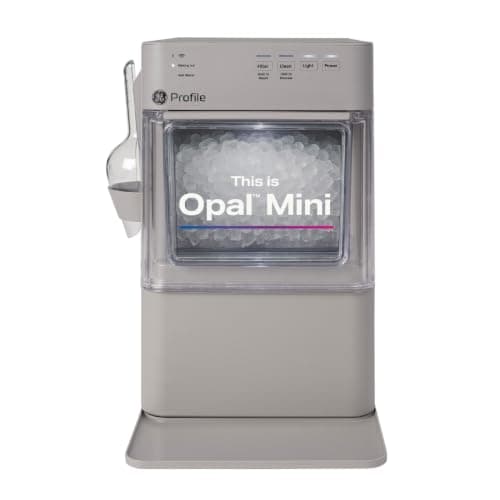 GE Profile P4NM20 series Neither machine compared here is sold new right now. This is GE's current small Opal. | The Opal you can buy today |
#ad We earn a commission on purchases made through this link. How this is funded. Prices last checked October 19, 2026.
The two manuals, side by side
| Spec | GE Profile OPAL01 | GE Profile XPIO13SCSS |
|---|---|---|
| Model | OPAL01 | XPIO13SCSS |
| Ice type | Nugget | Nugget |
| Rated output | 24 lbs/day [src] | 38 lbs/day [src] |
| Rated output per hour | Not published | 1.6 lbs/hour [src] |
| Bin capacity | 3 lbs [src] | 3 lbs [src] |
| Published power | Not published | Not published |
| Nameplate current | 2.5 A [src] | 3 A [src] |
| Voltage | 120 V [src] | 120 V [src] |
| Dimensions (W x D x H) | 10.5" W x 14" D x 17" H [src] | 16.5" H x 13.43" W x 17.5" D [src] |
| Weight, empty | 44 lbs [src] | 37.6 lbs [src] |
| Clearance required | 3" [src] | 3" [src] |
| Operating range | 55F to 90F [src] | Not published |
| Refrigerant | Not published | Not published |
| Noise | Not published | Not published |
| Warranty | Not published | Not published |
| Max $/mo | $6.48(nameplate) | $7.78(nameplate) |
What actually changed
- Output, up 58 percent. 24 lbs a day to 38, and the 2.0 adds a per-hour figure (1.6 lbs) that the original does not publish.
- Current, up 20 percent. 2.5 A to 3.0 A. More ice per hour requires more compressor work, so this is expected rather than a regression.
- Weight, down 6.4 lbs. 44 lbs empty to 37.6.
- Bin capacity, unchanged. 3.0 lbs on both. This is the number that limits a countertop machine at home, and six years of development did not move it.
- Operating range, no longer published. The original manual states 55F to 90F. The 2.0 manual's corresponding row was not legible in the copy we read, so we record it as Not published rather than assuming it carried over.
The support-page problem
Two consequences worth carrying away. First, listings advertising 38 lbs a day for a current Opal are not exaggerating. Second, the "300 W" figure that circulates for the Opal is the original's 300 VA nameplate, and the "360 W" figure is the 2.0's. Neither is a consumption measurement.
Running cost, both generations
| Machine | Nameplate | kWh/month | Ceiling |
|---|---|---|---|
| Opal 1.0 (OPAL01) | 120 V x 2.5 A = 300 VA | 36.0 | $6.48 |
| Opal 2.0 (XPIO13) | 120 V x 3.0 A = 360 VA | 43.2 | $7.78 |
Per pound of rated ice, the 2.0 is the more efficient machine: it costs about 20 percent more to run for about 58 percent more output. The upgrade is not just speed.
Which to buy
Buy the 2.0 unless the original is substantially cheaper. For two people, 24 lbs a day is genuinely enough and a discounted original is a sensible purchase — you are giving up speed and gaining nothing else except 6.4 lbs of weight.
If you already own an original that works, keep it. Nothing in these two spec tables justifies replacing a functioning appliance, and if yours has slowed down the cause is far more likely to be scale than age. Start with descaling.
The picks in full
1. The Opal you can buy today
GE Profile Opal Mini Nugget Ice Maker
The smallest and lowest-draw Opal GE has built, and the first one whose specification table omits the ice rate entirely.
- Rated output
- Not published
- Bin capacity
- 2.6 lbs
- Electrical
- 2 A at 120 V (240 VA nameplate)
- Ceiling at 4 hrs/day, $0.18/kWh
- $5.18/month (from the nameplate ceiling)
#ad We earn a commission on purchases made through this link. How this is funded. Prices last checked October 19, 2026.
2.0 A at 120 V is a 240 VA nameplate, against 360 VA for both full-size Opal 2.0 models. On the site's standard four-hours-a-day scenario that is roughly $5.18 a month as a ceiling rather than $7.78.
The 2.6 lb bin is smaller than the 3.0 lbs every full-size machine here publishes, which is about one tall glass less before the machine has to catch up.
GE's own specification table carries no ice-making rate for the Mini, exactly as it carries none for the Opal 2.0 Ultra. The 36 lbs a day in GE's press release and on the retail listing is a claim, not a published specification, and this site does not promote it to one.
Skip this if
You want a published ice-making rate. GE's specification table for the Mini prints no rate at all, so the 36 lbs a day on the box is a marketing figure with no spec-sheet backing.
Questions people actually ask
What is the difference between the GE Opal and the Opal 2.0?
From the two owner's manuals: the original Opal (OPAL01) is rated 2.5 A, 24 lbs per day and 44 lbs empty. The Opal 2.0 (XPIO13) is rated 3.0 A, 38 lbs per day plus 1.6 lbs per hour, and 37.6 lbs empty. Bin capacity is 3.0 lbs on both. So the 2.0 is substantially faster, over 6 lbs lighter, and draws more current.
Why does GE say the Opal makes 24 pounds a day when listings say 38?
Because GE's public Opal support specification page documents the first-generation machine and never says so. Every value on that page (120V AC / 60 Hz / 2.5 A, 24 pounds per day, 3 pounds of ice) matches the 2017 OPAL01 manual exactly. The 38 lbs figure comes from the Opal 2.0's own owner's manual and is correct for the current machine.
Is the Opal 2.0 worth upgrading to from the original?
If your original Opal still works, no — nothing in the published specs justifies replacing a working appliance. If you are buying either one used or discounted, the 2.0 is the better machine on every published figure except current draw, and it costs about $1.30 a month more to run at its ceiling.
Do the Opal and Opal 2.0 use the same filters and cleaning products?
GE sells filters and a cleaning solution across the Opal line, but part numbers vary by model and generation. Check the part number against your specific model rather than assuming, and do not substitute a descaler for the cleaning solution or vice versa: they do different jobs.
Sources
- GE Profile Opal 2.0 Owner's Manual 49-9000029 Rev. 6, p.17 (read 2026-09-02)
- FirstBuild Opal Use & Care manual, Ver. 2/13/2017, p.12 (read 2026-09-02)
- GE Appliances Opal support specification page (read 2026-09-02)
- EIA Electric Power Monthly, Table 5.6.A, June 2026 (read 2026-09-02)
Read next
- GE Profile Opal 2.0 (XPIO13SCSS)
3.0 A, 38 lbs a day, 1.6 lbs an hour. The best-documented machine in the category.
- GE Opal, First Generation (OPAL01)
2.5 A, 24 lbs a day, 44 lbs empty. The most completely specified machine we found.
- The Best Nugget Ice Makers
Six machines ranked on published specs, each with a sourced monthly running-cost ceiling.
- What a Nugget Ice Maker Costs to Run
Per-model monthly costs with the wattage sourced, the duty cycle stated and the arithmetic shown.
- GE Opal Error Lights and Warnings
What the indicators mean, and why a full reservoir can still show add water.
- Frigidaire Gallery EFIC255 vs GE Profile Opal 2.0
185 W published versus a 360 VA nameplate. 44 lbs a day versus 38. A real contest.
- GE Profile Opal 2.0 vs Opal 2.0 Ultra
Identical on current, weight and bin. The Ultra wants 4 inches of clearance and publishes no ice rate.
- GE Profile Opal Mini vs Opal 2.0 Ultra
2.0 A against 3.0 A, 2.6 lbs of bin against 3.0, and one published footprint between them.