Reviews
VEVOR Countertop Nugget Ice Maker (HZB-15N/S)
The only maker on this site that puts a decibel figure in a specification block, on a body that also sells as a Cowsar and an AGLUCKY with completely different published wattages.

Disclosure: we earn a commission if you buy through our links. It never affects which machines we recommend or how we rank them, and we take no sponsored placements. Read the full disclosure.
Quick picks
| # | Machine | Best for | Price |
|---|---|---|---|
| 1 | 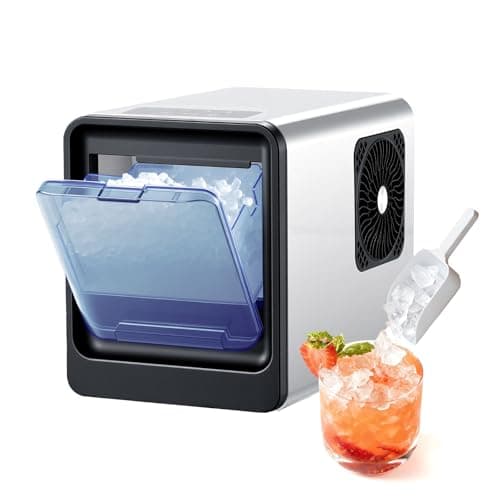 VEVOR HZB-15N/S A labeled specification block with a model number, a wattage, a storage capacity and a noise ceiling. | The only published dB figure |
#ad We earn a commission on purchases made through this link. How this is funded. Prices last checked October 19, 2026.
What VEVOR publishes
| Spec | VEVOR HZB-15N/S |
|---|---|
| Model | HZB-15N/S |
| Ice type | Nugget |
| Rated output | 33 lbs/day [src] |
| Rated output per hour | Not published |
| Bin capacity | 1.5 lbs [src] |
| Published power | 160 W [src] |
| Nameplate current | Not published |
| Voltage | Not published |
| Dimensions (W x D x H) | 8.7" W x 11.3" D x 12.7" H [src] |
| Weight, empty | 20.3 lbs [src] |
| Clearance required | Not published |
| Operating range | Not published |
| Refrigerant | Not published |
| Noise | 42 dB [src] |
| Warranty | Not published |
| Max $/mo | $3.46(published W) |
The decibel figure nobody else publishes
This site has said from the beginning that nobody in this category publishes a decibel rating. That was true of every manual and every specification table we had read, and it is still true of all of them — but it is no longer true of every specification block. VEVOR prints Noise Level: <=42dB alongside the model number, the wattage and the storage capacity.
It deserves credit and caution in about equal measure. The credit: it is a number, in the structured part of the page, next to other figures the maker is willing to be held to. The caution is longer:
- It is a ceiling, not a measurement. "Less than or equal to 42 dB" tells you what the machine should not exceed, which is not the same as what it does while harvesting ice.
- No test standard. A decibel figure without a method and a distance cannot be compared with anyone else's, and nobody else in this category publishes one to compare it with.
- No operating condition. An ice maker is not one noise. There is a compressor hum, a pump, and an auger harvest that is the part people actually notice.
So this site records 42 dB as a published figure and refuses to rank machines on it. Why a single number cannot answer the noise question in this category is the whole argument on the quietest nugget ice maker page.
160 W, and the badge problem
The specification block prints Power: 160W, which at four running hours a day and 18 cents per kWh is about $3.46 a month. That is a useful figure on its own. It becomes a more interesting one when you put it beside the two other badges selling the same body.
| Brand | Published size | Published wattage | Monthly at 4 hrs/day |
|---|---|---|---|
| VEVOR HZB-15N/S | 8.7 x 11.3 x 12.7 in | 160 W | About $3.46 |
| Cowsar | 8.66 x 11.3 x 12.68 in | 136 W | About $2.94 |
| AGLUCKY 15NB | 8.66 x 11.3 x 12.68 in | 310 W | About $6.70 |
None of this means any one page is lying. Badge-engineered appliances can differ in compressor, fan or control board, and a spec block can also simply be wrong. What it does mean is that a single published wattage from any of these three brands is worth less than the same figure from a maker who prints it in a manual with a model number on the cover — which is the argument for the Gevi V2.0, whose manual prints 170 W with a 3.0 A nameplate.
The same body under other names is reviewed on the Cowsar page and the AGLUCKY page, and the pattern across the cheap end of this market is covered on the budget nugget roundup.
1.5 lbs is the real constraint
VEVOR publishes Ice Storage Capacity: 1.5 lbs / 0.7 kg, and this is the number that will shape how the machine feels. A tall glass of nugget ice is roughly half a pound, so a full bin is about three glasses. Every full-size machine on this site publishes 3.0 lbs or more, which is six.
For one or two people topping up through the day that is fine, because the machine keeps making ice as you take it. For four people at once it is not, and no daily rating fixes it — the sizing arithmetic is on how much ice you actually need.
Credit where it is due on the rating itself: VEVOR labels 33 lbs a day as a maximum. Almost every listing in this category states a daily figure as though it were a promise, and calling it a ceiling is more honest than the norm.
The reservoir, and the 6-to-20-minute spread
Two description-copy figures are worth working through even though they sit outside the specification block, because together they tell you how the machine will behave.
The reservoir is about 1.1 liters. Water weighs a kilogram a liter, so a full tank is roughly 2.4 lbs of water, which is a little over the 1.5 lb bin. In practice that means one fill produces about one bin of ice plus a margin — so a household using it steadily is at the tap once or twice a day. Meltwater drains back to the reservoir rather than out of the machine, which softens that, and the mechanism is on how much water these machines use.
The first-ice claim is "6 to 20 minutes", and the width of that range is the honest part. A three-fold spread is what ambient and water temperature do to a small machine: a warm kitchen and warm water mean a longer freeze, and there is no operating range published here to tell you where the machine stops coping. Compare that with the Frigidaire EFIC189, whose manual states a cycle of 8 minutes and then tells you it varies with ambient and water temperature, and publishes both ranges. Cycle timing across the category is on how long a nugget ice maker takes.
What VEVOR does not publish
The gaps are the usual ones at this price, and two of them matter.
- No voltage and no current. A wattage tells you the running cost; a nameplate tells you what the machine may draw at startup, which is what trips an undersized circuit or inverter. The distinction is on electrical requirements.
- No operating temperature range. Six machines here publish one; this is not one of them, so a garage or a porch is a guess. The published field is on what temperature an ice maker needs.
- No refrigerant and no charge. Every manual on this site names one. A product page rarely does.
- No clearance figure. Assume the 3 to 6 inches the documented machines ask for.
The description copy adds a 1.1 liter reservoir, a first batch in 6 to 20 minutes and a 30-minute self-cleaning cycle. Those sit outside the specification block, so this site records them as claims rather than figures — and a cleaning cycle on plain water is a rinse in any case, as set out on how to clean a nugget ice maker.
Who should buy this
- Buy it if you want the cheapest nugget machine whose maker publishes a labeled specification block with a model number in it.
- Buy it if noise is your main worry and you accept that 42 dB is a ceiling with no method behind it. It is the only published figure in the category.
- Buy it if one or two people are drinking the ice and the machine can stay plugged in.
- Skip it if you serve a crowd. 1.5 lbs of storage is half what a full-size machine holds.
- Skip it if you need a nameplate or an operating range — for a garage, an RV or a shared circuit, buy a machine that publishes them.
- Skip it if the wattage is load-bearing in your decision. Three badges publish three different numbers for this body, and the Gevi V2.0 prints its figures in a manual instead.
The picks in full
1. The only published dB figure
VEVOR Countertop Nugget Ice Maker
The only machine on this site whose maker puts a decibel figure in a specification block, on a body that also turns up badged as a Cowsar and an AGLucky.
- Rated output
- 33 lbs/day
- Bin capacity
- 1.5 lbs
- Electrical
- 160 W published
- Ceiling at 4 hrs/day, $0.18/kWh
- $3.46/month (from published watts)
#ad We earn a commission on purchases made through this link. How this is funded. Prices last checked October 19, 2026.
VEVOR's specification block is unusually well labeled for this price: it names the model number, calls the daily rating a maximum, gives the storage capacity in pounds and kilograms, and states the housing steel grade.
It publishes no voltage, no current, no refrigerant and no operating temperature range, so there is no nameplate here and no documented advice about a cold or hot room.
The 42 dB figure is a ceiling with no test method attached. It is recorded because it appears in a specification block rather than in marketing copy, and it should not be read as a measurement.
Skip this if
You want an electrical rating you can size a circuit from, or a bin that serves more than three glasses. VEVOR publishes a wattage but no voltage or current, and the storage is 1.5 lbs.
Questions people actually ask
How loud is the VEVOR nugget ice maker?
VEVOR publishes 'Noise Level: <=42dB' in its specification block, which makes it the only machine on this site with a decibel figure anywhere except marketing copy. Treat it carefully: it is a ceiling rather than a measurement, and no test standard, measuring distance or operating condition is stated. Two other makers advertise numbers in description copy - Silonn 35 dB and 47 dB on different models, GoveeLife 40 dB - and this site records those as claims.
How much electricity does the VEVOR nugget ice maker use?
Its specification block prints 160 W. At four running hours a day and 18 cents per kWh that is about $3.46 a month, between the Cowsar's 136 W and the Gevi V2.0's 170 W. VEVOR publishes no voltage or current, so there is no nameplate figure here to size a circuit or an inverter from.
How much ice does it hold?
1.5 lbs, printed as 'Ice Storage Capacity: 1.5 lbs / 0.7 kg'. At roughly half a pound of nugget ice per tall glass that is about three glasses before the machine has to catch up, against six for the full-size Opals. The 33 lbs a day is labeled a maximum, which is more honest than most listings in this category manage.
Is the VEVOR the same machine as the Cowsar or the AGLUCKY?
The published dimensions say the bodies are the same: VEVOR gives 8.7 by 11.3 by 12.7 inches, Cowsar and AGLUCKY both give 8.66 by 11.3 by 12.68. The published wattages do not agree at all - 160 W here, 136 W on the Cowsar page, 310 W on the AGLUCKY page - and neither brand explains the difference. Buy on the badge you can verify is in stock, and treat any single wattage as approximate.
Does VEVOR publish an operating temperature range?
No. There is no operating range, no voltage, no current and no refrigerant in the specification block, so a garage or a sunroom is an assumption with this machine. The machines that do publish a range are compared on our operating-temperature guide.
Sources
- VEVOR product page, Countertop Nugget Ice Maker 33lbs/24H (model HZB-15N/S), product specification block (read 2026-09-27)
- Cowsar product page, 34lbs/24H Nugget Ice Makers Countertop (specification block) (read 2026-09-22)
- AGLUCKY product page, Nugget Ice Maker Countertop (model 15NB), specification block (read 2026-09-27)
- Gevi GIMN-1000B User Manual, p.17 (Technical Parameters) (read 2026-09-21)
- EIA Electric Power Monthly, Table 5.6.A, June 2026 (US residential average price) (read 2026-09-02)
Read next
- AGLUCKY Countertop Nugget Ice Maker (15NB)
34 lbs a day, 310 W published, and the same body Cowsar sells at 136 W.
- Cowsar Countertop Nugget Ice Maker
136 W published, 34 lbs a day claimed, 12.68 inches tall, and no model number anywhere.
- The Quietest Nugget Ice Maker
One published dB ceiling, no tested ratings anywhere. What to do about that, and what actually makes the noise.
- Best Budget Nugget Ice Makers
The cheap end of the category, ranked by what their makers are willing to publish.
- What a Nugget Ice Maker Costs to Run
Per-model monthly costs with the wattage sourced, the duty cycle stated and the arithmetic shown.
- Which Ice Maker Brand Should You Buy?
Brands ranked on what they publish, who supports them, and what you can actually buy today.