Guides
Can You Leave a Nugget Ice Maker On All the Time?
Yes, and the machine will not hurt itself doing it. The question worth asking is what you are paying for ice you are not drinking, because an unrefrigerated bin means the machine is re-freezing the same water all day.
Disclosure: we earn a commission if you buy through our links. It never affects which machines we recommend or how we rank them, and we take no sponsored placements. Read the full disclosure.
Quick picks
| # | Machine | Best for | Price |
|---|---|---|---|
| 1 | 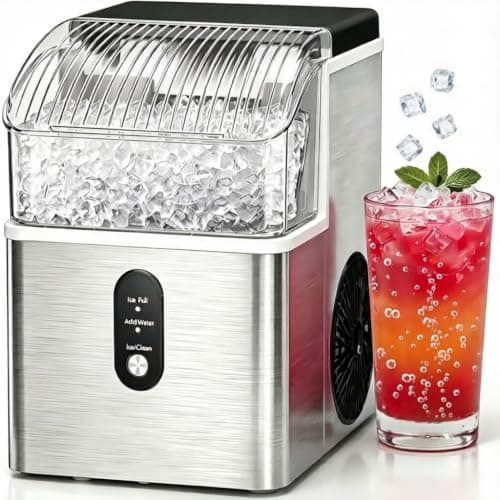 Cowsar Not stated by Cowsar 136 W published, the lowest draw of any purchasable nugget machine here, which is the figure that matters when the hours go up. | Cheapest to leave running | |
| 2 | 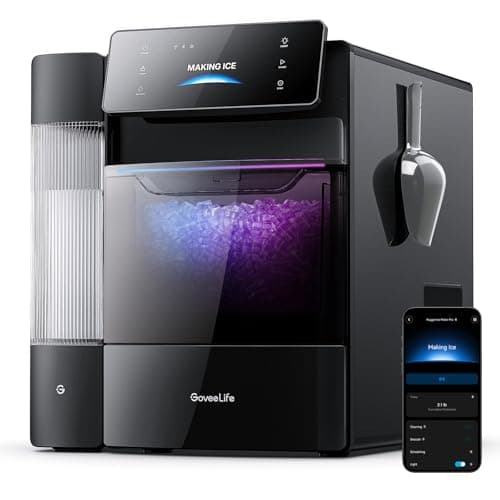 GoveeLife H8120 A 3.5 lb published basket, the largest here, so it reaches full and stops sooner and spends less of the day re-freezing. | Longest idle between harvests | |
| 3 | 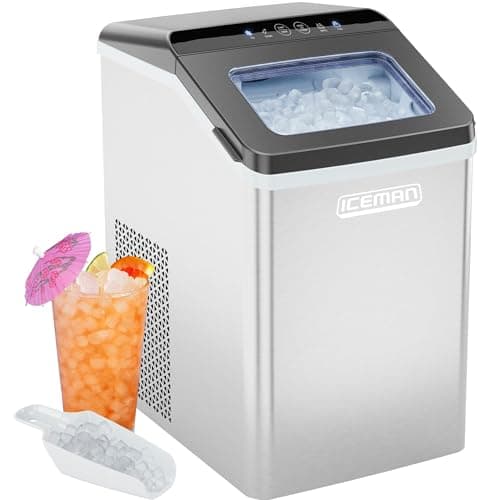 Iceman by Chefman RJ56-PB18-SS The only machine here that publishes both a wattage and a mid-size bin: 170 W and 2.4 lbs. | Best balance of the two |
#ad We earn a commission on purchases made through this link. How this is funded. Prices last checked October 19, 2026.
What actually happens when you leave it on
It helps to be precise about the cycle, because the usual worry — that the machine runs itself into the ground — is the wrong one.
- You switch it on. It makes ice at its own rate. GE is the only manufacturer in this category that publishes an hourly figure, and for the Opal 2.0 it is 1.6 lbs an hour.
- The basket fills. A sensor reads full and production stops. The machine is now idle and drawing next to nothing.
- The ice starts melting, because the basket is not refrigerated. Meltwater drains back to the reservoir on most machines.
- The sensor clears. The machine starts again and re-freezes water it already froze.
- Repeat, for as long as it is switched on.
Nothing in that sequence is abusive. The machine is doing what it was designed to do and it is spending most of the day idle. But steps 3 to 5 are the whole reason "leave it on" is a worse default than it sounds: the work is real and the ice is not. Why no machine in this category holds its ice is explained on do countertop ice makers keep ice frozen.
What it costs, with the arithmetic
A running cost needs a wattage, a duty assumption and a rate. The wattages below are each manufacturer's own published figure; the rate is the EIA's US residential average of about 18 cents a kWh; and the duty assumption is the variable you are changing when you leave the machine on.
| Machine | Published power | 4 hrs/day | 8 hrs/day | 12 hrs/day |
|---|---|---|---|---|
| Cowsar | 136 W | $2.94 | $5.88 | $8.81 |
| Iceman RJ56-PB18-SS | 170 W | $3.67 | $7.34 | $11.02 |
| Frigidaire EFIC255 | 185 W | $4.00 | $7.99 | $11.99 |
| GoveeLife H8120 | 210 W | $4.54 | $9.07 | $13.61 |
Two things fall out of that table. First, the scaling is linear and obvious — the hours are the whole story, which is why the choice to leave it on matters more than the choice of machine. Second, even the worst case is small in absolute terms: $13.61 a month is a heavily-used machine left on half the day. If the electricity is what was worrying you, stop worrying. The full method, including why four hours is the baseline, is on what a nugget ice maker costs to run.
The real cost is descaling, not electricity
This is the part that does not show up on a bill. Scale is dissolved mineral left behind when water freezes and melts, and it accumulates in proportion to how much water moves through the machine — not to how long the machine is plugged in.
A machine left on all day cycles repeatedly, so it passes several times as much water through the freezing cylinder as a machine switched on for an hour when someone wants a drink. Scale on that cylinder is what makes a machine slow down, and a slow machine is the single most common complaint in this category. You will reach your descaling interval sooner, and on hard water materially sooner. The procedure and the interval logic are on how to descale a nugget ice maker.
There is a second hygiene point. Water that sits warm in a reservoir between cycles is where biofilm forms, and biofilm is why ice starts tasting of the machine. A machine left on is at least moving its water; a machine left off with a full reservoir is worse. So the instruction is not simply "switch it off" — it is switch it off and empty it, which is covered on why ice tastes or smells bad.
If you are going to leave it on, what to look for
Two published specifications matter, and they pull in opposite directions. That tension is the whole basis of the picks on this page.
- The lowest published wattage, because the hours are going up and the wattage is the multiplier. The spread across purchasable nugget machines is 136 W to 310 W, which is more than a factor of two.
- The largest published bin, because a bigger basket takes longer to fill, stops production sooner, and holds a larger thermal mass that melts more slowly in proportion to its surface. A machine that reaches full and stays full is a machine that is not re-freezing.
- Not the daily output rating. A high pounds-per-day figure is actively unhelpful here: it means the machine refills the bin faster after each melt and therefore cycles more often. See how much ice you actually need.
| Machine | Rated output | Bin | Electrical | Max $/mo |
|---|---|---|---|---|
| Cowsar Not stated by Cowsar | 34 lbs/day [src] | Not published | 136 W [src] | $2.94(published W) |
| GoveeLife H8120 | 60 lbs/day [src] | 3.5 lbs [src] | 210 W [src] | $4.54(published W) |
| Iceman by Chefman RJ56-PB18-SS | 33 lbs/day [src] | 2.4 lbs [src] | 170 W [src] | $3.67(published W) |
The Cowsar wins on the first criterion outright at 136 W, and its honest downside is that it publishes no bin capacity at all, so you are choosing it on one number and guessing the other. The GoveeLife wins on the second with a 3.5 lb basket, and its downside is that it is also the thirstiest machine here at 210 W — the highest hours-multiplier of the three. The Iceman by Chefman is the compromise and the only machine on this site that publishes both a wattage and a mid-size bin; its downside is that its maker also claims a 20-minute first-ice time, slower than its own cheaper sibling, for reasons nobody explains.
So: on, or off?
Off, by default, with the bin and reservoir emptied. A countertop nugget machine is a make-it-when-you-want-it appliance. Treating it as an always-on ice supply asks it to do the one job it was not built for — storing ice — and you pay for that in descaling frequency.
On, deliberately, when you need volume. Leave it running for a day or two before people arrive and harvest the basket into lidded containers in the freezer every time it fills. Two or three harvests a day for two days will cover a party comfortably, and that is the only way to get 20 pounds out of a machine that holds three.
If what you actually want is ice that is simply always there, cold, without you managing it, then no countertop machine does that and you are shopping for a different appliance — either an undercounter machine or, as of 2026, a refrigerator with the maker built into the door. Both are compared on do any refrigerators make nugget ice.
The picks in full
1. Cheapest to leave running
Cowsar Countertop Nugget Ice Maker (34 lbs/24H)
The smallest nugget body and the lowest published wattage on this site, from a maker that publishes six figures on a product page and no model number anywhere.
- Rated output
- 34 lbs/day
- Bin capacity
- Not published
- Electrical
- 136 W published
- Ceiling at 4 hrs/day, $0.18/kWh
- $2.94/month (from published watts)
#ad We earn a commission on purchases made through this link. How this is funded. Prices last checked October 19, 2026.
Cowsar's product page carries a short specification block - brand, dimensions, capacity and wattage - and no model number. That makes the figures checkable only against the page itself, and there is no manual we could retrieve to compare them with.
Description copy on the same page adds a net weight of 20.68 lbs, a reservoir of about 1.1 liters (0.3 gallons), a 15-minute self-cleaning cycle on a five-second button hold, first ice in 7 minutes and an R600a compressor. Those sit outside the specification block, so this site records them as claims rather than figures.
Not published anywhere: voltage, current, ice basket capacity, installation clearance, warranty term and operating temperature range. The last one is odd, because the machine's own display shows the ambient temperature.
Skip this if
You want an electrical rating you can check against a manual, or a published bin capacity. Cowsar prints neither, and its own listings contradict its stated daily output.
2. Longest idle between harvests
GoveeLife Smart Nugget Ice Maker Pro
The biggest published basket and daily figure of any nugget machine you can buy, and the only connected machine here from outside GE, documented on a product page rather than in a manual.
- Rated output
- 60 lbs/day
- Bin capacity
- 3.5 lbs
- Electrical
- 210 W published
- Ceiling at 4 hrs/day, $0.18/kWh
- $4.54/month (from published watts)
#ad We earn a commission on purchases made through this link. How this is funded. Prices last checked October 19, 2026.
GoveeLife's owner's manual exists but could not be retrieved for this page, so every value is from the maker's own product page and carries that lower source tier. Anything the page does not print, including refrigerant, clearance and an operating temperature range, reads Not published.
The product page describes two cleaning modes, a 10-minute quick clean and a 30-minute deep descale, with an app reminder after every 100 hours of ice-making. That is a usage-based interval rather than a calendar one.
GoveeLife advertises an average noise level 'as low as 40 dB' in its description copy with no test standard or measuring distance, so, as with Silonn's '35db', it is not recorded as a specification and the noise field reads Not published.
Skip this if
You want every specification backed by an owner's manual, or a machine that fits a normal counter. Every figure here is from GoveeLife's product page, and it is 21.3 inches deep and 42 lbs.
3. Best balance of the two
Iceman by Chefman Pebble Countertop Ice Maker
One of only two machines on this site whose maker publishes a complete specification block including wattage, voltage, reservoir, bin and warranty - and it takes 20 minutes to first ice, longer than its own smaller sibling.
- Rated output
- 33 lbs/day
- Bin capacity
- 2.4 lbs
- Electrical
- 170 W published
- Ceiling at 4 hrs/day, $0.18/kWh
- $3.67/month (from published watts)
#ad We earn a commission on purchases made through this link. How this is funded. Prices last checked October 19, 2026.
Chefman publishes what almost nobody at this price publishes: wattage with voltage, reservoir volume in litres, bin capacity in pounds and kilograms, a model number, exterior dimensions, weight and a cETL mark with a one-year term. On documentation alone this is the strongest sub-$250 listing on the site.
The 2.4 lb bin sits between the 3.0 lbs the Opal family documents and the 1.5 lbs the VEVOR / Cowsar / AGLUCKY OEM body documents. It is a real middle, not a rounding of either.
No current rating, refrigerant, operating temperature range or noise figure is published, so there is no nameplate to size a circuit from and no documented guidance for a hot or cold room.
The 20-minute first-ice claim is the one number that reads oddly. Its own 140 W Compact sibling claims 8 minutes, and a slower start on the higher-wattage machine is not explained anywhere on the page.
Skip this if
You want ice quickly after switching on. Chefman's own page claims nugget ice 'in 20 minutes' for this machine while claiming 8 minutes for the cheaper Compact, so the larger model is the slower starter.
Questions people actually ask
Can you leave a nugget ice maker on all the time?
Yes. Every countertop nugget machine has a bin sensor that stops production when the basket is full, so leaving it switched on does not run the machine continuously and does not damage it. What it does mean is that as ice in the unrefrigerated bin melts, the sensor clears and the machine starts again, so a machine left on all day cycles repeatedly to replace ice nobody drank.
Is it safe to leave a countertop ice maker on overnight?
Yes, with the same caveats that apply to any plugged-in appliance: a dedicated outlet rather than an extension lead, clearance around the air outlet so it is not recirculating its own hot air, and a level surface so the overflow and drain work as designed. The machine will fill its bin, stop, and idle. Nothing about overnight operation is different from daytime operation.
Does leaving a nugget ice maker on waste electricity?
It uses more than running it on demand, and the multiplier is the hours rather than the watts. At four running hours a day, a 136 W machine costs about $2.94 a month and a 210 W machine about $4.54, at 18 cents per kWh. Double the running hours and both figures double. The machine draws nothing meaningful while the bin is full and it is idle, so what you pay for is the re-freezing, not the standing by.
Should I empty the bin before turning it off?
Yes, and empty the reservoir too if the machine will sit unused for more than a day or two. Standing water in a warm reservoir is how biofilm starts, and it is the single most common cause of ice that tastes wrong. The procedure is on the draining and storing guide.
Does running it constantly shorten the machine's life?
No manufacturer publishes a duty cycle or a lifespan figure, so there is no documented answer. What is documented is that scale accumulates in proportion to how much water passes through the machine, and a machine left on all day passes far more water than one run on demand. So the honest mechanism is not wear from running, it is that you will reach your descaling interval sooner.
When is leaving it on actually the right call?
The day before you need volume. No countertop machine holds more than 3.5 pounds, so the way to have 20 pounds of ice for a party is to leave the machine running for a day or two and harvest the bin into lidded containers in the freezer each time it fills. That is leaving it on for a purpose, which is different from leaving it on by default.
Sources
- GE Profile Opal 2.0 Owner's Manual 49-9000029 Rev. 6, p.17 (1.6 lb/hr, 3.0 lb bin) (read 2026-09-02)
- Frigidaire EFIC255 Use & Care Manual, p.12 (185 W) (read 2026-09-02)
- Cowsar product page, Nugget Ice Makers Countertop (136 W) (read 2026-10-17)
- GoveeLife product page, Smart Nugget Ice Maker Pro (3.5 lb basket, 210 W) (read 2026-10-17)
- Chefman product page, Pebble Countertop Ice Maker by Iceman (170 W, 2.4 lb bin) (read 2026-10-17)
- EIA Electric Power Monthly, Table 5.6.A, June 2026 (US residential average price) (read 2026-09-02)
Read next
- What a Nugget Ice Maker Costs to Run
Per-model monthly costs with the wattage sourced, the duty cycle stated and the arithmetic shown.
- Do Countertop Ice Makers Keep Ice Frozen?
No. The bin is unrefrigerated and the meltwater recirculates. What to do instead.
- How Much Ice Do You Actually Need?
Why rated output is the wrong number to shop on, and what bin capacity really limits.
- How to Descale a Nugget Ice Maker
Different chemistry from cleaning, and usually the fix for a machine making ice slowly.
- How to Drain and Store a Nugget Ice Maker
Drain, dry, stow upright, and the manufacturer-stated wait before you switch it on again.
- How Long Do Nugget Ice Makers Last?
No manufacturer publishes a lifespan. What actually fails, and what you control.
- Do Any Refrigerators Make Nugget Ice?
Whirlpool is the only one. Samsung's Ice Bites and LG's Craft Ice are not nugget ice, and GE sells none.