Countertop Ice Makers
The Best Ice Makers for a Home Bar
Pick the ice your drinks need and the rest of the decision makes itself. The mistake is buying the machine first and discovering afterwards that it waters down everything you pour.
Disclosure: we earn a commission if you buy through our links. It never affects which machines we recommend or how we rank them, and we take no sponsored placements. Read the full disclosure.
Quick picks
| # | Machine | Best for | Price |
|---|---|---|---|
| 1 | No photo Frigidaire EFIC452 Dense clear cubes, the lowest draw on the site, and it fits under a bar cabinet. | Best for spirits | |
| 2 | No photo GE Profile XPIO13SCSS The best-documented nugget machine, and the only one with a published hourly rate. | Best for highballs and sodas | |
| 3 | No photo NewAir NIM044BS00 3.3 lbs of bin, the largest published capacity in the category. | Best for a party | |
| 4 | No photo Frigidaire EFIC255 44 lbs a day on 185 W published, the strongest cost data here. | Best nugget value |
#ad We earn a commission on purchases made through this link. How this is funded. Prices last checked September 2, 2026.
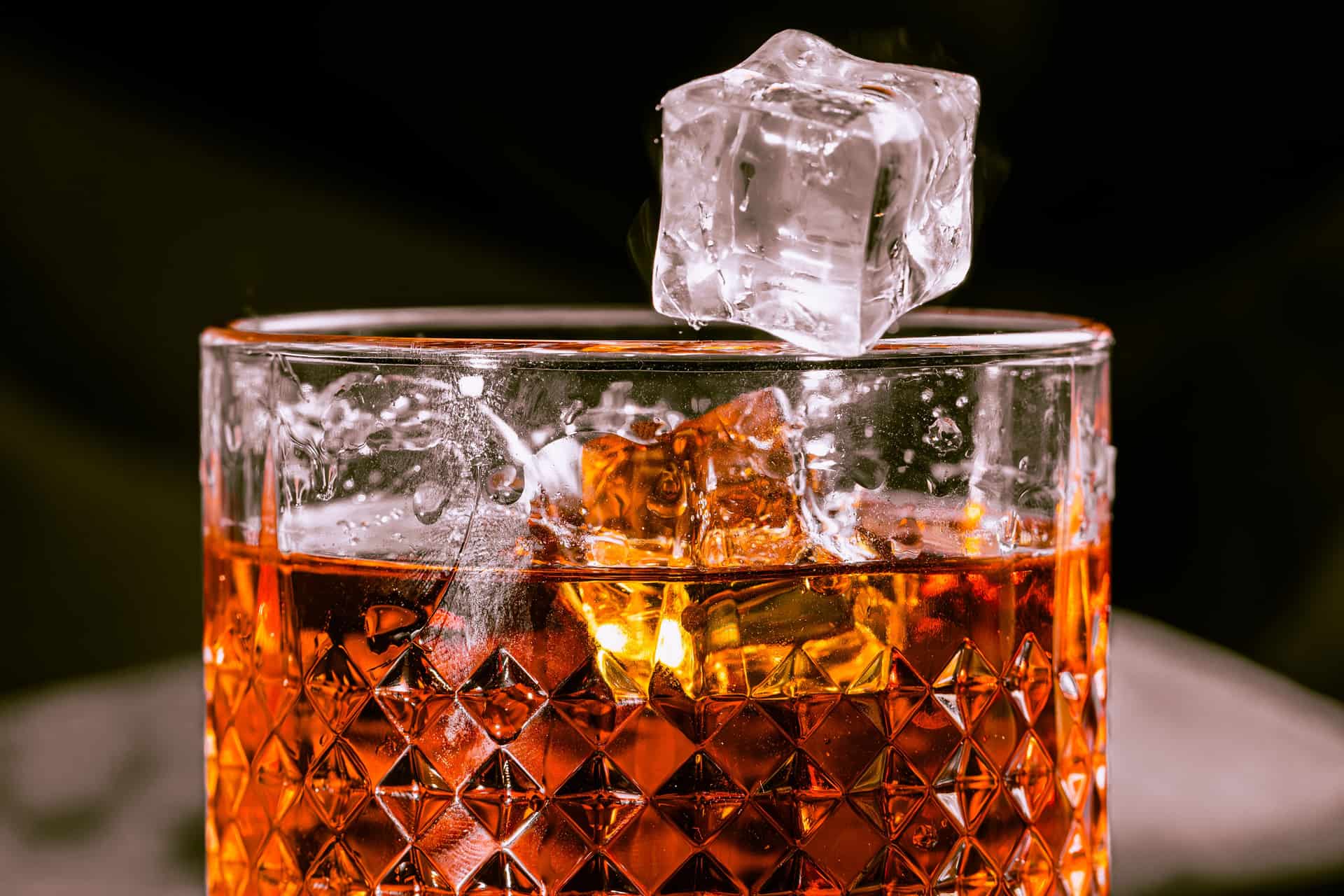
A home bar is the one setting where the shape of the ice genuinely changes the product you are making. Everywhere else in this category the ice is a preference. Behind a bar it is an ingredient, and the wrong one turns a carefully measured drink into a watery one within minutes.
So this page starts from the glass and works back to the machine. Every figure below is from a manufacturer manual, cited, with the date it was read.
What a bar machine is actually judged on
- The ice the drinks need. Dilution is the whole argument. Dense ice melts slowly and keeps a spirit tasting like itself; high-surface-area ice chills fast and waters down.
- Bin capacity for the busiest twenty minutes. Not the daily rating. Every machine here makes more in a day than a party drinks; almost none holds enough at once.
- Height under the cabinet. A bar is usually a counter with shelving above it, which makes the vertical dimension the binding constraint.
- What happens when it sits idle. A bar machine works hard on a Saturday and stands still for a fortnight, which is exactly the duty cycle biofilm likes.
- Noise, honestly caveated. Nobody in this category publishes a decibel figure, so nobody can rank it, and this page will not pretend otherwise.
The field on published figures
| Machine | Rated output | Bin | Electrical | Max $/mo |
|---|---|---|---|---|
| Frigidaire EFIC452 | 39.7 lbs/day [src] | Not published | 120 W [src] | $2.59(published W) |
| GE Profile XPIO13SCSS | 38 lbs/day [src] | 3 lbs [src] | 3 A [src] | $7.78(nameplate) |
| NewAir NIM044BS00 | 44 lbs/day [src] | 3.3 lbs [src] | 2.7 A [src] | $6.71(nameplate) |
| Frigidaire EFIC255 | 44 lbs/day [src] | 3 lbs [src] | 185 W [src] | $4.00(published W) |
Matching the ice to the drink
| Ice | Good for | Bad for | Why |
|---|---|---|---|
| Clear cube | Spirits neat or on the rocks, stirred cocktails, anything sipped slowly | Anything you want chilled instantly | Dense with low surface area, so it transfers heat slowly and dilutes least |
| Nugget | Highballs, sodas, iced tea, long drinks, anything you want to chew | Whisky, negronis, anything spirit-forward | Compressed flakes with enormous surface area — chills fast, waters down fast |
| Bullet | Volume, mixers, filling a cooler | Presentation, and slow drinks | Hollow cylinders, quick to make, quick to melt |
If your bar is mostly whisky, amaro and stirred drinks, this page has effectively one answer and the rest is detail. If it is mostly gin and tonics, palomas and sodas, it has a different one. If it is genuinely both, buy for the drinks you make most and accept that the other category is served imperfectly — because no countertop machine makes two kinds of ice.
Frigidaire EFIC452, for a spirits bar
Clear cubes are the reason to buy this machine and everything else is a bonus. It publishes 90 to 120 W, 18 kg per 24 hours and 24 cubes per cycle — the lowest power draw of anything on this site — and at 14.1 inches tall it is the only machine here that fits under a standard cabinet run with room to lift the lid.
The clarity is not cosmetic. Freezing water slowly pushes dissolved air and minerals out ahead of the ice front, and what is left is dense and transparent. Density is what makes it melt slowly, which is what keeps the last third of a drink tasting like the first.
The honest cons: it has no clean cycle at all — Frigidaire documents hand cleaning only for this model, which is the wrong trait for a machine that stands idle between weekends. It is slow by design, and if you want ice you can chew it is the wrong machine entirely.
GE Profile Opal 2.0, for long drinks
For a bar built on highballs, sodas and iced tea, nugget ice is the upgrade people actually notice, and the Opal 2.0 is the best-documented machine that makes it. GE publishes 38 lbs per day and 1.6 lbs per hour, and that hourly figure is unique in this category — it is the only machine where you can answer "how long until I have enough for six drinks" from the spec sheet rather than by watching it.
The honest cons: it is the largest electrical load here at a 360 VA nameplate, roughly $7.78 a month as a ceiling, and GE publishes no wattage at all so that figure is an upper bound rather than a measurement. The 3 lb bin is not refrigerated and empties quickly at a party. And at 16.5 inches tall with 3 inches of clearance required, it is a machine that needs planning under a cabinet.
NewAir NIM044BS00, when people are coming over
Bin capacity is the number a party exposes, and this is the only machine in the category that moves it. NewAir publishes a 3.3 lb bucket capacity against the 3.0 lbs that is standard, in the lightest full-size body here at 34.17 lbs.
Three tenths of a pound sounds trivial written down. In practice a tall glass is about half a pound, so it is roughly one extra drink before the machine has to catch up — and at a party, catching up is the thing it never gets to do.
The honest cons: NewAir publishes an ice-making current of 2.7 A rather than a wattage, so its cost figure is a ceiling, around $6.71 a month. Its 44 lbs a day comes from the manual's title rather than its specification table. And the machine is 15 inches deep before clearance.
Frigidaire Gallery EFIC255, the value option
If you want nugget ice and the Opal's price is not appealing, this is the machine with the strongest cost data on the site: 185 W published against a 20 kg per 24 hour rating. A published consumption figure rather than a nameplate means the roughly $4.00 a month is close to real rather than an upper bound, and 44 lbs a day is more than the Opal's 38.
It is also the narrowest full-size machine here at 10 inches wide, which on a bar top with bottles competing for space is a genuine advantage.
The honest cons: Frigidaire's specification table does not publish a bin capacity at all — the 3 lb figure comes from retail listings and is flagged on this site as the weakest source tier. Its CLEAN cycle runs on plain water, which rinses rather than cleans.
The bin is the party problem
Every machine on this page makes far more ice in a day than an evening needs, and every one of them holds between about three and seven tall glasses at a time. Those two facts together define how a bar machine is actually used.
Run it the day before, empty the bin into the freezer, and let it refill. Do that twice and you have a reserve that does not depend on the machine keeping pace with a room full of people. Then let it top up through the evening for whatever the reserve does not cover.
What you cannot do is treat it as an ice store, because the bin is insulated and unpowered on every machine in this category. Switched off, it is water in hours. That is explained in full on do countertop ice makers keep ice frozen, and the quantity arithmetic is on how much ice you actually need.
The maintenance trap of a bar machine
A kitchen ice maker runs most days. A bar machine runs hard on a Saturday and then stands still with a damp interior for two weeks, which is the ideal condition for the slime that makes ice taste wrong.
The fix is unglamorous and takes five minutes: drain the reservoir and the bin whenever the machine will sit unused for more than a day or two, and leave the lid open so it dries. That single habit does more than any clean cycle. The rest of the routine is on how to clean a nugget ice maker, and which machines can flush their own water path is on the self-cleaning roundup.
Choosing, in three steps
- Name the drink you make most often. Spirit-forward means clear cubes; long and mixed means nugget. That single answer eliminates two thirds of the category.
- Measure the vertical gap above the bar, then subtract room to open a lid. Height eliminates more of these machines than price does.
- Plan the party around the freezer, not the bin. Every machine here is a producer, and none of them is a store.
The picks in full
1. Best for spirits
Frigidaire Countertop Clear Ice Maker
Clear cubes rather than nugget or bullet, the shortest machine here, and the lowest published power draw of anything on the site.
- Rated output
- 39.7 lbs/day
- Bin capacity
- Not published
- Electrical
- 120 W published
- Ceiling at 4 hrs/day, $0.18/kWh
- $2.59/month (from published watts)
#ad We earn a commission on purchases made through this link. How this is funded. Prices last checked September 2, 2026.
90 to 120 W published is the lowest draw of any machine on this site, and it is a published consumption range rather than a nameplate.
14.1 inches tall is the only machine here that clears a standard under-cabinet gap without argument.
Twenty-four cubes per cycle and 18 kg a day. Clear ice melts slowly and dilutes a drink less, which is the entire reason to choose it over nugget.
Skip this if
You want chewable ice. Clear cube machines are slow by design — the clarity comes from freezing water gradually.
2. Best for highballs and sodas
GE Profile Opal 2.0 Nugget Ice Maker
The machine everything else is measured against, and the only one whose maker publishes both a production rate and a per-hour rate.
- Rated output
- 38 lbs/day
- Bin capacity
- 3 lbs
- Electrical
- 3 A at 120 V (360 VA nameplate)
- Ceiling at 4 hrs/day, $0.18/kWh
- $7.78/month (from the nameplate ceiling)
#ad We earn a commission on purchases made through this link. How this is funded. Prices last checked September 2, 2026.
GE's owner's manual rates the 2.0 at 3.0 A, which at 120 V is a 360 VA nameplate — the highest here. That is a ceiling, not a running draw, but it is the ceiling you are budgeting an outlet for.
The 3 lb bin is not refrigerated. Ice melts, the meltwater drains back into the reservoir and gets re-frozen, so the bin is a holding tray rather than a freezer.
GE is the only manufacturer in this set that publishes an hourly rate as well as a daily one, which makes 'how long until I have a glass of ice' answerable from published data instead of guesswork.
Skip this if
You want the cheapest route to nugget ice, or a small footprint. It is the biggest current draw in this table and its 3 lb bin empties fast.
3. Best for a party
NewAir 44 lb. Countertop Nugget Ice Maker
The largest bin in this set and the lightest full-size body, with a current figure labeled honestly as ice-making current.
- Rated output
- 44 lbs/day
- Bin capacity
- 3.3 lbs
- Electrical
- 2.7 A at 115 V (310.5 VA nameplate)
- Ceiling at 4 hrs/day, $0.18/kWh
- $6.71/month (from the nameplate ceiling)
#ad We earn a commission on purchases made through this link. How this is funded. Prices last checked September 2, 2026.
3.3 lbs of bin capacity is the biggest here — a 10 percent edge over the 3 lb standard, which is one extra tall glass.
At 34.17 lbs it is the lightest full-size machine in this set, nearly 10 lbs under the first-generation Opal.
The specification table calls out 'ice making current' rather than a generic rating. That is a more useful number than a nameplate and we wish more manufacturers printed it.
Skip this if
You want the brand with the deepest support documentation. NewAir's manual is good on specs and thin on service procedure compared with GE's.
4. Best nugget value
Frigidaire Gallery Countertop Nugget Ice Maker
The only nugget machine here whose maker publishes an actual power consumption instead of a nameplate ceiling, and it is a low one.
- Rated output
- 44 lbs/day
- Bin capacity
- 3 lbs
- Electrical
- 185 W published
- Ceiling at 4 hrs/day, $0.18/kWh
- $4.00/month (from published watts)
#ad We earn a commission on purchases made through this link. How this is funded. Prices last checked September 2, 2026.
185 W published means the running-cost figure for this machine is not a derived ceiling — it is arithmetic on a number Frigidaire printed. That is the strongest cost data on the site.
It is rated at 20 kg a day, which is 44 lbs — higher than the Opal 2.0's 38. Both numbers are measured under ideal conditions the manual does not describe.
Ten inches wide and 16.5 tall makes it the narrowest full-size nugget machine in this set.
Skip this if
You need a manufacturer-published bin capacity. Frigidaire's specification table omits it, so the 3 lb figure on this page comes from a retail listing rather than the manual.
Questions people actually ask
What kind of ice is best for a home bar?
It depends on the drink. Dense clear cubes are best for spirits and stirred cocktails because they melt slowly and dilute less. Soft nugget ice is best for highballs, sodas and anything served long, because it chills fast and is pleasant to chew. Bullet ice is a general-purpose compromise that melts quickly. No countertop machine makes more than one of the three.
How much ice do I need for a party?
Roughly half a pound per tall glass, so a bin holding 3 lbs is about six drinks before it needs to catch up. Every countertop machine here holds between 1.32 and 3.3 lbs at a time, which means for a gathering the machine is a producer rather than a store: make ice in advance, move it to a cooler or the freezer, and let the machine keep topping up during the evening.
Do countertop ice makers keep ice frozen for a bar?
No. Not one machine in this category refrigerates its bin. Ice sits in an insulated but unpowered compartment, melts, and the meltwater drains back to the reservoir to be frozen again. Left running the bin looks permanently full; switched off it is water within hours. For a bar that means the freezer is still your ice store and the machine is what fills it.
How loud is an ice maker in a bar area?
Nobody publishes a decibel rating for any machine in this category, so this site does not print one. What can be said is that these machines cycle: a compressor runs, an auger or a harvest mechanism moves, and ice drops. In a room where people are talking that is background noise; in a quiet room adjacent to a bedroom it is not. The noise question is covered in full on the quietest nugget ice maker page.
Can a countertop ice maker sit under a bar cabinet?
Sometimes, and height is the number to check. A standard counter-to-cabinet gap is about 18 inches. The Frigidaire EFIC452 is 14.1 inches tall and clears it comfortably. The Frigidaire EFIC255 is 16.5 inches and the NewAir NIM044BS00 is 16.54, both of which fit but leave little room to open the lid. Add the 3 to 4 inches of side and rear clearance the manuals require before you commit.
Sources
- Frigidaire EFIC452 Use & Care Manual, p.10 (product specifications) (read 2026-09-02)
- Frigidaire EFIC255 Use & Care Manual, p.12 (product specifications) (read 2026-09-02)
- GE Profile Opal 2.0 Owner's Manual 49-9000029 Rev. 6, p.17 (read 2026-09-02)
- NewAir NIM044BS00 Owner's Manual, p.5 (specifications) (read 2026-09-02)
- EIA Electric Power Monthly, Table 5.6.A, June 2026 (read 2026-09-02)
Read next
- Nugget Ice for Cocktails
Where nugget ice belongs behind a bar, and where a clear cube is the right answer.
- Bullet Ice vs Clear Ice Makers
Fast hollow cylinders against slow dense cubes, on published specs from both manuals.
- Nugget vs Clear Ice Makers
Chewable versus slow-melting. How each is made and which belongs in your glass.
- How Much Ice Do You Actually Need?
Why rated output is the wrong number to shop on, and what bin capacity really limits.
- The Best Countertop Ice Makers
The whole countertop category ranked by ice type, with sourced specs and running costs.
- Do Countertop Ice Makers Keep Ice Frozen?
No. The bin is unrefrigerated and the meltwater recirculates. What to do instead.