Reviews
Silonn Countertop Ice Maker (SLIM21)
The smallest machine on this site, the cheapest brand on it, and — unexpectedly — one of the better-documented ones. The catch is printed on page seven of its own manual.
Disclosure: we earn a commission if you buy through our links. It never affects which machines we recommend or how we rank them, and we take no sponsored placements. Read the full disclosure.
Quick picks
| # | Machine | Best for | Price |
|---|---|---|---|
| 1 | 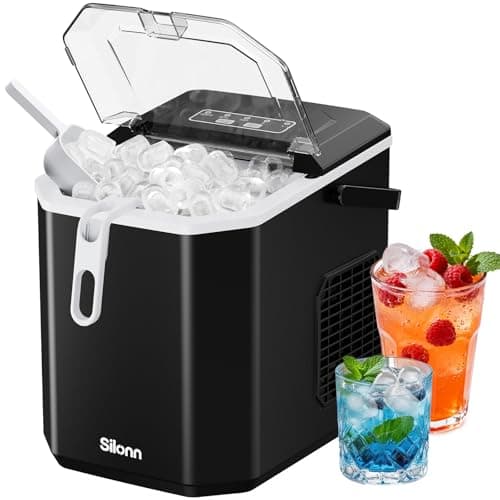 Silonn SLIM21 A full published spec table and a documented weekly self-clean, in the smallest body here. | Best compact machine with a clean cycle |
#ad We earn a commission on purchases made through this link. How this is funded. Prices last checked October 19, 2026.
What Silonn publishes
| Spec | Silonn SLIM21 |
|---|---|
| Model | SLIM21 |
| Ice type | Bullet |
| Rated output | 26 lbs/day [src] |
| Rated output per hour | Not published |
| Bin capacity | 1.32 lbs [src] |
| Published power | Not published |
| Nameplate current | 1.5 A [src] |
| Voltage | 115 V [src] |
| Dimensions (W x D x H) | 8.7 x 11.4 x 11.6 in (axes not labeled in the manual) [src] |
| Weight, empty | 13.7 lbs [src] |
| Clearance required | Not published |
| Operating range | 50F to 90F [src] |
| Refrigerant | Not published |
| Noise | Not published |
| Warranty | 12 months [src] |
| Max $/mo | $3.73(nameplate) |
The budget brand that actually publishes numbers
Three of the budget machines on this site — Euhomy, ecozy and KBice — have manuals with no specification section at all. Every numeric field on those pages reads Not published, and that is a fact about the documentation rather than a gap in our research.
Silonn is the exception, and it is not a close one. Page 11 of its manual prints voltage and frequency, working power, ice-making current, ice-harvesting current, rate, reservoir volume, basket capacity, ice shape, ice size, material, net weight and product size in a single table. That is more fields than GE publishes for the Opal 2.0.
Two of those fields are unusual enough to be worth naming. Separating the ice-making current from the ice-harvesting current tells you the machine draws more during harvest than during freeze, which is true of all of them and printed by almost none of them. And stating the ice shape in the specification table, rather than leaving it to the marketing copy, is exactly the disclosure this category is worst at.
The 160 W figure is a ceiling, and the manual says so
The table prints working power as "<=160W". That less-than-or-equal sign is doing real work: it is a maximum, not a consumption measurement, so it belongs in the same class as GE's nameplate rather than in the same class as Frigidaire's published 185 W.
So this site does not treat it as a published consumption figure. The cost on this page is derived the same way the Opal's is, from volts times amps: 1.5 A at 115 V is 172.5 VA, which at four running hours a day and 18 cents per kWh gives about $3.73 a month as an upper bound. The whole calculation, and how to substitute your own electricity rate, is on the running-cost page.
Worth noting either way: 172.5 VA is less than half the Opal 2.0's 360 VA ceiling. Small machines cost less to run, and this is the smallest one here.
The line on page seven, and why it matters
This is the specification that should change somebody's purchase, and it is not in the specification table. The First Use section says to use the machine in locations between 50F and 90F.
Publishing that at all puts Silonn ahead of almost everyone here. Only one other machine on this site prints an operating range: the first-generation GE Opal, at 55F to 90F. Frigidaire, NewAir and the current Opal manuals we read do not print one, so for those machines there is nothing to check.
What the range says still matters, because this machine is sold for camping and RV use in its own listing title. An unheated garage in January, a screened porch in spring or a camper parked overnight in the mountains sits under 50F, and a refrigeration cycle in a cold room does not simply run slower — low ambient temperature changes the pressures the compressor works against, which is why manufacturers print a range in the first place. If the machine is going somewhere seasonally cold, read this line before the ice rate.
1.32 pounds is the real limit
Rated daily output is close to irrelevant on a countertop ice maker, because basket capacity is what stops you. This machine holds 1.32 lbs (0.6kg) against the 3.0 to 3.3 lbs that every full-size machine here holds.
A tall glass of ice is roughly half a pound. So a full basket on this machine is about two and a half glasses, against six or seven on an Opal or a NewAir. For one person at a desk that is a non-issue, because the machine refills while you drink. For four people making drinks at once it is the whole story. The sizing arithmetic is on how much ice you actually need.
The flip side is genuinely useful: 13.7 lbs and roughly 8.7 by 11.4 by 11.6 inches makes this the only machine covered here that one person moves with one hand, and the manual's own title calls out the carry handle. Nothing else in this category is portable in that sense.
The clean cycle, and what it is not
Silonn documents its cleaning better than either GE or Frigidaire documents theirs. Page 9 says to remove the basket, fill to the MAX line, hold the ON/OFF/CLEAN button for five seconds, run the 30-minute self-cleaning cycle, then drain the excess water over a sink — and it recommends doing that once a week.
Thirty minutes plus a stated weekly interval is more specific than anything GE or Frigidaire commits to for their own machines. It is still a circulation cycle on plain water, which means it rinses the pump and the water lines and does nothing at all to mineral scale. Which machines have a cycle like this, and what each one actually does, is compared on the self-cleaning roundup, and the chemistry is on descaling.
It makes bullet ice, and that is a decision
Most people who arrive at this site are looking for nugget ice. This machine does not make it. Its specification table states the ice shape as Bullet, with a small or large size selected by the SELECT button on the panel.
Bullet ice is water frozen onto chilled metal prongs and released as hard hollow cylinders. It is quick to make, which is why the small machines use the mechanism, and it is hard rather than chewable. If the appeal of a countertop ice maker for you is the soft pellet ice from a drive-through, this is the wrong machine and no setting fixes it. The mechanical difference is set out on nugget ice versus bullet ice.
Setting it up
Two instructions from the First Use section are worth following exactly, because both are commonly skipped and both produce symptoms that look like a fault. Stand the unit upright for 24 hours before switching it on, which lets refrigerant and oil settle after shipping. And discard the first four cycles of ice, on a new machine and again after any long period of disuse.
The panel itself is four indicators and two controls, per page 6 of the manual: a POWER light, an ADD WATER light that turns red when the reservoir is low, an ICE FULL light that turns red when the basket is full, and S and L lights that flash green to show which ice size is selected. The ON/OFF button also carries the clean function on a five-second hold. There is no display and no timer.
What Silonn does not publish
- Refrigerant. Absent from the specification table. Every other documented machine here prints R600a.
- A tested noise figure. Silonn advertises a "35db low-noise design" on its product page with no test standard and no measuring distance, so this site records it as marketing and leaves the noise field reading Not published — the same treatment every other machine here gets.
- Cycle time, as a specification. "9 cubes in 6 minutes" appears in the retail listing title and on Silonn's product page, not in the manual's table. It is a manufacturer claim rather than a published specification, and this page does not treat the two as equivalent.
- Which figure is which dimension. The table prints 8.7 x 11.4 x 11.6 inches without labeling width, depth or height, so the spec sheet above repeats it unlabeled rather than guessing.
One caveat about the brand rather than the machine: this level of documentation is not Silonn-wide. Its nugget machine publishes a model number, a weight and a capacity and no electrical figure at all, which is set out on the Silonn nugget ice maker review.
Who should buy this
- Buy it if the machine has to move — desk to kitchen, house to camper, or into a cupboard between uses. At 13.7 lbs with a handle, nothing else here competes.
- Buy it if one or two people are drinking the ice. A 1.32 lb basket refills faster than one person empties it.
- Buy it if you want the lowest running-cost ceiling on this site and can live with 26 lbs a day.
- Skip it if you want nugget ice. It makes hard bullet cubes, and the nugget roundup is the page you want instead.
- Skip it if it is going somewhere that drops below 50F. The manual's own operating range rules that out, which is worth weighing against a listing that markets it for camping.
- Skip it if you serve several people at once. Two and a half glasses of basket capacity is the constraint you will hit on day one.
The picks in full
1. Best compact machine with a clean cycle
Silonn Countertop Bullet Ice Maker with Handle
The smallest machine on this site and one of only three budget-brand ones whose maker publishes a real specification table, including a documented 30-minute self-clean cycle.
- Rated output
- 26 lbs/day
- Bin capacity
- 1.32 lbs
- Electrical
- 1.5 A at 115 V (172.5 VA nameplate)
- Ceiling at 4 hrs/day, $0.18/kWh
- $3.73/month (from the nameplate ceiling)
#ad We earn a commission on purchases made through this link. How this is funded. Prices last checked October 19, 2026.
Silonn publishes what almost no other budget brand does: voltage, ice-making and ice-harvesting current, working power, rate, basket capacity, weight and size, all in one table.
The self-clean cycle is documented in the same manual — hold the ON/OFF/CLEAN button for five seconds, run 30 minutes on plain water, weekly. That is a longer cycle and a clearer frequency than either GE or Frigidaire commits to.
Silonn advertises a '35db low-noise design' on its product page. There is no test standard or measuring distance behind that number, so it is not recorded as a specification here and the noise field still reads Not published.
Skip this if
You want nugget ice or a bin that holds more than a couple of glasses. It makes hard bullet cubes and the basket is 1.32 lbs.
Questions people actually ask
How much ice does the Silonn SLIM21 make?
26 lbs a day, printed in the manual's own specification table on page 11 as 'Ice-Making Rate: 26 lbs per Day'. That is the lowest rated output of any machine on this site, against 38 to 44 lbs for the full-size nugget machines. The basket holds 1.32 lbs at a time, which is roughly two and a half tall glasses.
How much power does the Silonn SLIM21 use?
The manual prints 'Working Power <=160W', which is a maximum rather than a measured consumption, plus an ice-making current of 1.5 A and an ice-harvesting current of 1.8 A at 115 V. This site derives the cost ceiling from 1.5 A x 115 V = 172.5 VA, which is about $3.73 a month at four running hours a day and 18 cents per kWh. That is a ceiling, not a bill.
Does the Silonn SLIM21 make nugget ice?
No. Its specification table states the ice shape as 'Bullet', in small or large size. Bullet ice is hard hollow cylinders frozen onto chilled prongs. It is not the soft chewable pellet ice made by an auger, and no setting on this machine produces that.
Does the Silonn SLIM21 really self-clean?
It has a documented clean cycle, which is not the same thing. The manual says to remove the basket, fill to the MAX line, hold the ON/OFF/CLEAN button for five seconds and let it run for 30 minutes, then drain over a sink, and it recommends doing this once a week. The cycle circulates plain water through the pump and water lines. It does not descale, and it does not clean the basket.
What temperature does the Silonn SLIM21 need?
The manual's First Use section says to use it in locations between 50F and 90F. Only three other machines on this site publish an operating range at all - the first-generation GE Opal and the GE Profile Opal Mini at 55F to 90F, and the Gevi V2.0 at 50F to 90F - so this is one of the few in the category you can check at all. It still matters: a garage, a screened porch or an unheated outbuilding sits below 50F for part of the year, and this machine is sold for camping and RV use.
Sources
- Silonn SLIM21 Instruction Manual, p.11 (PRODUCT SPECIFICATIONS) (read 2026-09-02)
- Silonn SLIM21 Instruction Manual, p.7 (First Use) (read 2026-09-03)
- Silonn SLIM21 Instruction Manual, p.6 (Control Panel Introduction) (read 2026-09-03)
- Silonn SLIM21 Instruction Manual, p.9 (Self-Cleaning) (read 2026-09-02)
- Silonn product page, Countertop Bullet Ice Maker with Handle (26 Lbs), SLIM21T (read 2026-09-03)
- EIA Electric Power Monthly, Table 5.6.A, June 2026 (US residential average price) (read 2026-09-02)
Read next
- The Best Self-Cleaning Countertop Ice Makers
Which countertop ice makers have a real clean cycle, what it does, and which have no clean button at all.
- Nugget Ice vs Bullet Ice
Two mechanisms, two products. What actually separates chewable ice from hollow cylinders.
- The Best Portable Ice Makers
Portable machines ranked on published output and draw, with what portable really means.
- How Much Ice Do You Actually Need?
Why rated output is the wrong number to shop on, and what bin capacity really limits.
- The Best Countertop Ice Makers
The whole countertop category ranked by ice type, with sourced specs and running costs.
- What a Nugget Ice Maker Costs to Run
Per-model monthly costs with the wattage sourced, the duty cycle stated and the arithmetic shown.
- The Best Ice Makers for an RV
Inverter load, published temperature limits and carry weight. The three numbers that decide an RV ice maker.
- The Best Ice Makers for a Dorm Room
What fits on a dorm dresser, what the housing contract allows, and who carries the water.