Reviews
Igloo Automatic Countertop Ice Maker (ICEB26)
The cheapest machine on this site with a real specification table behind it. It publishes the widest temperature window in the category, and it is the only machine here that does not run on R600a.
Disclosure: we earn a commission if you buy through our links. It never affects which machines we recommend or how we rank them, and we take no sponsored placements. Read the full disclosure.
Quick picks
| # | Machine | Best for | Price |
|---|---|---|---|
| 1 | 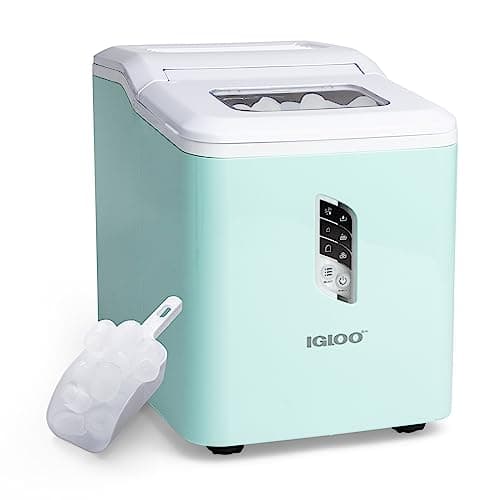 Igloo ICEB26AQ (manual covers ICEB26AQ, ICEB26BK and ICEB26RR) A full manual specification table, the widest published temperature window, and bullet ice at the bottom of the price range. | Cheapest documented machine |
#ad We earn a commission on purchases made through this link. How this is funded. Prices last checked October 19, 2026.
What Igloo publishes
| Spec | Igloo ICEB26AQ (manual covers ICEB26AQ, ICEB26BK and ICEB26RR) |
|---|---|
| Model | ICEB26AQ (manual covers ICEB26AQ, ICEB26BK and ICEB26RR) |
| Ice type | Bullet |
| Rated output | 26 lbs/day [src] |
| Rated output per hour | Not published |
| Bin capacity | 2 lbs [src] |
| Published power | 120 W [src] |
| Nameplate current | 2 A [src] |
| Voltage | 120 V [src] |
| Dimensions (W x D x H) | Not published |
| Weight, empty | Not published |
| Clearance required | 4" [src] |
| Operating range | 45F to 90F [src] |
| Refrigerant | R134a [src] |
| Noise | Not published |
| Warranty | Not published |
| Max $/mo | $2.59(published W) |
45F to 90F, the widest window on this site
This is the finding that earns the page. Igloo's manual recommends a room temperature between 45F and 90F. Every other published range in this category starts at 50F or 55F, so this is the lowest floor any maker here commits to, by five degrees.
It goes one step further than that, with the only cold-room operating advice in any manual on this site: below 60F, select the small ice-cube size. There is a mechanism behind it — a colder room means a colder cylinder and a longer freeze, and a smaller cube completes in the time the machine allows — and it is the sort of instruction that only turns up when somebody has actually run the machine in a cold room.
For a garage, a basement bar or a screened porch that is the difference between a documented condition and a guess. The whole published field is on what temperature an ice maker needs, and the room-by-room ranking is on ice makers for a garage.
120 W, and the cheapest running cost here
The manual prints 120 Watts, 2 Amps at 110-120 V. Publishing both a wattage and a current is rare in this category, and the wattage is the useful one: at four running hours a day and 18 cents per kWh, 120 W is about $2.59 a month. Only the Frigidaire EFIC189, at a published 105 W, comes in lower among the machines with a single published wattage.
Be careful what you conclude from that, though. Bullet machines are cheaper to run because of what they do, not because they are better engineered: water freezes onto chilled prongs and the cylinders drop off when the prongs warm briefly. There is no auger turning inside a refrigerated cylinder, which is the expensive, power-hungry part of a nugget machine — the mechanism is compared on nugget ice versus bullet ice.
Per pound it is less flattering: 120 W for a 26 lb rating is about 4.6 watts per daily pound, against 4.2 for the Frigidaire EFIC255's 185 W and 44 lbs. Cheap to run, but not efficient — it is a small machine, not a frugal one. The arithmetic is on the running-cost page.
R134a, the odd one out
Every other machine documented on this site runs on R600a. This one lists Refrigerant: R134A, and the difference shows up in the manual itself: there is no flammable-refrigerant warning in it, because R134a is a hydrofluorocarbon rather than a hydrocarbon. Open any R600a manual in this category and the first page carries a fire-and-explosion caution.
For a buyer that cuts both ways. R134a will not ignite, which is one fewer thing to think about in a garage or a camper. It is also the older refrigerant, with a far higher global warming potential than isobutane, which is why the rest of this category has moved away from it. Neither point should decide a purchase at this price, but the site records what the manual says rather than assuming the category standard.
What it publishes that GE does not
It is worth pausing on how much of this manual is filled in, because the price does not predict it.
| Figure | Igloo ICEB26 | GE Profile Opal Mini |
|---|---|---|
| Wattage | 120 W | Not published |
| Current | 2 A | 2.0 A |
| Refrigerant | R134a | Not published |
| Reservoir volume | 3 quarts | Not published |
| Basket capacity | 2 lbs | 2.6 lbs |
| Cycle time | 6 to 15 minutes | Not published |
| Daily output | 26 lbs | Not published |
| Operating range | 45F to 90F | 55F to 90F |
| Clearance | 4 in | 4 in |
| Dimensions and weight | Not published | 8.59 x 15.59 x 14.56 in, 27 lbs |
The 3-quart reservoir deserves its own note: it is the largest reservoir volume any manual on this site publishes, roughly two and a half times the 1.2 liters Silonn prints for the SLIM21. On a machine you fill by hand, that is the number that decides how often you are at the sink, and it is covered on how much water these machines use.
The gap: no footprint at all
There are no dimensions and no weight anywhere in this manual. For a machine whose whole appeal is sitting on a counter, that is the one omission that actually costs you something — you cannot measure a space against it before it arrives, and you cannot tell whether it clears a wall cabinet.
What you do get is the clearance figure: at least four inches of empty space on all sides, the same gap GE asks for around the Opal Mini. Plan for that on top of whatever the body turns out to be. The machines that do publish a footprint are ranked on nugget ice makers for small kitchens.
The variant maze, and which machine this is
Igloo's 26 lb line is a family rather than a model. Its manuals cover the ICEB26AQ, BK and RR, the carry-handle ICEB26HN series in several colors, a stainless IGLICEB26SS, a 33 lb ICEB33SL and a nugget dispensing IGLICEND40SS. The retail listings add reservoirs of 1, 1.5 and 3 quarts and a self-cleaning variant.
This page is built on the manual that covers the ICEB26AQ, and the buy row points at the Aqua 26 lb machine that manual belongs to, which we verified on sale new on 26 September 2026. If you buy a different Igloo — a handled one, a stainless one, a self-cleaning one — assume a different spec sheet, because that is what the manuals show.
One more for anyone who arrived here wanting chewable ice: Igloo does document a nugget dispensing machine, the IGLICEND40SS, and we could not verify it on sale new, so it is not featured anywhere on this site. The dispensing machines that are available are on self-dispensing nugget ice makers.
Who should buy this
- Buy it if the machine is going somewhere cool. A published 45F floor is the lowest in the category and the only one that comes with cold-room advice attached.
- Buy it if you want ice cheaply and do not care about the shape. At the bottom of the price range with a full specification table, this is the least risky cheap machine on the site.
- Buy it if refilling annoys you. Three quarts is the biggest published reservoir here.
- Skip it if you came for nugget ice. This makes hollow bullet cubes, and the chewable-ice field is on the nugget roundup.
- Skip it if you are fitting it into a measured space. No dimensions, no weight, and four inches of clearance on every side.
- Skip it if you want a documented clean cycle. We found no clean-cycle procedure in the manual we read, and Igloo sells a separate self-cleaning variant with its own manual. The machines with a documented cycle are on the self-cleaning roundup.
The picks in full
1. Cheapest documented machine
Igloo Automatic Countertop Ice Maker
The cheapest machine on this site with a full manual specification table, the widest published temperature window in the category, and the only one that does not run on R600a.
- Rated output
- 26 lbs/day
- Bin capacity
- 2 lbs
- Electrical
- 120 W published
- Ceiling at 4 hrs/day, $0.18/kWh
- $2.59/month (from published watts)
#ad We earn a commission on purchases made through this link. How this is funded. Prices last checked October 19, 2026.
For a machine at this price the manual is unusually complete: voltage, wattage, current, refrigerant, daily output, cycle time, basket capacity, reservoir volume, clearance and a recommended room-temperature range all appear in it.
The reservoir is printed as 3 quarts, which is the largest reservoir volume any manual on this site states - more than double the 1.2 liters Silonn prints for the SLIM21.
It makes bullet ice, not nugget, so it is a volume-and-cost machine rather than a chewable-ice machine. Igloo also documents a nugget dispensing model, the IGLICEND40SS, which we could not verify on sale new.
Skip this if
You want nugget ice, or you need to know how much counter it takes: Igloo publishes a wattage, a refrigerant and a temperature range but no dimensions or weight at all.
Questions people actually ask
What temperature can an Igloo ice maker run in?
Its manual recommends a room temperature between 45F and 90F, which is the widest published window of any machine on this site and the lowest published floor by five degrees. The same page adds advice nobody else gives: below 60F, select the small ice-cube size. That makes it the best-documented machine here for a cool garage, a basement or an unheated porch.
How much electricity does the Igloo ice maker use?
The manual prints 120 Watts and 2 Amps at 110-120 Volts. At four running hours a day and 18 cents per kWh, 120 W works out at about $2.59 a month. Only two machines here come in lower: the Frigidaire EFIC189 at a published 105 W, about $2.27, and the EFIC452 at the top of its 90-120 W range. Part of that is the mechanism rather than the engineering: a bullet machine freezes water onto chilled prongs and has no auger to drive, so it does less work than a nugget machine per pound of ice.
Does the Igloo ice maker make nugget ice?
No. It makes bullet ice - hollow cylinders formed on chilled prongs, in two selectable sizes. That is a different product from the soft chewable nugget ice this site is mostly about, and no setting changes it. If chewable ice is the point, this is the wrong machine.
How big is the Igloo ICEB26, and how much water does it hold?
The reservoir is 3 quarts, which is the largest reservoir volume any manual on this site publishes, and the ice basket holds 2 pounds. What Igloo does not publish is the machine's own size: there are no dimensions and no weight anywhere in the manual, so this page carries none. It does ask for four inches of clearance on all sides.
What refrigerant does the Igloo ice maker use?
R134a, per the manual's features list. That makes it the only machine on this site not running on R600a. The practical difference is that R134a is a hydrofluorocarbon rather than a flammable hydrocarbon, which is why this manual carries no flammable-refrigerant warning while every other manual here does. Note that some other Igloo 26 lb variants list R600a instead, so check the plate on the machine you receive.
How long does the Igloo ice maker take to make ice?
The manual states 9 ice cubes every 7 to 15 minutes, and a cycle of 6 to 15 minutes depending on the cube size selected and the ambient temperature. Publishing a cycle time at all is unusual in this category, where almost every maker states a daily rating and nothing about how long you wait for the first batch.
Sources
- Igloo ICEB26 Automatic Ice Maker instruction manual (covers ICEB26AQ, ICEB26BK and ICEB26RR), safety and parts sections (read 2026-09-26)
- GE Profile Opal Mini Owner's Manual 49-9000083 Rev. 0, p.15 (Ice Maker Product Specifications) (read 2026-09-13)
- Frigidaire EFIC452 Use & Care Manual, p.10 (product specifications) (read 2026-09-02)
- Silonn SLIM21 Instruction Manual, p.7 (First Use, operating range) (read 2026-09-03)
- EIA Electric Power Monthly, Table 5.6.A, June 2026 (US residential average price) (read 2026-09-02)
Read next
- Silonn Countertop Ice Maker (SLIM21)
26 lbs a day, a 1.32 lb basket, a documented 30-minute clean cycle, and a 50F to 90F operating window.
- The Best Ice Makers for a Garage or Outdoor Kitchen
Published operating ranges, what a hot or cold garage does, and why none of them is an outdoor appliance.
- What Temperature Does an Ice Maker Need?
Every published operating range in the category, and what happens above and below them.
- Nugget Ice vs Bullet Ice
Two mechanisms, two products. What actually separates chewable ice from hollow cylinders.
- The Best Countertop Ice Makers
The whole countertop category ranked by ice type, with sourced specs and running costs.
- What a Nugget Ice Maker Costs to Run
Per-model monthly costs with the wattage sourced, the duty cycle stated and the arithmetic shown.